
Livraison le jour même ou le lendemain

Qualité garantie

Débloquez vos offres de bienvenue: Livraison GRATUITE | Jusqu'à -80 % | 30 jours d'essai gratuits à JoyPlus
Téléchargez l'application
A non-stick frying pan compatible with induction needs to combine several qualities: even heating, the ability to withstand regular use, easy cleaning and compatibility with your hob. However, some product listings can be unclear about whether a coating is “healthy”, whether the pan is suitable for all hobs and how easy it really is to maintain.
Before choosing your frying pan, here are the most common pitfalls and the criteria that genuinely deserve your attention.
The term PFOA-free refers to one specific substance. It does not automatically mean that the pan is free from all PFAS or PTFE. If this is important to you, look for a more comprehensive statement, such as PFAS-free and PTFE-free, then carefully check the wording used on the manufacturer’s product listing.
Claims should also be treated with a degree of caution: “no intentionally added” does not necessarily mean that no detectable traces would be found in an analysis. A detailed description of the materials is more useful than a general safety promise.
To work on induction, an all-hob pan must have a suitable ferromagnetic base. Some models are also compatible with gas, electric and ceramic hobs, but compatibility with halogen or infrared hobs may require an additional check.
The stated diameter generally refers to the pan’s upper rim. Therefore, with a 28 cm model, the surface actually in contact with the hob may be smaller. This affects stability and heating speed.
A pan that is easy to clean is not necessarily suitable for every use. Metal utensils, heating an empty pan at high temperatures and thermal shock can shorten the lifespan of a non-stick coating.
Even when a pan is described as dishwasher-safe, hand-washing with a soft sponge is often preferable to help preserve its surface.
A stainless steel frying pan or a 304 stainless steel frying pan can be a good choice if you are looking for a robust, durable construction. Multi-layer models generally combine stainless steel with an aluminium core to distribute heat more evenly.
However, stainless steel does not release food as easily as a non-stick coating. When searing meat or frying vegetables, you need to manage the preheating, temperature and amount of fat carefully.
A ceramic frying pan makes it easier to release food, particularly when it is new, but it also requires moderate heat and non-abrasive utensils. Terms such as “granite”, “stone” and “diamond” are often commercial descriptions, so always check the base material and the exact type of coating.
Before placing your order, check the following:
A Bakelite or silicone handle may remain more comfortable to hold on the hob, but this does not automatically mean that it can withstand oven use. Always follow the stated maximum temperature, particularly when using a glass lid.
A 20 to 24 cm frying pan is suitable for eggs, omelettes, individual portions and breakfast dishes. A 28 cm frying pan provides more space for cooking for several people, stir-frying vegetables or searing several pieces of meat.
If you often prepare dishes with sauces, one-pan meals or large quantities, a deep sauté pan with a lid will be more versatile. It can even replace a saucepan for certain cooking tasks while helping to reduce splashes.
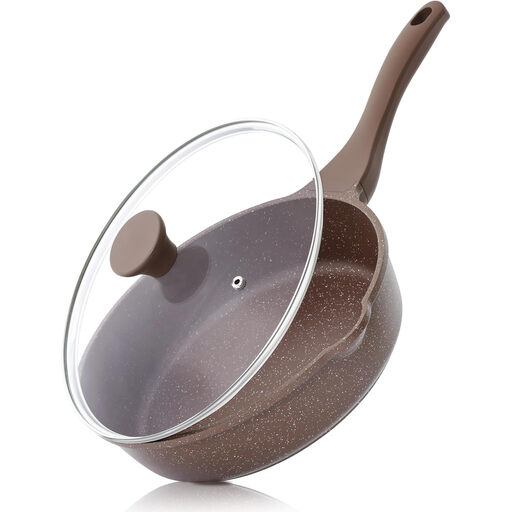
Why this choice suits this profile : Its deep shape is ideal for everyday meals, stir-fried vegetables and dishes with sauces. The listing states that it is compatible with induction and gas, and that the handle stays cooler during cooking.
The listing states that the surface is free from PFOA, PFOS, lead and cadmium. However, the manufacturer recommends hand-washing and using non-metal utensils.
Deep 3.3-litre pan, lid included depending on the version, sponge-clean surface and stated induction compatibility.
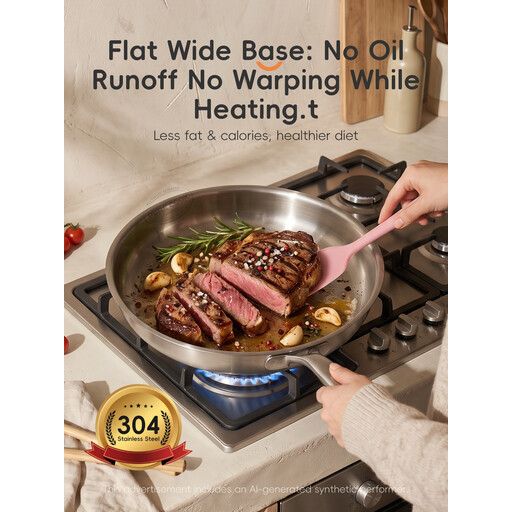
Why this choice suits this profile : Its three-layer construction, combining 304 stainless steel and aluminium, is designed for people who prioritise a durable pan without an added non-stick coating.
The stated compatibility covers gas, induction, electric and ceramic hobs, as well as halogen hobs. However, you need to manage the preheating carefully, as stainless steel does not release food instantly like a non-stick coating.
Family-sized 28 cm format, conductive aluminium core, stated resistance to warping and care with neutral detergent.
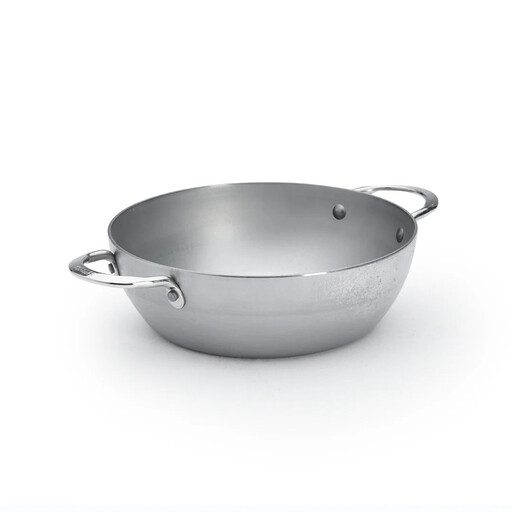
Why this choice suits this profile : The carbon steel and two handles make this deep pan easier to handle when preparing generous portions or dishes that benefit from good heat retention.
It does not claim to be non-stick straight out of the box: the surface develops a patina with use. This requirement is balanced by a construction without an artificial coating.
Two handles, deep shape, carbon steel and the potential to develop a naturally non-stick patina with regular care.
We have put together a complete, real-time updated list of products that fully meet these strict selection criteria and European safety regulations.
A 20 to 24 cm frying pan is suitable for individual portions and small dishes. For two to four people, the 28 cm format provides more cooking surface, provided that the base diameter matches the zone on your induction hob.
Not necessarily. PFOA and PTFE belong to different categories. Check the manufacturer’s precise statement and distinguish between “no intentionally added”, certification and independent analysis.
It depends on the model. Some product listings allow it, while others recommend hand-washing only. To minimise wear to the coating, it is best to use a soft sponge, warm water and a neutral detergent.