
Livraison le jour même ou le lendemain

Qualité garantie

Débloquez vos offres de bienvenue: Livraison GRATUITE | Jusqu'à -80 % | 30 jours d'essai gratuits à JoyPlus
Téléchargez l'application
Choosing a new non-stick frying pan can quickly become overwhelming. Between promises of durability, health claims, and induction compatibility, it's easy to get lost in the details. As product experts, our mission is to bring you clarity. Together, we'll cut through the marketing noise to guide you toward a smart, sustainable purchase.
Replacing your pan every year because the coating is peeling? That’s not a sustainable solution for anyone. Before you take the plunge, let's review the three common mistakes that lead to buyer's remorse.
healthy cooking, it's crucial to understand the true nature of the coating.To avoid falling into these traps, let's focus on the features that truly make a difference.
The coating is the core technology of a non-stick pan. There are two main types:
PFOA-free pan label is now a legal requirement in Europe. For those most concerned about composition, some brands go further, offering PTFE coatings guaranteed to be made without the intentional addition of any PFAS (the entire chemical family).Ceramic pan coatings (Sol-Gel technology): Made from a silica derivative (sand), they are naturally free of PTFE and PFAS. They can withstand higher temperatures, but their non-stick properties can degrade more quickly if not maintained with care.The choice, therefore, depends on your priorities: the absolute non-stick performance of PTFE or the PFAS-free composition of ceramic.
For an all-hob non-stick pan including induction to be truly effective, its ferromagnetic base must be thick and wide. The simple "induction" logo is not enough. A quality base ensures:
A good indicator? A heavy, perfectly flat base that covers nearly the entire diameter of the pan.
A good pan should simplify your life. Consider these practical aspects:
oven-safe pan is ideal for starting a dish on the hob and finishing it in the oven (to brown a gratin, for example). Always check the maximum temperature the handle can withstand (stainless steel or removable handles are the most versatile).easy-to-clean pan often has a smooth interior without rivets where food can get stuck. Dishwasher compatibility is a plus, although hand washing remains the best way to preserve the coating in the long run.24 cm pan is the quintessential all-purpose size. For dishes with sauce, a non-stick sauté pan with higher sides will be much more practical. And for fans of Asian cuisine, an induction wok is a must.Instead of an exhaustive list, here are our targeted recommendations, which meet specific needs based on the criteria we've just discussed.
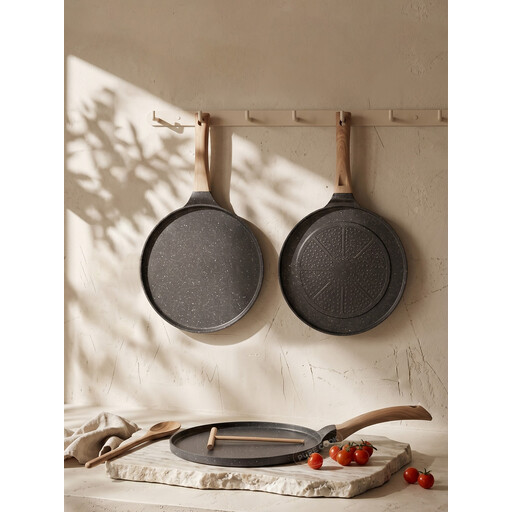
Why we chose it: Perfect for daily meals, this 26 cm pan is lightweight, easy to handle, and heats up quickly. It's ideal for searing a steak, frying eggs, or sautéing vegetables for two to three people, completely hassle-free.
It doesn't overpromise. This is a simple, effective tool with a functional non-stick coating and reliable induction compatibility thanks to its aluminium alloy base.
Its wooden handle stays cool to the touch on the hob, offering a comfortable and secure grip. Its feather-light weight makes it very easy to handle for daily use.
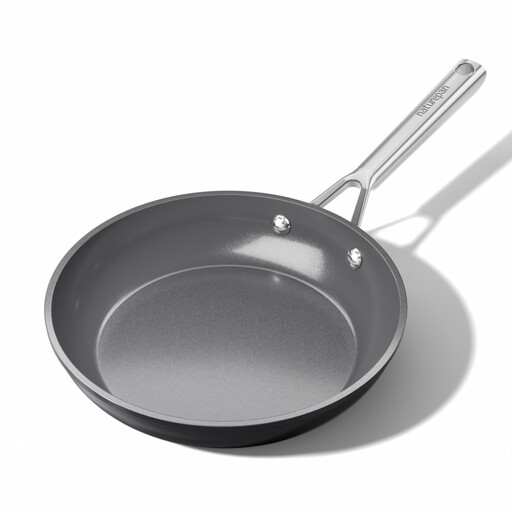
Why we chose it: For those seeking uncompromising materials and great versatility. Its ceramic coating is guaranteed free of PTFE/PFOA/PFAS, and its oven-safe design makes it perfect for much more than just simple frying.
It directly addresses the "healthy cooking" trap by being transparent about its composition (PFAS-free). Its oven compatibility is clearly stated (up to 260°C), making it a truly versatile tool.
Its ceramic coating, reinforced with titanium and diamond particles, promises good durability for this type of technology. Its thick base ensures uniform heat distribution.
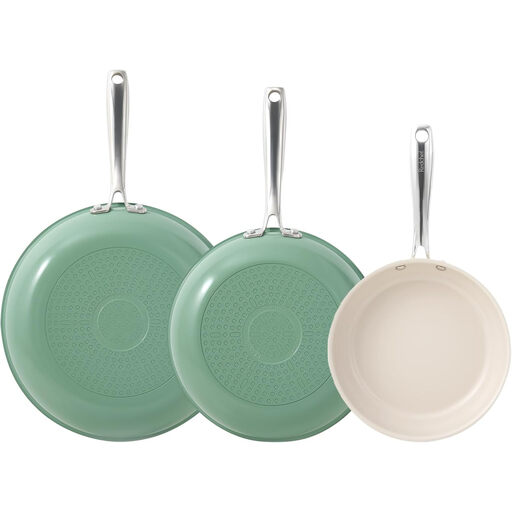
Why we chose it: A `pan set` is often the most economical and practical solution for outfitting a kitchen. This set covers the three most common diameters (20, 24, and 28 cm), offering maximum flexibility.
This set provides a complete and coherent solution, saving you from juggling mismatched pans. Its very high-temperature oven compatibility (up to a stated 450°C) is a true testament to its robustness.
The triple-layer ceramic coating and forged aluminium body ensure rapid, even heat distribution, regardless of size. The riveted stainless steel handles are built to last.
We have curated a complete selection of products that meet our selection criteria and current safety standards.
Regardless of the coating, a few simple steps can significantly extend its lifespan. Avoid overheating it while empty. Use wooden, silicone, or nylon utensils. For cleaning, always let the pan cool down before running it under water to prevent thermal shock. Hand washing with a soft sponge will always be gentler on the coating than a dishwasher.
The "PFOA-free" label guarantees that this specific substance was not used during manufacturing, in compliance with European regulations. However, this does not mean the coating is free from all substances in the same chemical family, the PFAS. If this is a concern for you, ceramic pans guaranteed to be PFAS-free, cast iron, or stainless steel are alternatives to consider.
Performance on an induction hob depends entirely on the quality and size of the pan's ferromagnetic base. If this disk is too small or too thin, the hob will struggle to detect it or will heat slowly and unevenly. For optimal performance, ensure the diameter of the pan's base matches the size of your induction cooking zone.