
Livraison le jour même ou le lendemain

Qualité garantie

Débloquez vos offres de bienvenue: Livraison GRATUITE | Jusqu'à -80 % | 30 jours d'essai gratuits à JoyPlus
Téléchargez l'application
A non-stick frying pan for all hob types needs to work on an induction hob, gas, electric or ceramic hob, while still being easy to handle every day. The problem is that product listings can sometimes cause confusion between partial compatibility, promises of longevity and incomplete information.
Before you place your order, three pitfalls are worth your attention:
To choose an induction non-stick frying pan, check that the product listing explicitly mentions this technology. The diameter stated usually refers to the top rim of the pan, not the surface area actually in contact with the hob. A wide, perfectly flat base helps heat to spread more evenly.
The models featured here are advertised as compatible with several heat sources: gas, electric, ceramic and induction. For a halogen or infrared hob, it's best to consult the manufacturer's recommendations – compatibility can vary depending on the base design.
An aluminium pan heats up quickly and is generally lightweight. It often has a non-stick or ceramic coating. Stainless steel, as found in a stainless steel pan, is more resistant to scratches and corrosion, but requires more care with temperature control when it isn't coated.
The main options are as follows:
The PFOA-free label is sought after by many households. However, it doesn't mean you can ignore the usage instructions: avoid heating the pan when empty and replace it if the coating is badly chipped or significantly damaged.
Here's a simple guide to choosing between a 20 cm, 24 cm, 26 cm or 28 cm pan:
A pan with a removable handle is easy to store and can go from hob to oven, provided you remove the handle before putting it in the oven when the instructions ask you to. Also check for the dishwasher-safe label. Even when it's allowed, the dishwasher can speed up wear on the coating – a soft sponge and mild detergent are generally preferable.
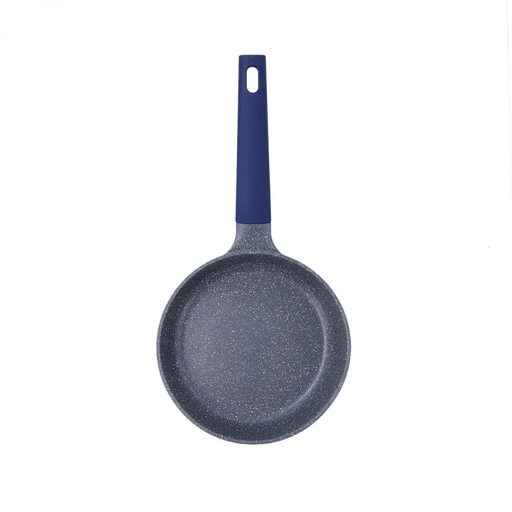
Why this choice suits this profile: its 28 cm diameter is ideal for everyday meals and its cast aluminium construction lends itself to multi-portion cooking.
The listing specifies induction compatibility thanks to a ferritic base and clearly states the oven usage limitations.
PTFE non-stick coating, all-hob compatible base and dishwasher-safe cleaning mentioned on the listing.
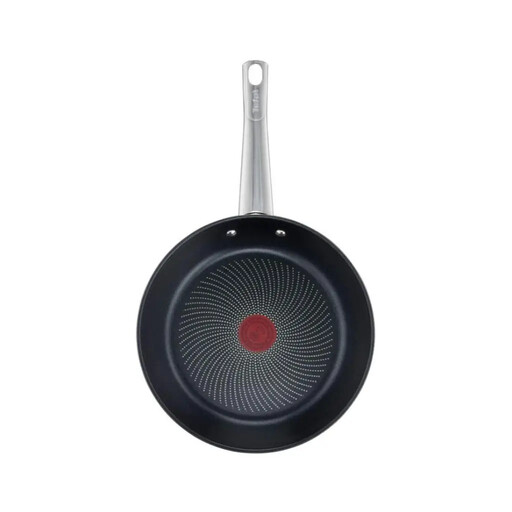
Why this choice suits this profile: this model combines a stainless steel finish, a Thermo-Spot indicator and a 28 cm diameter suited to family cooking.
The listing details the four compatible hob types, the maximum oven temperature and the stated PFOA-free status.
Titanium-reinforced coating, riveted stainless steel handle, oven-safe up to 250°C and stated dishwasher compatibility.
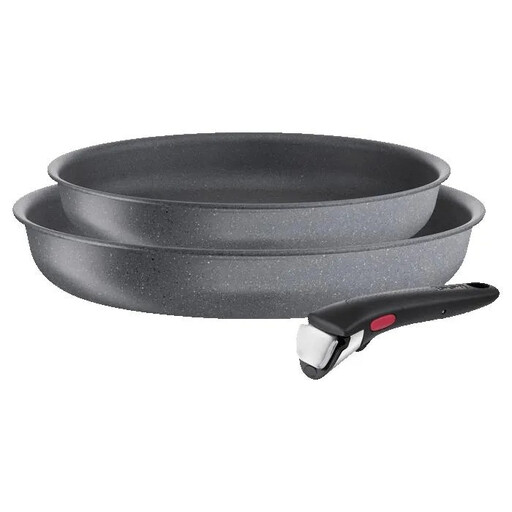
Why this choice suits this profile: the 24 cm and 28 cm sizes cover multiple uses, while the removable handle makes storage easier in a kitchen that's often short on space.
The set states the dimensions and induction compatibility precisely. It also reminds you of an essential limitation: the handle must be removed before putting the pan in the oven.
Two diameters, stackable design and Mineralia+ coating stated to be free from PFOA, lead and cadmium.
We've put together a comprehensive, up-to-date selection of frying pans that meet these demanding criteria, while also taking European safety regulations into account.
To slow down wear on the coating and keep cooking even:
A pan dedicated to eggs and pancakes can stay compact, while a large family model benefits from a base suited to the induction zone. The cost of use depends mainly on the lifespan of the coating, how you care for it and your energy consumption – cooking at a moderate temperature and choosing a diameter that matches the heating zone helps to avoid unnecessary waste.
Choose a reference whose listing explicitly mentions induction. A ferritic, magnetic base or a base specially designed for this technology is essential. The diameter of the heating zone should also be consistent with that of the pan.
Dishwasher compatibility makes cleaning easier, but repeated cycles, detergents and heat can speed up wear on some coatings. Hand washing with a soft sponge is often preferable to keep the surface in good condition for longer.
The 24 cm size is suitable for one or two portions, the 26 cm offers more versatility and the 28 cm is better suited to families or larger quantities. For cooking eggs or individual pancakes, a 20 cm model may be enough.