
Livraison le jour même ou le lendemain

Qualité garantie

Débloquez vos offres de bienvenue: Livraison GRATUITE | Jusqu'à -80 % | 30 jours d'essai gratuits à JoyPlus
Téléchargez l'application
A new non-stick cookware set can be a game-changer in the kitchen, but buying one often turns into a headache. Between promises of durability and marketing claims about safety, it's hard to navigate the options. The result: many people end up with pans that start sticking after just a few months or warp on their induction hob.
As the Head of Product Recommendations at Joybuy, I'm here to help you see things more clearly. This guide breaks down the common pitfalls to avoid and the essential criteria for making the right choice—one that truly suits your cooking style.
Before you even start looking at products, it's crucial to know the pitfalls that lead directly to buyer's remorse.
To avoid these traps, you need to focus on two fundamental aspects: the material of the cookware's body and the nature of its coating.
The material of your pan or pot is key: it determines how well heat is conducted and distributed. Cast aluminium represents an excellent compromise here. Lighter than traditional cast iron, it heats up quickly and ensures very even heat distribution, which prevents the hot spots that damage non-stick coatings.
For those with induction hobs, the number one criterion is the base of the cookware. It must be perfectly flat and incorporate a ferromagnetic disc. The trick to check? Use a magnet: if it sticks firmly to the outer bottom, compatibility is guaranteed. A thick base is also a sign of stability and long-term resistance to warping.
The era of Teflon (PTFE) dominance is over. Today, ceramic cookware is on the rise. Derived from sand, these coatings are known for being free of PFAS, PFOA, and other similar chemical compounds.
When making your choice, look for labels like PFAS-free or PFOA-free. A quality coating, whether ceramic or a new-generation PTFE, is often multi-layered to better resist scratches and wear over time.
Rather than a random list, we've selected products that meet specific needs, in line with the quality and safety criteria we've just discussed.
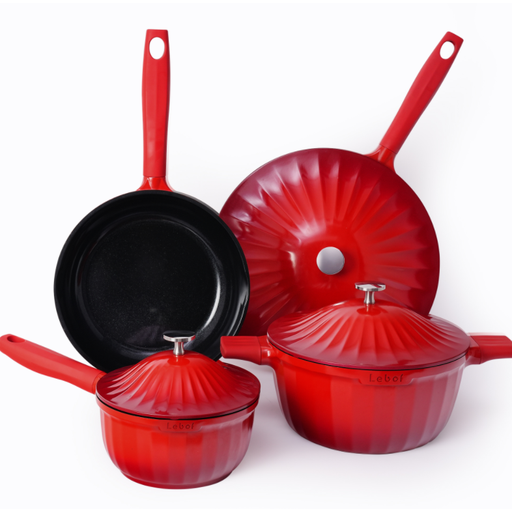
Why we chose it: Perfect for outfitting a new kitchen or upgrading your gear with a cohesive set. This collection covers the essentials (frying pans, saucepans, stockpot) for daily cooking, with a strong focus on material safety.
The titanium-infused ceramic coating is designed for enhanced scratch resistance. The cast aluminium body ensures fast, even heating, which protects the coating and guarantees excellent performance on induction hobs.
A complete set certified PFAS, PFOA, and PTFE-free, compatible with all heat sources, including induction.
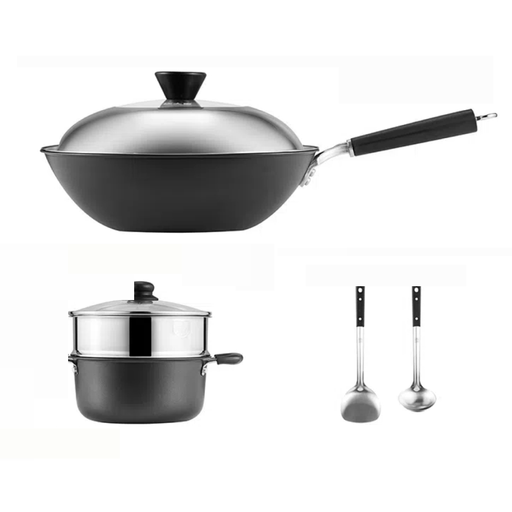
Why we chose it: For those who love variety, from quick stir-fries to slow-simmered dishes. This set combines materials suited for specific cooking styles, offering a versatility that uniform sets lack.
Instead of a one-size-fits-all coating, this set uses the right material for the right job: the wok's pure iron is ideal for high-heat searing, while the soup pot's aluminium provides gentle, consistent heat for soups and stews.
Exceptional versatility thanks to the combination of a traditional wok for high-heat cooking and a soup pot for saucy dishes.
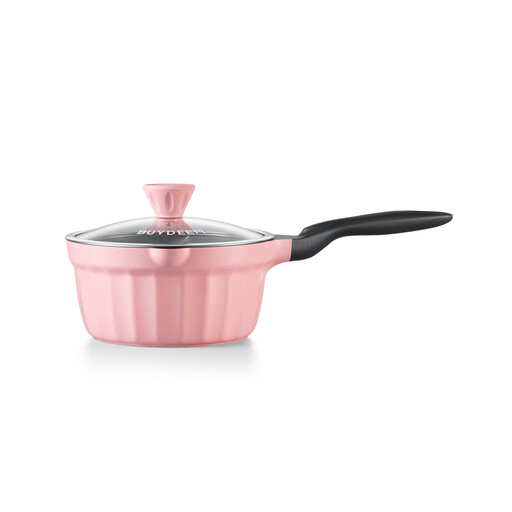
Why we chose it: Perfect for meals for one or two, preparing sauces, or reheating small portions. Its compact footprint and thoughtful features, like the pour spout, make it incredibly practical for daily use.
Its cast aluminium construction guarantees fast, even heating, preventing the hot spots that can damage the coating. The ceramic coating is explicitly advertised as PFOA/PFAS-free.
Fast and even heating, a convenient integrated pour spout, and compatibility with all hobs, including induction.
Discover our full selection of products that meet our quality and safety standards.
The lifespan of a ceramic pan depends primarily on its care. With the right habits, a quality model can last for several years. A few golden rules to preserve the coating: avoid metal utensils, never heat it empty on high power, and avoid thermal shock (don't run it under cold water while it's still hot). Hand washing will always be gentler than a dishwasher for maintaining its non-stick properties.
The easiest way is to look for the coil-shaped symbol on the packaging or the bottom of the pan. Alternatively, do the magnet test: hold a magnet to the pan's outer base. If it sticks firmly, you're good to go! Also, make sure the bottom is perfectly flat to ensure optimal contact with the hob.
Absolutely not. Modern PFAS-free pans and pots, especially those with a high-quality ceramic coating, offer excellent non-stick performance. In reality, performance depends more on the overall build quality (body thickness, multi-layer coating, base quality) than on the presence or absence of certain substances. A well-designed pan will always perform well.