
Livraison le jour même ou le lendemain

Qualité garantie

Débloquez vos offres de bienvenue: Livraison GRATUITE | Jusqu'à -80 % | 30 jours d'essai gratuits à JoyPlus
Téléchargez l'application
Choosing a new non-stick cookware set can quickly become a headache. Between marketing promises and the reality of daily use, it's easy to end up with pans that warp, coatings that peel after a few months, or utensils that are incompatible with your stovetop. As the Head of Product Recommendations at Joybuy, my mission is to help you avoid these pitfalls. Let's break down the most common mistakes together so you can make the right choice with complete peace of mind.
To avoid disappointment, two technical parameters should be monitored closely: they are the real secret to the quality and longevity of your cookware.
The coating is the core technology of a good pan. The main options on the market are:
Cooking performance depends directly on the utensil's design.
Rather than a random list, we have selected products that meet specific needs, applying the criteria we've just broken down.
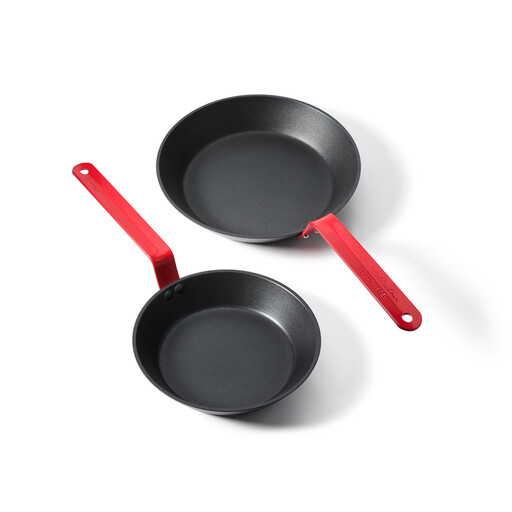
Why we chose it: This duo is perfect for daily use. It covers essential needs, from a fried egg to a vegetable stir-fry. Its oven-safe compatibility up to 232°C (450°F) offers highly convenient versatility for browning or keeping a dish warm.
The thick, magnetic stainless steel base ensures efficient heating on induction, avoiding the "false compatibility" trap. The Swiss ILAG coating, known for its durability, dispels fears of premature wear and tear.
Stovetop-to-oven versatility and a durable PFOA/PFOS-free coating, ideal for heavy use.
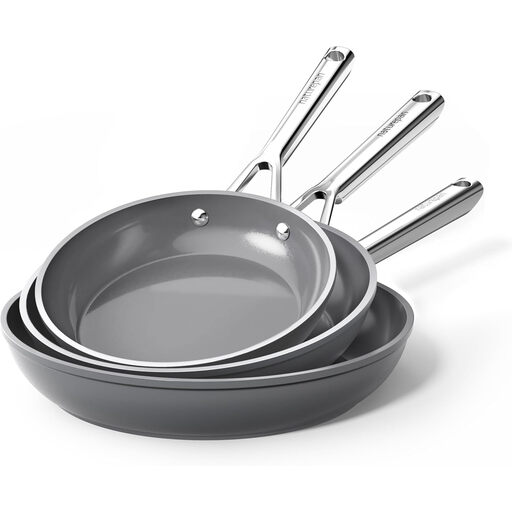
Why we chose it: For those who prioritise a healthy composition, this set is a top-tier option. The ceramic coating is explicitly formulated to be free of PFAS, PFOA, and PTFE. The three sizes (20, 24, and 28 cm) cover all needs, from the simplest to the most generous meals.
It goes beyond the simple "PFOA-free" claim by guaranteeing a complete absence of the entire PFAS family, which removes any ambiguity. The titanium and diamond reinforcement addresses the fragility sometimes associated with early ceramic coatings.
A ceramic coating guaranteed to be free of any controversial substances (PFAS/PTFE) for complete peace of mind.
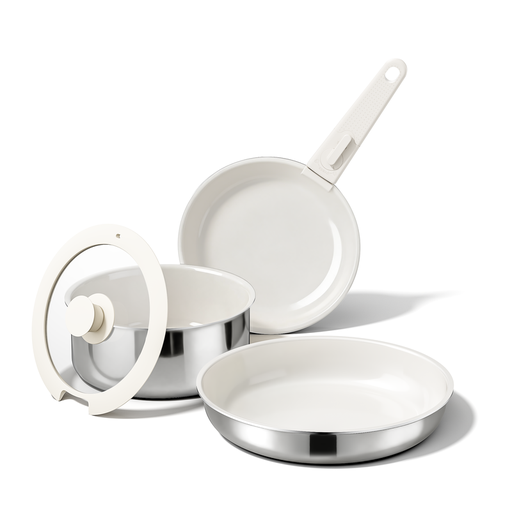
Why we chose it: The detachable handle is a game-changer for small kitchens, RVs, or anyone who dreams of impeccably organised cupboards. This system allows you to stack pots and pans, use them in the oven like baking dishes, and easily store them in the refrigerator.
It solves a very real problem that most cookware sets ignore: bulkiness. Its triple-layer stainless steel construction ensures perfect heat distribution, preventing disappointing performance on induction.
Significant space-saving thanks to the detachable handle and maximum versatility: stovetop, oven, table, and fridge.
Versatility is clearly the underlying trend. More and more cookware, like the items we've selected, is designed to go from the stovetop to the oven, transforming into a baking dish in an instant. If you're looking to complete your set with dedicated ovenware, such as crème br?lée ramekins or a compatible modern dinnerware set, many options are available.
We've curated a full range of products that meet our demanding selection criteria and current safety standards.
On average, expect between 2 and 5 years, depending on the product's quality and your care. To maximise its life:
The main health advantage of a ceramic pan is its complete absence of PTFE and PFAS. Although modern PTFE coatings (without PFOA) are considered safe for normal use, many consumers prefer, as a precautionary principle, to choose materials that are entirely free of them. Ceramic is the perfect answer to this requirement.
Nothing could be simpler! Take a magnet (a simple fridge magnet will do) and hold it to the bottom of the pan. If it sticks firmly, it's compatible. Another clue: the induction symbol (which looks like a horizontal coil) is often engraved on the bottom of the utensil or on its packaging.