
Livraison le jour même ou le lendemain

Qualité garantie

Débloquez vos offres de bienvenue: Livraison GRATUITE | Jusqu'à -80 % | 30 jours d'essai gratuits à JoyPlus
Téléchargez l'application
A yoga mat that slips can turn a relaxing session into a frustrating, and even dangerous, nightmare. Faced with an overwhelming number of options, it's hard to distinguish between marketing promises and reality. The risk? Ending up with equipment that's completely unsuited for your needs. As a product expert at Joybuy, my mission is to guide you beyond the marketing jargon, helping you decode the key features to make an informed choice that fits your practice and your budget.
Before we dive into our selection, let's review the most common pitfalls that can ruin your practice:
Keeping these points in mind is the first step toward investing in a sports mat that will support you for years to come.
To avoid these disappointments, three technical criteria make all the difference when judging the quality and suitability of an exercise mat.
The choice of material has a direct impact on grip, weight, durability, and feel.
The thickness of your mat should be chosen based on your practice and sensitivity.
A standard mat measures approximately 183 x 61?cm. If you are tall or enjoy having ample room for your movements, an extra-large yoga mat (190?cm long or 80-100?cm wide) can radically improve your practice. Finally, if you frequently transport your mat, check its weight and whether it includes a carrying strap—a simple accessory that is a real game-changer.
Rather than searching for a non-existent "perfect" mat, it's better to find the one that matches your profile. Here are our suggestions to guide you.

Why we love it: Perfect for starting out, this mat features alignment lines that help you position your hands and feet correctly. A real plus for learning the basic postures.
Its 6 mm thickness is the ideal compromise, sacrificing neither comfort nor stability. Its textured TPE material ensures good grip right from the start, preventing the frustration of a slippery mat.
Alignment markers to guide your practice. Lightweight (730 g) and comes with its own carrying strap.
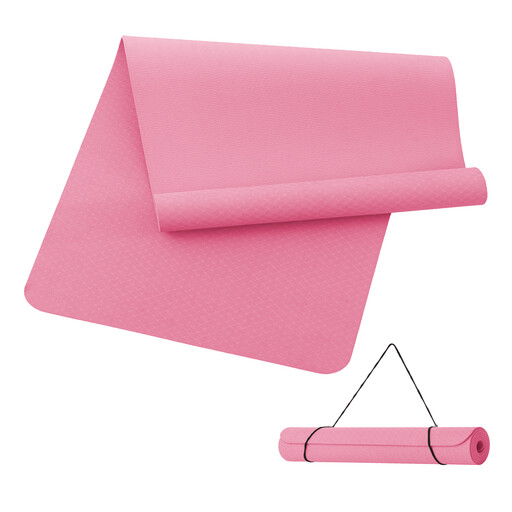
Why we love it: For anyone who feels cramped on a standard mat. Its extra-large dimensions offer unparalleled freedom of movement, perfect for wide-ranging floor exercises or for taller individuals.
It solves the problem of limited space that forces you to constantly readjust. Its dual-sided textured surface (leaf and wave patterns) ensures reliable grip across its entire (very) large surface.
Generous dimensions of 190 x 100 cm. TPE material with a dual-sided non-slip texture.

Why we love it: Its 10 mm thickness provides maximum cushioning, effectively protecting the knees, elbows, and spine. It's an excellent ally for Pilates, floor-based fitness, or gentle yoga.
It directly addresses the problem of discomfort on hard floors. Unlike some very thick but low-density mats, its high-density TPE material maintains good stability while absorbing impact.
Superior cushioning thanks to its 10 mm thickness. Dual-textured surface for flawless grip.
We've curated a complete selection of mats that meet our quality criteria and current safety standards.
Most TPE mats are very easy to clean. After each session, a simple wipe with a damp cloth is enough to remove sweat and dust. For a deeper clean, use a solution of warm water with a few drops of mild soap. Rinse with a clean, damp cloth, then let it air dry away from direct sunlight, which could damage the material. Most importantly, avoid the washing machine and harsh detergents.
It all depends on the frequency of use, the type of practice, and the quality of the material. A well-made PVC mat can last for several years. A well-maintained TPE model will typically last between one and three years with regular use. The first signs of wear? A loss of grip or the appearance of small particles flaking off.
Not necessarily. While a 10?mm mat is excellent for comfort in floor-based postures (Pilates, Yin Yoga), its thickness can make balancing poses (like Tree Pose or Warrior III) more challenging. The significant cushioning reduces the feeling of connection to the ground and, therefore, stability. For a dynamic yoga practice (Vinyasa, Ashtanga), a thickness of 4 to 6?mm remains more suitable.