
Livraison le jour même ou le lendemain

Qualité garantie

Débloquez vos offres de bienvenue: Livraison GRATUITE | Jusqu'à -80 % | 30 jours d'essai gratuits à JoyPlus
Téléchargez l'application
Whether it's for a morning yoga session, an intense Pilates class, or your home fitness routine, the quality of your mat is essential. A good non-slip yoga mat must combine stability, comfort, and durability. But with a market flooded with marketing promises, it's easy to make a purchase you'll regret. This guide is here to help you decode the essential criteria and make an informed choice that's perfectly suited to your practice.
Before we break down the technical specs, let's review the most common disappointments so you don't fall into the same traps.
To avoid these letdowns, three points need close examination: the material, the thickness, and the dimensions.
The choice of material is decisive: it determines the grip, weight, durability, and even the ecological impact of your mat.
Thickness is a crucial trade-off. It must ensure the comfort of your joints without undermining your stability, whether you use it as a floor mat for your exercises or as a Pilates mat.
A standard mat size (around 183 x 61 cm) can quickly feel restrictive. If you're tall or like to have plenty of room to move, opting for an extra-large yoga mat (up to 190 x 100 cm) will be a game-changer. Finally, don't underestimate portability: a mat with a carrying strap will make your life much easier when taking it to the studio.
To put theory into practice, here are a few models that perfectly illustrate these criteria, each meeting a specific need.
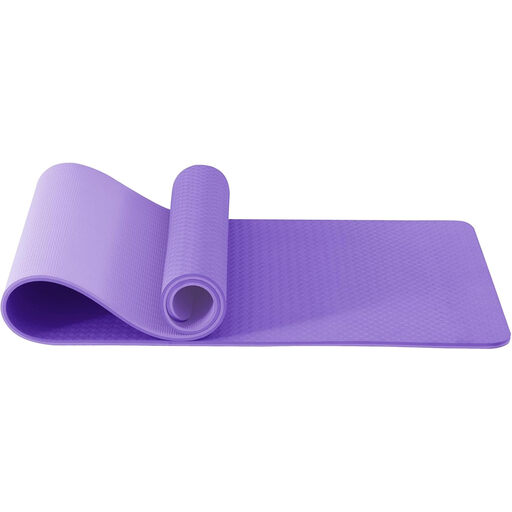
Why we chose it: Ideal for people with sensitive joints or for floor-based practices like Pilates and strength training. Its generous thickness absorbs impact and insulates from cold floors.
It directly addresses the problem of overly thin mats that cause pain. Its 10mm thickness offers maximum cushioning without sacrificing too much stability, thanks to its high-density TPE composition.
Premium cushioning to protect knees and elbows. Its dual-sided textured surface ensures good grip, and the carrying strap is included.

Why we chose it: Perfect for taller individuals or those who appreciate total freedom of movement without ever stepping off the mat, whether for yoga, Pilates, or stretching.
No more standard mats that are too narrow or too short. Its extra-large dimensions (190 x 100 cm) provide a luxurious practice area for total focus.
Maximum practice space. The 6mm thickness and TPE material ensure an ideal balance of comfort and stability, even on this large surface.

Why we chose it: Designed for yogis who sweat or for hot yoga enthusiasts. Its natural cork surface provides a grip that intensifies with moisture.
It ends the nightmare of a mat that gets slippery with sweat. Its natural cork surface absorbs moisture to boost its grip, allowing you to hold your poses with complete confidence.
A grip that gets better as you sweat. Cork is also naturally antimicrobial, and the TPE base ensures the mat won't budge an inch.
Explore our full selection of mats that tick all the boxes from our guide and meet current safety standards.
For most TPE and cork mats, a simple cleaning is all that's needed. After each session, wiping it with a damp cloth is sufficient. If necessary, use a little highly diluted mild soap. Always let it air-dry (away from direct sunlight) before rolling it up. And most importantly, never put it in the washing machine!
It all depends on the frequency of use, your practice, and, of course, the quality of the material. A budget PVC model will last a year or two with regular use. A good TPE, cork, or natural rubber mat, if well-maintained, can last you for 5 years or more. It's time to replace it when it loses its grip, starts to crumble, or if the cushioning is gone.
A 10mm mat is very comfortable, but its thickness can indeed make balance poses (like Tree Pose or Warrior III) more challenging. Its soft cushioning creates a slight instability that requires more engagement. For a practice rich in balancing, a 5 or 6mm mat remains the best compromise between comfort and connection to the ground. If joint comfort is non-negotiable, one trick is to place one foot next to the mat during the most demanding balance poses.