
Livraison le jour même ou le lendemain

Qualité garantie

Débloquez vos offres de bienvenue: Livraison GRATUITE | Jusqu'à -80 % | 30 jours d'essai gratuits à JoyPlus
Téléchargez l'application
Would you like to hang a dressing gown, towel or decorative item without getting the drill out ? A no-drill adhesive hook is a practical solution for many homes, particularly for renters, students and anyone who likes to rearrange their interior regularly.
However, not every model is suitable for every surface or purpose. Incorrectly assessing the weight, a dusty wall or a damp room can quickly compromise adhesion. Here are the points to check before buying an adhesive wall hook.
An adhesive hook can indeed be removed cleanly, provided you follow the installation and removal instructions. That does not mean that all paints, wallpapers and textured surfaces will react in the same way.
The Command models featured here are generally designed for smooth surfaces: tiles, glass, wood or certain painted walls. However, the product descriptions specify restrictions concerning wallpaper, uneven surfaces, unpainted walls and fresh paint.
The maximum capacity shown on the packaging applies under specific usage conditions. A bulky item or one that is handled regularly can exert considerably more pulling force than an item simply placed on the hook.
Before choosing a nickel decorative hook or an adhesive metal hook, add together the weight of the item and that of any accessories attached to it. Always allow a safety margin, particularly in a hallway or bathroom where towels are often removed and rehung.
Even a moisture-resistant hook must be installed on a properly prepared surface. A wet or greasy surface, or one covered with household cleaning product residue, can prevent the strips from adhering properly.
In a shower, check that the model is specifically designed for damp environments: a standard wall hook does not automatically have this feature.
The maximum load is the first criterion to examine :
For a long-lasting wall installation, avoid hanging a fragile or valuable item from an adhesive fixing, even when the stated capacity appears sufficient.
A repositionable hook supplied with a replacement strip can be useful, but it will not make an uneven surface perfectly smooth. Surfaces that are generally compatible include tiles, glass, mirrors, wood and painted walls.
Before installation, clean the area thoroughly in accordance with the manufacturer's instructions, then allow it to dry completely. Several Command models recommend pressing firmly on the hook for approximately 30 seconds, then waiting before hanging an item from it.
For a kitchen or bathroom, look for the descriptions water-resistant, moisture-resistant or rust-resistant. A satin or brushed nickel finish can also complement taps and other metal accessories. However, appearance should never take priority over the product's technical suitability for the room.
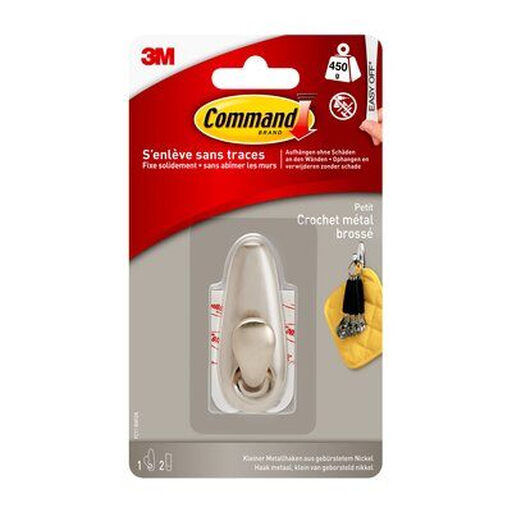
Why this model suits them : its compact size is ideal for small items, while its tool-free installation makes it easy to start organising your walls without getting the drill out.
The maximum load of 450 g reduces the risk of overloading this small hook. The product description states that it can be removed without holes or residue and includes replacement strips.
A brushed nickel finish, tool-free installation and stated compatibility with wood, tiles and painted surfaces.
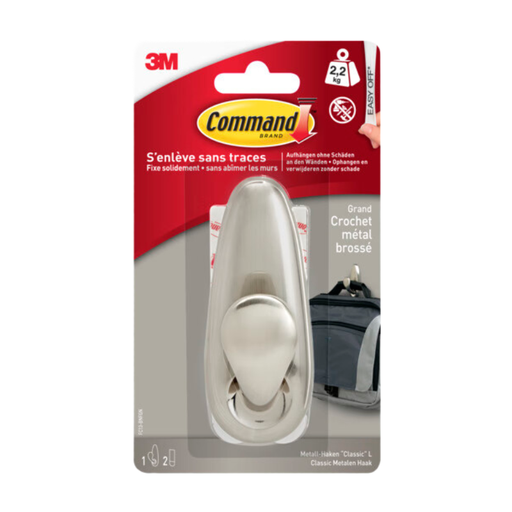
Why this model suits them : its generous size and brushed metal finish blend easily into a carefully styled interior, whether in a hallway, bedroom or living room.
Its maximum load of 2.2 kg lets you choose a fixing suited to heavier items, rather than relying solely on the hook's appearance.
A metal construction, brushed nickel finish, tool-free adhesive fixing and the option to reposition it using new strips.
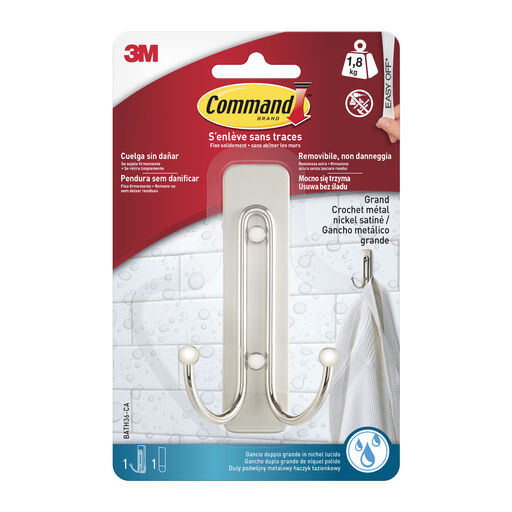
Why this model suits them : this double hook is a natural fit for a bathroom or kitchen where several towels and accessories need to remain close at hand.
The product description states that it is water- and rust-resistant, with a maximum load of 1.8 kg. However, it advises against installation on a damp surface or textured material.
Two hanging points, moisture-resistant adhesive strips and stated removal without holes or residue, provided you pull the tab slowly.
We have put together a comprehensive, real-time selection of products that meet these exacting criteria, in compliance with European safety regulations.
Avoid installing the hook on fresh paint, wallpaper, a powdery wall or a constantly wet surface. If in doubt, carry out a test first in an inconspicuous area.
Some models are specifically designed for damp rooms and offer water or rust resistance. Choose a bathroom hook that is clearly intended for this environment. The surface must nevertheless be completely dry and clean at the time of installation.
Its lifespan depends on the weight suspended, temperature, humidity, surface and frequency of use. Check the adhesive regularly if the hook supports a towel or dressing gown that is handled every day. A new strip may be needed if the hook is repositioned.
The system is generally designed to minimise marks when the tab is pulled slowly in the correct direction. However, the result depends on the condition of the wall and its covering. Follow the restrictions given in the instructions and do not install the hook on a surface that is not recommended.