What should you compare when choosing an appliance?
For drying without an external air outlet, first check the space available and the load you can actually dry. Then compare each model’s installation and usage requirements.
| Factor | What to check | Who it matters to |
|---|
| Drying capacity |
The drying capacity in kg; for a washer-dryer, check this separately from the washing capacity. |
If you do frequent or large loads, being able to dry your usual load in one go becomes a priority. Around 31% of consumers would put this capacity first. |
| Available space |
The height, width and depth; if stacking two appliances, check that they’re compatible and use the fixing kit specified by the manufacturer. |
In a compact home, saving floor space may matter more than having a separate tumble dryer. This space-saving benefit would be a priority for around 25% of consumers. |
| Running costs |
The figures for the drying cycle you’ll use; for a washer-dryer, check the combined cycle figures, including water consumption. |
If you regularly dry clothes straight after washing, the resources used by the full cycle will influence your decision. Around 25% of consumers would prioritise this factor. |
| Installation and maintenance |
The ventilation and temperature requirements in the manual; whether water is collected in a tank or drained away, and access to the filters. |
If your room has limitations or emptying a tank would be difficult, ease of installation and maintenance may take priority over other factors. This would be a deciding factor for around 19% of consumers. |
Appliances to consider on Joybuy
This selection includes separate heat-pump or condenser tumble dryers, as well as a washer-dryer. Compare their drying capacity and manual requirements with the space you have available.
 Image unavailable
Hotpoint CHD84MWBSEE, 8 kg heat-pump tumble dryer
Worth considering if you can make room for a separate tumble dryer for regular loads. The listed capacity is 8 kg. Check the dimensions, ventilation and water drainage requirements in the manual before planning its installation.
View on Joybuy
 Image unavailable
Electrolux EDH1018CD GentleCare, 8 kg condenser tumble dryer
Compare this model if you want a dedicated drying capacity without an external air vent. It’s listed as an 8 kg condenser tumble dryer. Check the space required, ventilation instructions and water management options.
View on Joybuy
 Image unavailable
Samsung WD11DG6B85BEU3, 11/6 kg washer-dryer
Worth considering if you need one appliance to handle both washing and drying. Its stated capacity is 11 kg for washing and 6 kg for drying. To run both cycles without removing any laundry in between, don’t exceed the drying capacity. Also check the dimensions and connections required for your chosen location.
View on Joybuy
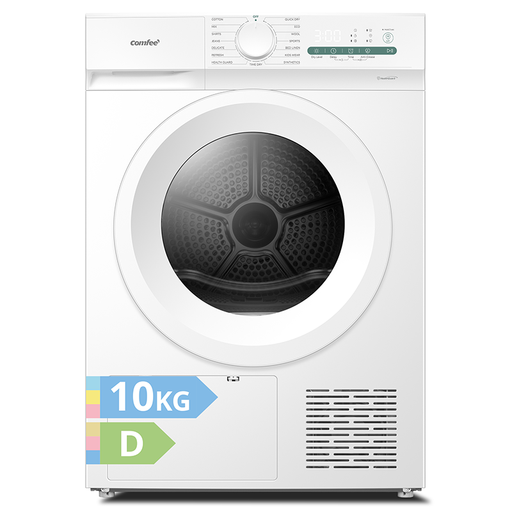 Image unavailable
Comfee' CD10EHP05W-HR, heat-pump tumble dryer
Worth considering if you’re looking for a separate heat-pump tumble dryer without an external air outlet. The capacity information for this model is inconsistent, with figures of 8 kg and 10 kg both shown. Confirm the drying capacity on the listing and in the manual for the exact model before choosing it. Also check its dimensions and how it handles condensate.
View on Joybuy
Frequently asked questions
Can you install a tumble dryer without an external air outlet?
Yes, if you choose a condenser dryer, including a heat-pump model. Que Choisir explains that these appliances don’t need to be connected to an external outlet, unlike vented models. However, you must still follow the ventilation, temperature and clearance requirements in the manual.
Do you need to empty the tank on a heat-pump tumble dryer?
It depends on how the model handles condensed water. For example, Electrolux France lists a 5,56 L water tank for its EW9HI783FC. If you’d rather not empty a tank, check whether the model and your installation support direct drainage, and whether the required accessories are included.
Can a washer-dryer dry a full load of laundry?
Not if the load exceeds its drying capacity. For example, Electrolux France lists capacities of 10 kg for washing and 6 kg for drying for the EW9W1166RB. Any load over 6 kg must be reduced before drying in this model.
Which energy and water figures should you compare for a washer-dryer?
Compare the figures for the wash-and-dry cycle if that’s the one you’ll use. Figures for washing alone relate to a different type of use. Also check the electricity and water consumption for the combined cycle in the model’s product information.
What maintenance does an appliance without an external air outlet need?
Follow the model’s manual for cleaning the filters, accessing the condenser and collecting or draining water. Que Choisir points out that cleaning the filters and condenser remains important for the tumble dryers concerned, even when a self-cleaning function is advertised.


