Households with room for just one appliance
A washer-dryer can combine both functions if you’re happy to limit a continuous wash-and-dry load to its drying capacity. UFC-Que Choisir points out that this is lower than the washing capacity.


If you have room for a second appliance and often dry full loads, a separate tumble dryer lets you wash and dry at the same time. If you can only fit one appliance, a washer-dryer saves you from transferring the laundry, but its drying capacity is usually lower than its washing capacity, and a complete cycle can take a long time. If you mainly use an indoor airer, a faster spin can shorten drying times; it won’t replace proper ventilation.
A washer-dryer can combine both functions if you’re happy to limit a continuous wash-and-dry load to its drying capacity. UFC-Que Choisir points out that this is lower than the washing capacity.
If you can fit a second appliance, a separate tumble dryer means you don’t have to size every wash to the drying capacity of a washer-dryer. Be sure to check the space required and the programme times for the model you’re considering.
If you don’t need your laundry to come out of the machine dry, check your washing machine’s spin efficiency. ADEME links this to faster indoor drying, but removing moisture from your home is a separate matter.
Consider this if: you have room for a second appliance and regularly dry large loads.
The trade-off: you’ll need to set aside space for it and transfer the laundry after washing.
Consider this if: you can only install one appliance and want to run washing and drying one after the other.
The trade-off: a full wash load may exceed the drying capacity, so you may need to remove some laundry.
Consider this if: you can hang your laundry indoors and mainly want to reduce drying time.
The trade-off: you’ll still need to hang the laundry out, and moisture must be able to escape from your home.
| Factor | What to check | My needs |
|---|---|---|
| Available space | Measure the space, the overall depth and the clearance needed for the door. If you’re choosing a separate tumble dryer, also check the installation requirements in its manual. | I may only be able to set aside space for one laundry appliance. |
| Load to be dried | For a washer-dryer, check the washing and drying capacities separately in kg. For a separate tumble dryer, choose a drying capacity that suits the loads you usually do. | I want to be able to dry a full wash load without removing some of the laundry. |
| Time and energy use | For a washer-dryer, compare the figures for the complete cycle, not just the wash. For a tumble dryer, check the energy use per 100 cycles and the eco programme time on the current energy label. The European Commission says this label applies to models placed on the market since 1 July 2025. | I want to know how long drying takes and compare programmes that suit the way I use the appliance. |
| Spin efficiency and indoor air | If you’re drying clothes on an airer, check the spin-drying efficiency class. If moisture is difficult to remove, also check the air circulation and ventilation. ADEME says mechanical ventilation removes moisture continuously. | I can hang out my laundry, but I don’t want to mistake a more effective spin for a solution to damp in my home. |
On a 9/6 kg washer-dryer, 9 kg is the washing capacity and 6 kg is the drying capacity. So a 9 kg load can’t be dried in one continuous cycle at full capacity.
If you want to run both stages without removing any laundry, plan your loads around the drying capacity.
The European Commission distinguishes between wash-only figures and complete-cycle figures on washer-dryer energy labels. The first set doesn’t show the time, water or energy used for a wash followed by drying.
Compare the figures for the wash-and-dry cycle using similar load sizes.
According to the European Commission, the new tumble dryer energy label applies to models placed on the market since 1 July 2025. Its A to G scale can’t be compared directly with the old A+++ or A++ ratings.
Use the label that applies to the model, and compare the energy use and eco programme time of appliances with similar capacities.
An effective spin makes air-drying easier, but it doesn’t remove moisture from your home. ADEME distinguishes between airing your home each day and the continuous role of mechanical ventilation.
If moisture seems difficult to remove, get the ventilation or air circulation checked separately from your choice of appliance.
Bosch’s French catalogue features 8 and 9 kg heat pump tumble dryers.
LG France’s product information for the F964V50WRS model lists a 9 kg washing capacity and a 6 kg drying capacity.
According to AEG France’s product information, the LWR75A966V washer-dryer has a 9 kg washing capacity and a 6 kg drying capacity.
These models are separate tumble dryers, worth considering if you can set aside space for one. Compare their capacities, installation requirements and programmes with the loads you usually do.
 Image unavailable
For drying laundry in a separate appliance: this model has a stated capacity of 8 kg and a C energy rating. Check its dimensions, the clearance required and the time and energy-use figures for the programme you’re interested in.
 Image unavailable
A separate drying option with a stated capacity of 8 kg and a D energy rating. Before choosing, check its dimensions against the space available and look at the time and energy use of the programmes that suit your household.
 Image unavailable
This 8 kg model lets you dry your laundry in a separate appliance. Check its dimensions, door clearance and energy label details before comparing it with heat pump models.
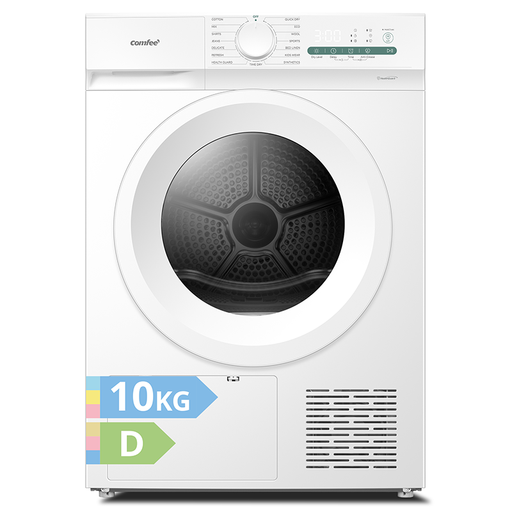 Image unavailable
A separate D-rated appliance to consider if you have room to install it. Confirm the capacity of this variant before planning your loads, as listings differ between 8 kg and 10 kg. Also check its dimensions and cycle details.
The two figures refer to washing and drying: on a 9/6 kg model, you can wash up to 9 kg but dry up to 6 kg. To run both stages without removing any laundry, keep the load within the complete-cycle capacity stated for the model.
Compare the wash-only figures with those for the wash-and-dry cycle separately. The European Commission says the label includes information such as energy use per 100 cycles, water use per cycle, cycle time and noise. Make sure you match each figure to the relevant capacity and cycle.
Check the type of appliance and its installation requirements: a vented tumble dryer needs a suitable outlet, unlike a condenser model. Also measure the space and leave the clearances specified in the manual for your chosen model.
If you dry laundry indoors and moisture seems difficult to remove, check the air circulation and ventilation separately from any appliance purchase. ADEME says mechanical ventilation removes moisture continuously. A more effective spin can speed up drying, but it can’t do the same job.