For a quick office lunch, choose a no-salt stock cube if your priority is limiting the salt added through seasoning. A ‘reduced salt’ cube is another option, but that claim does not mean ‘no salt’. Before buying, compare the salt per serving, dilution instructions and ingredients for the specific recipe, taking the rest of your meal into account.
Who is this choice for?
Lunches made with a kettle or microwave
A stock cube can quickly add flavour to rice, pasta, soup or vegetables at the office. However, check the quantity of water and preparation method given for the product you choose, as these vary depending on how it is used.
Anyone keeping an eye on the salt in their lunch
If your meal already includes bread, cheese, a ready meal or a sauce, check how much salt the cube adds to the portion you’ll eat. The French Health Insurance service reminds us that salt comes from all the food we eat throughout the day.
Shoppers with dietary requirements
A vegetable recipe and a poultry recipe may not suit the same diets. Knorr France and Carrefour France product pages also show that ingredients and allergen information vary between products, so the label on the pack you buy is what matters.
What should you check before buying?
For a quick lunch, start with what matters most to you, then compare the claim on the front of the pack with the prepared serving and the ingredients list.
| What matters |
What to check |
Who is it for? |
| Salt in your lunch |
Compare ‘no salt’ and ‘reduced salt’, then check the salt per prepared serving and the recommended volume of water. |
If my meal already contains salty foods, I want to keep track of what the cube adds rather than relying only on the claim on the front of the pack. Around 42% of consumers would make keeping an eye on salt a priority. |
| Preparing lunch at the office |
Check the dilution instructions and choose a recipe to suit your planned meal: soup, pasta, rice or vegetables. |
When I’m short on time and have a container for my lunch, I’m mainly looking for something simple that works in a range of dishes. Almost 33% of consumers would prioritise this practical need. |
| Ingredients and allergens |
Read the ingredients list and ‘may contain’ statements on the specific pack, especially for celery and ingredients of animal origin. |
If certain ingredients don’t suit my diet, the exact recipe matters more than convenience or the salt claim. Around 25% of consumers would prioritise this compatibility. |
Mistakes to avoid
-
Taking ‘25% less salt’ to mean ‘no salt’
Knorr France and Carrefour France’s product page for Maggi stock both describe this reduction in comparison with the average for stock cubes, excluding reduced-salt products. That claim alone doesn’t tell you how much salt will be in your serving.
Compare the nutrition information for the specific product with the amount of stock you’ll use.
-
Ignoring the dilution volume
The amount of water you use changes the strength of the prepared stock. Using a whole cube in less liquid than the amount stated on the pack isn’t the recommended preparation method.
Check the instructions for the specific product and adjust the amount you make to suit your container. Don’t assume that one whole cube makes a single serving.
-
Assuming the ingredients from the recipe name
A vegetable stock may contain celery or warn of traces of other allergens. Carrefour Original’s reduced-salt chicken stock product page, meanwhile, lists poultry fat and dried chicken skin.
Before eating, check the ingredients list and allergen information on the exact pack, rather than assuming they’re the same as another variety.
Stock brands to consider
These examples relate to specific recipes: a salt claim or ingredients list won’t necessarily apply to a brand’s entire range.
Knorr
Knorr France lists a no-salt vegetable stock and a separate reduced-salt vegetable stock.
- The product page for its no-salt vegetable stock states that it contains 0,02 g of salt per serving, making it worth considering if limiting added salt is your top priority.
- The reduced-salt version’s product page states that it contains 1,4 g of salt per serving. Check the ingredients and allergen information on the pack you choose, too.
Maggi
Carrefour France’s product page for a Maggi vegetable stock claims 25% less salt than the average stock on the market, excluding reduced-salt products.
- The ingredients list published on this product page describes a recipe with no ingredients of animal origin.
- It lists celery and may contain traces of eggs, cereals containing gluten and milk. Check the packaging if you have any dietary requirements.
Carrefour Original
Carrefour France lists a 120 g reduced-salt chicken stock under this brand.
- This chicken recipe offers a point of comparison if you’re not necessarily looking for vegetable stock.
- Its ingredients include poultry fat and dried chicken skin. Check the pack for information about possible traces, too.
Stock cubes on Joybuy
This selection features a reduced-salt vegetable stock cube for seasoning a lunch prepared at the office. If your main priority is a no-salt recipe, don’t confuse this claim with ‘25% less salt’.
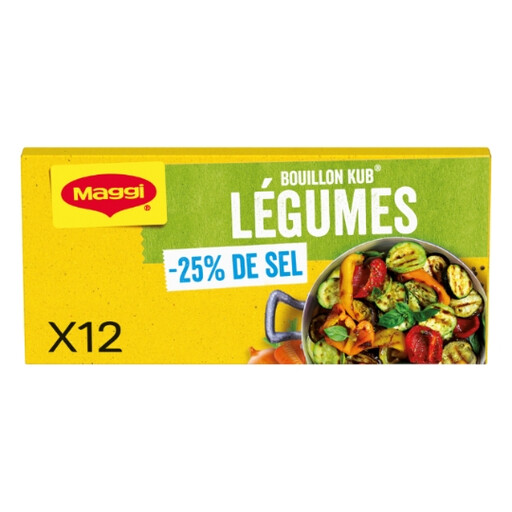 Image unavailable
MAGGI KUB 25% Less Salt Vegetable, 120 g
A handy cube option for seasoning a vegetable lunch or soup at the office. ‘25% less salt’ doesn’t mean ‘no salt’, so check the pack for the amount of salt in your serving and the dilution instructions.
View on Joybuy
Frequently asked questions
Does ‘reduced salt’ mean ‘no salt’?
No. Reduced salt is a comparison, not a claim that the product contains no salt. Knorr France says its reduced-salt vegetable stock contains 25% less salt than the average stock on the market, excluding reduced-salt products, while its ‘no salt’ product page states that it contains 0,02 g of salt per serving. Check the figure and serving size given for the product you choose.
How much stock cube should I use for lunch at the office?
Follow the liquid volume and preparation method on the pack of your stock cube. Before using a whole cube in a small serving, check whether the amount recommended by the manufacturer suits your dish. Taste it before adding any more salty seasoning.
Is reduced-salt vegetable stock automatically suitable for a vegan diet or someone with an allergy?
No. The words ‘vegetable’ or ‘reduced salt’ aren’t enough to confirm that a product is suitable for your dietary requirements. Carrefour France’s product page for the Maggi stock in question lists celery and possible traces of eggs, cereals containing gluten and milk. Read the ingredients and warnings on the pack you buy.
Why should I look at the other foods in my lunch, too?
The salt in the stock cube adds to the salt in the rest of your meal. As the French Health Insurance service reminds us, salt is found in a range of foods. If your lunch already includes bread, cheese, a ready meal or a sauce, compare the servings before choosing your seasoning.


