
Livraison le jour même ou le lendemain

Qualité garantie

Débloquez vos offres de bienvenue: Livraison GRATUITE | Jusqu'à -80 % | 30 jours d'essai gratuits à JoyPlus
Téléchargez l'application
Installing a shelf, a skirting board or a hook without getting the drill out can make a renovation project much simpler. But not all products sold as extra-strong adhesives are created equal, and they aren't all suited to the same surfaces or the same loads. Choose the wrong one, and a no-nails, no-screws fixing adhesive might hold for a few hours, leave marks on the wall, or lose its grip before it has even fully cured.
Here are the most common pitfalls and the criteria to check before you place your order.
Some adhesives hold surfaces together as soon as pressure is applied. That doesn't mean they can immediately support the intended weight. The curing time stated by the manufacturer is still essential, especially for a shelf, a batten or a slightly heavy decorative item.
During this phase, you may need to hold the object in place or prop it up. Removing the temporary support too early is one of the main causes of failure.
An indoor adhesive designed for porous surfaces behaves differently on painted walls, tiles, metal or smooth plastic. Dust, grease, a crumbly surface or moisture can also significantly reduce adhesion.
The claim "no drilling required" doesn't mean you can skip preparing the surface. You need to check the compatibility of both materials, their porosity and the general condition of the surface.
An adhesive intended for heavy objects doesn't automatically replace a mechanical fixing in every situation. The weight, the shape of the object, the contact surface area and the leverage effect all come into play. A loaded shelf puts far more strain on the bond than a flat item simply glued to a wall.
For a heavy object or one installed above a walkway, consult the manufacturer's recommendations and, if necessary, plan for an additional fixing.
For fixing to wood, brick, stone or plaster, check whether the product sheet specifies that at least one of the two surfaces must be porous. This is the case with Pattex No Nails No Screws Fix Extra Strong, designed for indoor use on materials such as wood, brick, stone and plaster.
A painted wall may require extra checks: the adhesive can bond perfectly to the paint, but the overall strength will then depend on how well that paint layer adheres to the surface underneath.
A solvent-free adhesive can be a good choice for limiting odours in a living space. That doesn't mean you can skip ventilating the room or following the safety instructions. In particular, check the recommendations regarding contact with eyes and skin, ventilation and storage out of reach of children.
For a bathroom, kitchen or an installation near a window, a moisture-resistant adhesive will often be more suitable. The water-resistant version of Pattex is stated for both indoor and outdoor use, with resistance to moisture and water according to the manufacturer's information.
Cartridges of 380 g or 450 g are typically used with a suitable gun. They are most relevant for repeated jobs, rather than for hanging a single decoration. Remember to check:
A pack of 3 x 380 g cartridges can be handy for several rooms, fitting skirting boards or a series of battens. It saves you buying a new cartridge for each small job, provided the adhesive is well suited to your surfaces.
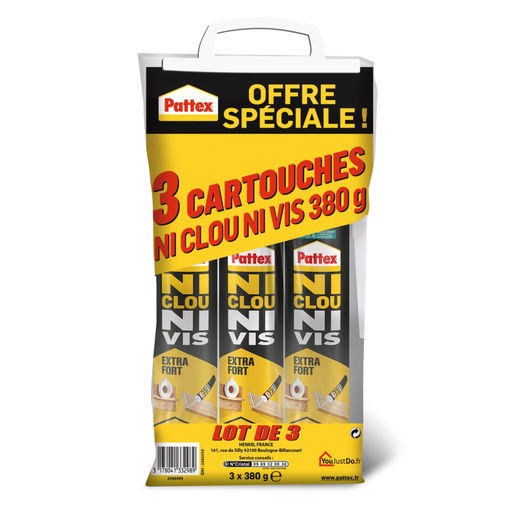
Why this choice suits this profile: This pack of three cartridges is ideal for repeated indoor fitting jobs, such as installing skirting boards, hooks, battens or small shelves.
The product sheet clearly states that one of the two materials must be porous. A useful indication to avoid using it on two perfectly smooth surfaces.
A solvent-free formula, white colour and stated compatibility with wood, brick, stone and plaster indoors.
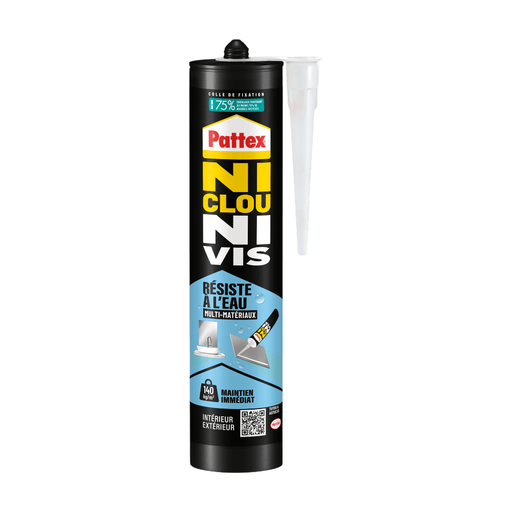
Why this choice suits this profile: This format is aimed at those looking for a versatile fixing solution for decoration and renovation projects across several rooms in the house.
Its product sheet details the usage limitations, notably excluding PE, PP, PTFE, acrylic glass, copper, brass and flexible PVC.
Stated resistance to water, moisture and UV rays, with repositioning possible within the 10 minutes indicated by the manufacturer.
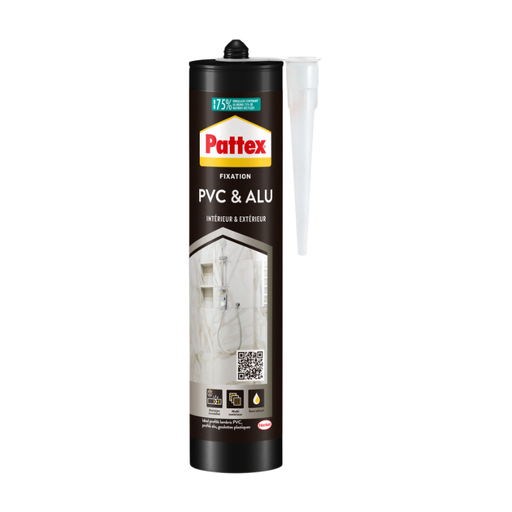
Why this choice suits this profile: This product is designed for jobs involving PVC, aluminium, tiles, metal or plastic, particularly for fitting panels, mouldings and conduits.
Compatibility is detailed material by material, and exclusions, notably PE and PTFE, are stated before application.
A Flextec formula stated to be flexible, usable both indoors and outdoors, with resistance to moisture and temperature variations according to the product sheet.
We've selected a complete, real-time updated list of products that meet these demanding criteria as well as European safety standards.
For walls and ceilings, also check the condition of the coating. If it is peeling, it will bring the object down with it, even if the adhesive itself hasn't lost any of its properties.
It all depends on the weight, the contact surface area, the substrate and the manufacturer's recommendations. An adhesive marketed as extra-strong doesn't automatically mean it can support a heavy load in every situation. For a loaded shelf, distribute the weight and plan for an additional fixing if the situation requires it.
The initial hold and the final strength are two different stages. The time varies depending on the product, temperature, humidity and the materials used. Always follow the time stated on the cartridge. For the water-resistant version shown here, the product sheet states final strength is reached after 24 hours.
A permanent fixing adhesive can leave marks or pull off paint when removed. For temporary decoration, it's better to use a repositionable fixing paste. However, it is not suitable for heavy objects or damp or highly textured surfaces.