
Livraison le jour même ou le lendemain

Qualité garantie

Débloquez vos offres de bienvenue: Livraison GRATUITE | Jusqu'à -80 % | 30 jours d'essai gratuits à JoyPlus
Téléchargez l'application
Fixing a shelf, mirror or decoration without drilling can make DIY jobs much easier, whether you’re a tenant or a homeowner. But not all products sold as no-nail, no-screw fixing adhesive are designed for the same uses.
The first pitfall is relying solely on the stated load capacity. That depends on the surface, temperature, setting time and how the weight is distributed. A tape intended for a light object won’t necessarily suit a letterbox or a shelf.
Another common mistake: overlooking the type of materials. A mounting adhesive may bond to wood or plaster, yet be unsuitable for polyethylene, polypropylene, silicone or a constantly damp surface. Finally, a so-called ‘instant’ fix doesn’t necessarily reach its full strength straight after application.
Compare the stated load with the actual weight of the object, taking into account the length of tape or the number of fixing points. For an ultra-strong double-sided adhesive tape, the load may be given per roll or per strip. For pads, it’s usually expressed per pad, after a specified period.
Surface preparation also plays a decisive role:
Pattex Extra Strong mounting adhesive, for example, is intended for indoor use and requires at least one of the two surfaces to be porous. Its product sheet states a final strength after 24 hours.
Porous surfaces include wood, brick, plaster and certain stones. Glass, metal, tiles and several plastics are non-porous surfaces. A strong indoor/outdoor adhesive based on hybrid polymer can suit a wider range of situations, but it’s still essential to check which materials are excluded.
Some products are not recommended on PE, PP, PTFE, acrylic glass, copper, brass or flexible PVC. This information is far more useful than a simple promise of versatility. For fixing a mirror or a pane of glass, a clear adhesive may also be preferable to a white formula, especially if the joint remains visible.
A permanent fixing suits skirting boards, beading, panels and accessories intended to stay in place for a long time. For temporary decoration, it’s better to opt for a repositionable fixing putty or removable pads.
Pattex putty in pre-cut squares is designed for posters, photos, cards and small, light objects. Fix & Défix pads, meanwhile, are stated to hold up to 2 kg per pad after 24 hours, on a smooth, clean, degreased surface. They are not intended for fragile wallpapers, textured surfaces or surfaces that could be damaged.
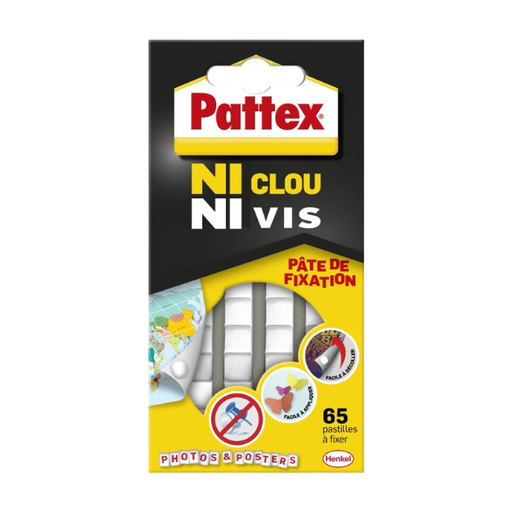
Why this choice suits this profile: A ready-to-use solution for fixing photos, posters or small decorations, without a cartridge gun or any special tool.
Its non-permanent nature means you don’t reach for a strong adhesive for a decoration that will change. The instructions do, however, advise against damp, rough or textured surfaces.
65 pre-cut squares, malleable and repositionable for light objects.
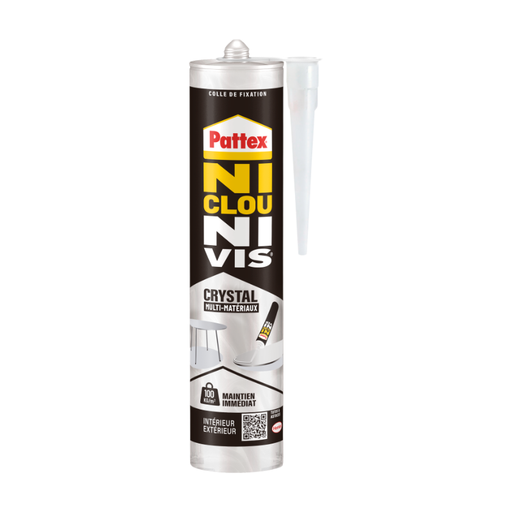
Why this choice suits this profile: Its clear finish is discreet on mirrors, glass and decorative projects where a visible joint would be unsightly.
The product sheet specifies the excluded materials and states that permanent immersion is not suitable. So you need to tell the difference between occasional dampness and continuous contact with water.
Formula stated as solvent-free and odourless, with resistance to UV, moisture and temperature variations from −30 °C to +80 °C.
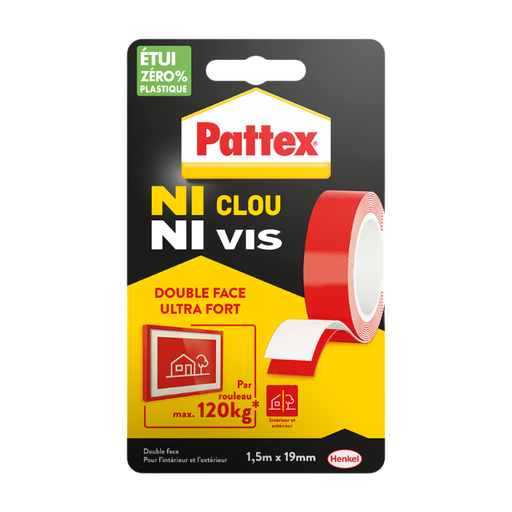
Why this choice suits this profile: The roll format lets you cut the length to suit various assemblies, indoors and outdoors, on compatible surfaces.
The product sheet distinguishes porous from non-porous surfaces and reminds you that surfaces must be clean and dry. The stated load, up to 120 kg per roll, does not mean you can ignore the recommended dosage.
1.5 m × 19 mm format, stated immediate adhesion, resistance to moisture and high temperatures according to the product sheet.
An adhesive doesn’t let you off preparing the surface properly. For painting or renovation work, a multi-function painter’s tool can be used to scrape off residue, remove old sealant or smooth filler. The ROLLINGDOG folding model includes a scraper, filling knife, nail puller and a hammer end. Use it with gloves and safety glasses, and never work on a live electrical installation.
To move a chest of drawers or a table without scratching the floor, furniture glider pads are among the handiest DIY accessories. The Scotch Honeycomb nail-on models come in 19, 22 and 25 mm diameters, with a stated load of 100 to 150 kg for four pads depending on the reference. Choose a diameter that suits the furniture legs and check regularly that no dust has built up under the pads.
Yes, provided the paint adheres well to the surface, is dry, clean and not powdery. First test in an inconspicuous area. Textured or crumbly surfaces, as well as fragile wallpapers, can reduce adhesion or be damaged when removed.
The initial grip can be quick, but maximum strength often takes several hours. Some products specify a 24-hour period. Follow the instructions on the packaging, hold the object in place during application and avoid dynamic loads, such as a piece of furniture that gets pulled or an accessory handled regularly.
Choose a product explicitly intended for outdoor use and check its resistance to moisture, UV and temperature variations. Even a water-resistant adhesive isn’t necessarily designed for prolonged immersion. For a heavy load or an unstable surface, a mechanical fixing will often remain the safest solution.