
Livraison le jour même ou le lendemain

Qualité garantie

Débloquez vos offres de bienvenue: Livraison GRATUITE | Jusqu'à -80 % | 30 jours d'essai gratuits à JoyPlus
Téléchargez l'application
The chore of defrosting, the incessant hum of the compressor, a skyrocketing electricity bill… Choosing a new home appliance is often about putting an end to these hassles. A No Frost fridge-freezer is specifically designed to meet these challenges, promising optimal food preservation without ever building up frost.
This guide breaks down the essential criteria and gives you our practical advice for finding the model that will fit perfectly into your kitchen and your daily life.
Before you start shopping, let's review the technical points that will make all the difference day-to-day.
The ideal format depends primarily on the size of your household and your shopping habits.
The No Frost technology, also known as ventilated cooling, has become the market standard. Its principle? To circulate cold, dry air evenly throughout the appliance to prevent frost formation and ensure a stable temperature. The result: food stays fresh longer, and the chore of defrosting becomes a distant memory.
Paired with an Inverter compressor, this technology helps maintain low energy consumption. The European energy label (from A to G) remains your best guide for comparing the performance of different models.
In a kitchen that opens into the living room, silence isn't a luxury—it's a necessity. A refrigerator is considered quiet when its noise level is below the 40-decibel (dB) mark. Models equipped with an Inverter compressor are often the quietest, as their speed adjusts continuously, avoiding the noisy, abrupt starts and stops. In addition to adding a touch of elegance, a high-quality finish like a stainless steel design is often a sign of superior overall construction, which includes good sound insulation.
Here is our selection of models that caught our attention for their technical specifications and well-thought-out design.
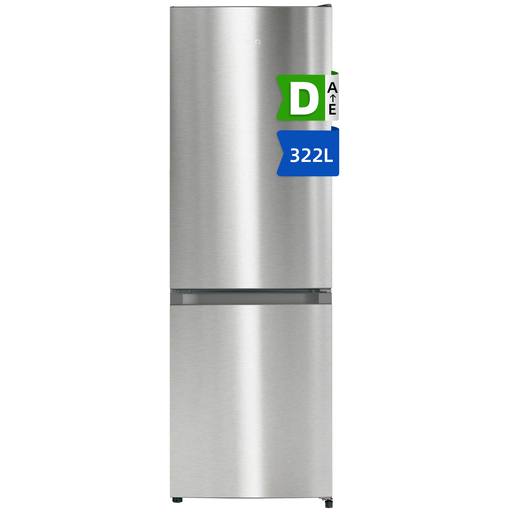
Why it stands out: This model offers an ideal balance between performance and a compact footprint. The Total No Frost technology with a Multi-Airflow system ensures even cold distribution throughout the 226?L fridge and 96?L freezer. Its Inverter compressor ensures quiet operation and low energy consumption.
Advantages:
Who is it for?: The smart choice for couples or small families looking for a reliable, economical, and quiet combi fridge-freezer for daily use.
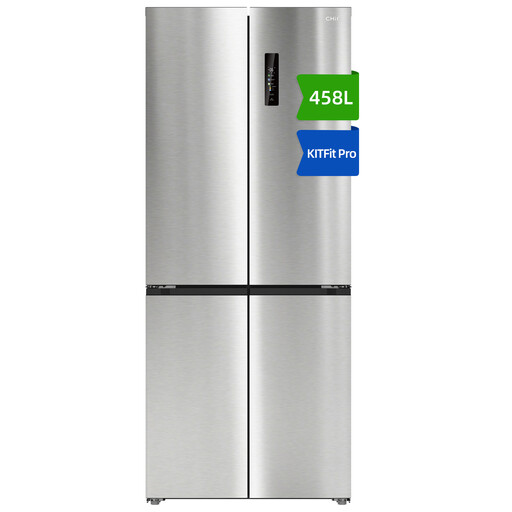
Why it stands out: This model is distinguished by its KITFIT design, which allows it to integrate perfectly into your kitchen (only 4?mm of side clearance required). Its 28?L "Care+ Zone," an independent compartment with three temperature settings (0?°C, 4?°C, 7?°C), offers unprecedented storage flexibility for meats, vegetables, or drinks.
Advantages:
Who is it for?: Ideal for modern households seeking a perfectly integrated stainless steel design and advanced preservation options for their food.

Why it stands out: With its XXL volume of 525 litres (333?L for the fridge and 192?L for the freezer), this American-style refrigerator is designed for large families. It combines generous storage volume with essential technologies like No Frost and Multi-Airflow.
Advantages:
Who is it for?: Perfect for large families and those who love to stock up. It offers maximum refrigeration and freezer space without compromising on quietness or energy efficiency.
Do the models in our selection not check all your boxes? To discover a wider range, including specific products like an insulated freezer cooler, feel free to browse our full catalogue.
Fan-assisted cooling simply uses a fan in the refrigerator section to even out the temperature. The freezer, however, still needs to be defrosted manually. In contrast, ventilated cooling (No Frost) circulates cold, dry air in both compartments (fridge and freezer), which prevents any frost from forming. Say goodbye to the chore of defrosting!
When they first appeared, No Frost models were indeed a bit more energy-hungry. Today, that's a thing of the past. Modern appliances, especially those with an Inverter compressor, feature low energy consumption. Even better: the absence of frost optimises the cooling circuit's performance, which translates into long-term energy savings.
A refrigerator is considered quiet when it's below the 40-decibel (dB) mark. Models that are around 37?dB, like those in our selection, are particularly discreet. They will go completely unnoticed in an open-plan kitchen or a studio apartment.