
Livraison le jour même ou le lendemain

Qualité garantie

Débloquez vos offres de bienvenue: Livraison GRATUITE | Jusqu'à -80 % | 30 jours d'essai gratuits à JoyPlus
Téléchargez l'application
Installing storage without damaging your walls is particularly appealing to tenants, people living in a recently renovated home, and anyone who likes to reorganise their space quickly. But not all no-drill wall hooks are created equal, and they don’t all meet the same demands.
An adhesive hook can work perfectly on a painted, smooth wall, while a suction-cup hook for the bathroom needs a non-porous, completely airtight surface. The weight it can hold, the humidity level, and the removal method can make all the difference between a practical accessory and a purchase that’s soon relegated to the cupboard.
The capacity stated on the packaging usually refers to very specific conditions: a compatible surface, correct application, evenly distributed weight, and a suitable environment. A hook rated for 1.3 kg may not necessarily be able to hold a heavy bag that’s being moved around or a damp bathrobe.
For a towel hook or a bathroom wall hook, allow a margin between the weight of the item and the stated maximum load. Wet fabrics, metal accessories, and items left hanging for several hours put more strain on the fixing.
Rough, porous, dusty, or uneven surfaces reduce adhesion. Wallpaper, certain fragile paints, untreated wood, and textured tiles therefore need special attention.
Suction-cup hooks work best on glass, metal, mirrors, smooth tiles, or acrylic. Adhesive models are often more versatile, but they aren’t automatically suitable for all painted walls.
In a bathroom, steam and splashes can weaken a poorly chosen fixing. Even a hook designed to resist moisture must be installed on a clean, dry surface, following the manufacturer’s instructions.
Another classic mistake: pulling directly on the hook. With a removable adhesive model, the tab usually needs to be pulled slowly, in the direction intended. Mishandling can peel off the paint, even when the product is designed to come away cleanly.
The maximum load should be clearly stated, preferably in kilograms. Compare it to your actual use: keys, tea towel, razor, lightweight towel, bathrobe, or coat don’t all put the same strain on the fixing.
The shape also plays a role. A groove or lip can stop a towel from slipping. A double hook frees up more space, but requires a sufficiently stable fixing. In a hallway, rounded edges reduce the risk of snagging clothes.
A stainless steel or metal hook can easily find its place in a bathroom or kitchen. Be careful not to confuse a finish that looks like stainless steel with a genuine stainless steel construction. In damp rooms, look for a mention of rust or water resistance in the product description.
Plastic, ABS, or models with a TPE suction cup are generally easy to clean. In all cases, choose a soft cloth and a mild soap over abrasive products.
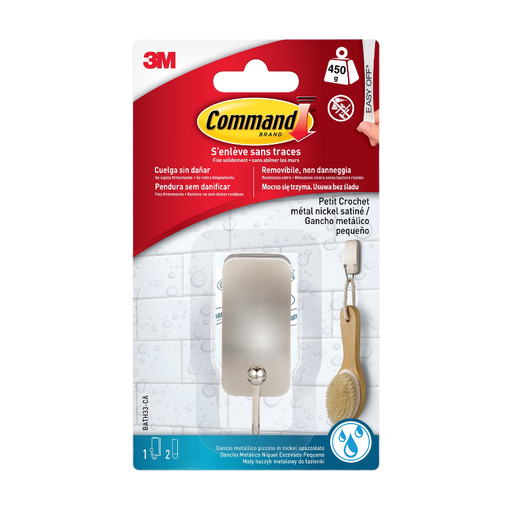
Why this choice suits this profile: this compact adhesive hook is ideal for small items in a bathroom or kitchen. It installs without tools on a smooth, dry surface.
Its stated load of 0.450 kg clearly limits overambitious uses. The description recommends smooth surfaces and advises against textured or uneven supports.
Satin nickel finish, stated water and rust resistance, with adhesive strip included.
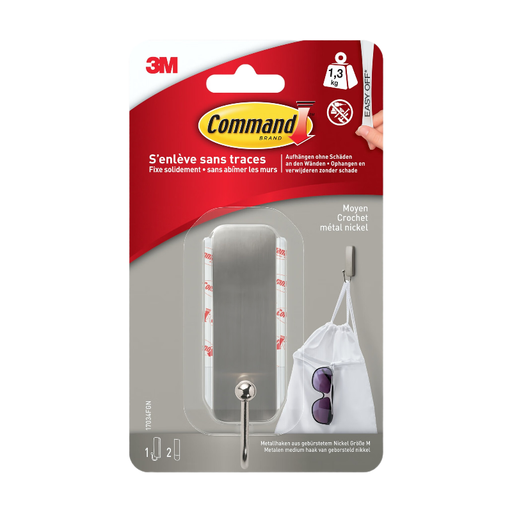
Why this choice suits this profile: its nickel-plated metal hook fits easily into a hallway, bathroom, or kitchen where aesthetics matter as much as a no-drill installation.
The stated capacity is 1.3 kg: it helps you gauge the use rather than relying on a vague promise of strong adhesion.
Nickel-plated metal, tool-free installation, and removal stated to leave no holes or sticky residue.
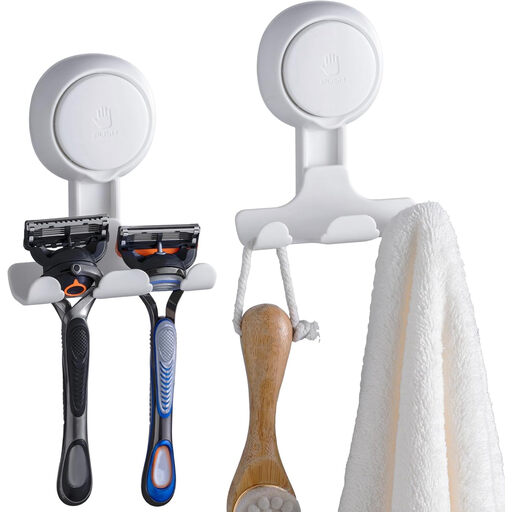
Why this choice suits this profile: these two holders are designed for storing razors, sponges, shower heads, or small towels in a shower fitted with smooth tiles, glass, or stainless steel.
The description specifies incompatible surfaces: painted walls, porous surfaces, untreated marble, and uneven tiles. Drainage holes limit water stagnation.
Repositionable suction cup, design combining metal, stainless steel, plastic, and TPE, with a stated load of up to 11 lb, approximately 5 kg.
We’ve put together a comprehensive, real-time updated selection of products that fully meet these demanding criteria and European safety standards.
To preserve a bathroom storage solution, do not exceed the stated load and do not hang fragile items above a walkway or a sink.
Yes, some models are designed for painted, smooth walls. The paint must be sufficiently stable, clean, and dry. Avoid freshly painted, crumbly, or textured surfaces, as well as wallpaper, unless the instructions explicitly say otherwise.
It can work on smooth tiles, glass, or stainless steel, provided the surface is non-porous, clean, and dry at the time of application. Condensation, uneven grout, and textured tiles can reduce the hold. Check the fixing before any heavy use.
It all depends on the material, humidity, weight, and surface preparation. An adhesive strip can stay in place as long as it retains its grip, while a suction cup can be removed and repositioned. Regular checks are still useful, even when the product is described as removable.