
Livraison le jour même ou le lendemain

Qualité garantie

Débloquez vos offres de bienvenue: Livraison GRATUITE | Jusqu'à -80 % | 30 jours d'essai gratuits à JoyPlus
Téléchargez l'application
No-drill wall hanging meets a very practical need: decorating a rented home, putting up a whiteboard in the office or hanging a mirror without getting out the drill. But not every solution is suitable for every wall or every load.
Before buying a wall hook for a heavy item or a nail- and screw-free wall fixing, check three things: the type of wall, the actual weight of the item and how the fixing is removed. The wrong choice could lead to a fall, adhesive marks or a patch of paint being pulled off.
A claim such as ‘holds up to 30 kg’ refers to the maximum limit stated by the manufacturer, under specific conditions. It doesn’t mean that a hook will automatically suit every wall or every item weighing 30 kg.
Weigh the frame, mirror or shelf with its accessories. Allow a reasonable safety margin too, and take movement into account: a coat that’s taken off several times a day puts more strain on a fixing than a picture that stays completely still.
Command adhesive strips are mainly designed for smooth, clean and dry indoor surfaces. They may work on paint that’s firmly bonded, glass, metal, tiles or certain laminates. Wallpaper, powdery walls, rough or damp surfaces, and freshly painted walls, however, can greatly reduce their grip.
On plasterboard, a plasterboard hook with metal claws may be more suitable than an adhesive strip, provided you follow the stated capacity and check the condition of the wall.
A removable wall fixing helps avoid holes and residue, but preparation is still essential. Clean the surface as directed on the packaging, allow the recommended waiting time and remove the product slowly, in the direction indicated. Never pull an adhesive strip off sharply.
For damage-free picture hanging, also check that your frame is compatible with the chosen system and that the fixing points distribute the load properly.
Start by working out what you need before comparing products:
For a large or heavy item, you may need two hooks. In every case, the load must stay within the limits stated for the model and the surface it’s being used on.
On plasterboard, the hardened steel claws of the 3M CLAW hook push directly into the wall when pressed with your thumb. This tool-free installation avoids the need for conventional wall plugs, but it’s only suitable for compatible drywalls.
On a smooth, painted surface, adhesive strips may work for no-drill picture hanging. They generally need to be positioned accurately, pressed firmly and left for a while before you hang anything.
A removable system should come off without needing to twist it excessively. For adhesive strips, pull the tab slowly downwards, parallel to the wall, following the instructions. For a claw hook, use the removal method provided and don’t reuse it unless the manufacturer says you can.
A tool-free installation doesn’t mean you can skip regular stability checks, especially in a hallway, a child’s bedroom or a busy workplace.
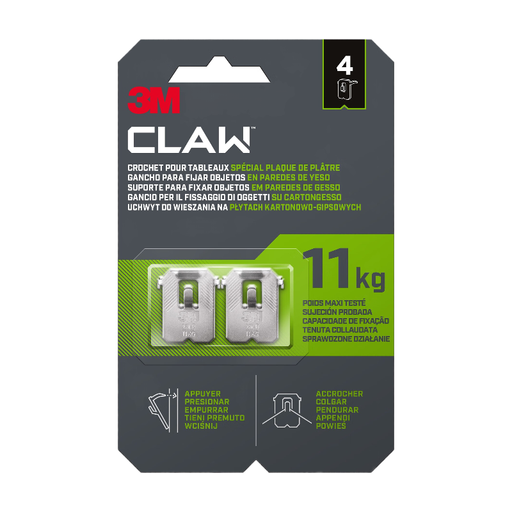
Why this is a good fit for this type of user : This pack of four hooks lets you hang several items on plasterboard, including frames, pictures and objects weighing up to 11 kg, according to the product information.
Its stated capacity and suitable surface are clearly defined: this isn’t an adhesive product to use indiscriminately on every wall.
Hardened steel claws, installation with a simple press of the thumb and four hooks in the pack.
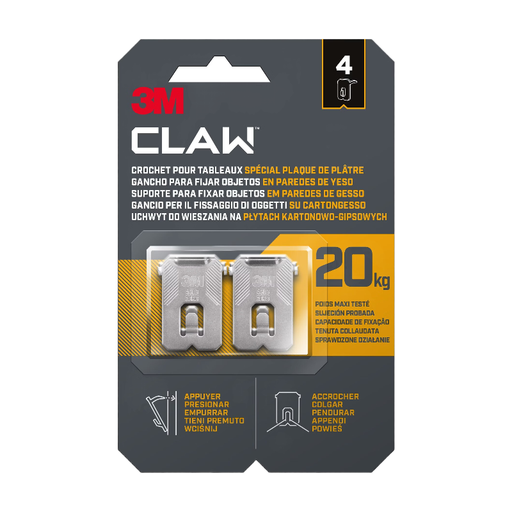
Why this is a good fit for this type of user : This pack suits more demanding decorating projects on drywalls, including large pictures, mirrors or wall displays weighing up to 20 kg, according to the product specifications.
The stated maximum load makes it easier to compare a solution designed for heavy items, without relying solely on the ‘no nails or screws’ promise.
Stated capacity of up to 20 kg, four metal hooks and tool-free installation.
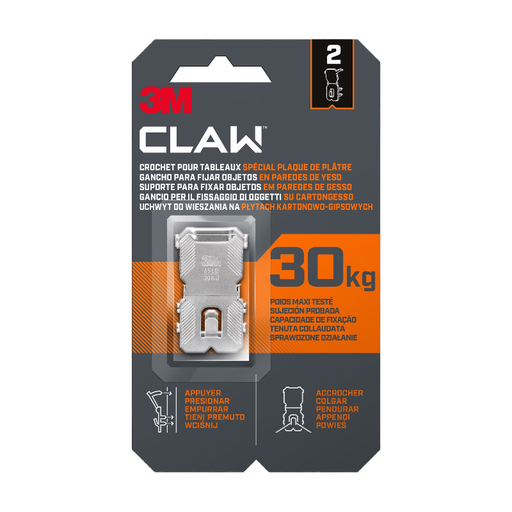
Why this is a good fit for this type of user : These two hooks are designed for large decorative items on plasterboard, with a stated capacity of up to 30 kg when installed on a suitable surface and in line with the instructions.
Two hanging points distribute the load more evenly than a single hook, while keeping installation tool-free.
Two metal hooks and a stated capacity of up to 30 kg for heavy decorations.
We’ve put together a comprehensive, real-time list of products that meet these strict selection criteria and the requirements of European safety regulations.
Yes. Some solutions are designed for drywalls, including metal claw hooks. However, check the maximum load, the condition of the wall and the instructions. For a very heavy item or one that’s likely to be knocked frequently, a traditional fixing may still be preferable.
It depends on the surface, temperature, humidity, weight supported and whether the installation instructions have been followed. There’s no universal duration that applies to every product. Check the fixing regularly and replace it as soon as it starts to peel away or shows signs of wear.
On a smooth, clean and dry wall, removable strips may be suitable for a lightweight or medium-weight frame. On plasterboard, you could consider a 3M CLAW hook if the load and wall match the product specifications. In every case, keep the instructions and, where possible, test compatibility on an inconspicuous area.