
Livraison le jour même ou le lendemain

Qualité garantie

Débloquez vos offres de bienvenue: Livraison GRATUITE | Jusqu'à -80 % | 30 jours d'essai gratuits à JoyPlus
Téléchargez l'application
Hanging a picture frame, mirror or towel without reaching for the drill is particularly appealing to tenants, students and home décor enthusiasts. But a no-drill wall fixing that’s poorly chosen can peel off, leave marks or fail to support the advertised weight.
Before buying removable fixing strips or a wall hook, check three essential points: the surface, the actual weight of the object and the removal method. Here are the criteria to examine to avoid nasty surprises.
The load stated on the packaging usually corresponds to an installation carried out under the conditions specified by the manufacturer. It can depend on the number of strips used, the size of the support, the temperature or even the condition of the wall.
A 6 kg frame, for example, should not be hung with a fixing rated for 7 kg without keeping a safety margin. For a fixing for pictures and mirrors, take into account the weight of the frame, the glass and any accessories.
Adhesive strips are best suited to smooth, clean and dry surfaces, such as well-adhered paint, glass, tiles or metal. They are generally less suitable for wallpaper, rough walls, fragile paints or dusty surfaces.
A hook advertised as moisture-resistant does not automatically become suitable for a constantly wet wall. In a bathroom, choose a product explicitly designed for humid environments.
A removable fixing strip often needs to be removed by pulling slowly on the tab, in the direction indicated. Pulling it towards you or ripping the support off risks damaging the paint. Read the instructions before fitting and make sure the tabs remain accessible.
For a damage-free wall fixing, clean the area with a product compatible with your wall covering, then let it dry completely. Avoid placing a strip on a freshly painted surface until the paint is sufficiently dry and stable.
In a kitchen or bathroom, choose a water-resistant adhesive hook designed for humid rooms. For a bedroom or living room, standard strips can work if the wall is smooth and indoors.
The stated capacity is not enough: also check the size of the fixing. Small and medium strips are suitable for light or moderately heavy items, while XL models are intended for heavier objects.
For a mirror or large picture, distribute the load across several points. A two-hook system can also improve stability. Products supporting up to 30 kg should only be used on the specified surface, with an object whose weight remains below the stated limit.
Adhesive strips are discreet and practical on smooth surfaces. Plasterboard hooks, on the other hand, use metal claws that penetrate slightly into the surface. They can be more suitable for heavy objects, but are not suitable for all walls.
Before choosing a no-drill picture hanger, identify your wall: plasterboard, painted concrete, tiles, varnished wood or wallpaper. A fixing designed for a dry partition should not be considered universal.
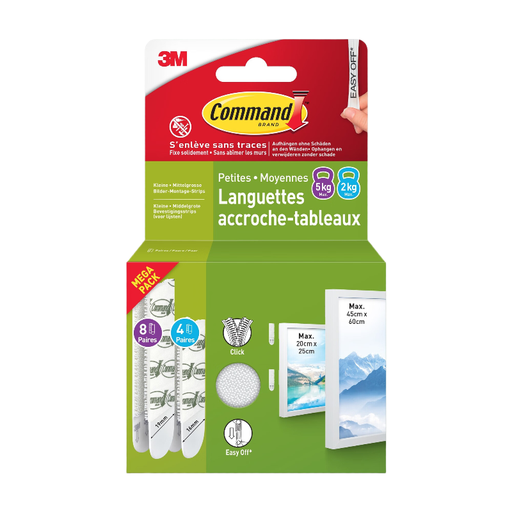
Why this choice suits this profile: This pack includes four small pairs and eight medium pairs, allowing you to complete several installations in a student or family home.
The different sizes reduce the risk of using an oversized strip or, conversely, one that is insufficient for a small white picture frame.
A practical multipack, removable strips and a design intended for smooth indoor surfaces.
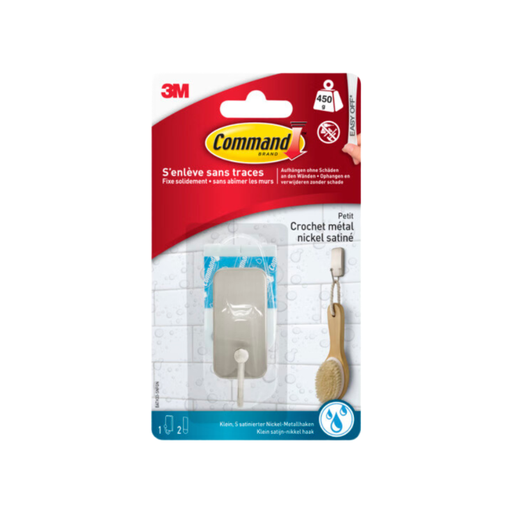
Why this choice suits this profile: Its satin nickel finish blends easily into an entrance hall, bathroom or kitchen where aesthetics matter as much as organisation.
The product page specifies the usage limits: the hook must not be placed on wallpaper, a textured surface or an unpainted wall.
A double hook, water-resistant adhesive and a stated capacity of up to 2.2 kg.
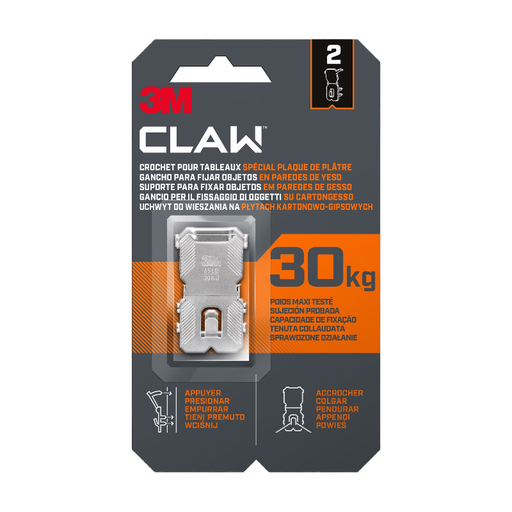
Why this choice suits this profile: This model is aimed at those who want to hang a mirror, a large picture or a heavy decoration on plasterboard.
It is not a universal adhesive: its hardened steel claws are designed for a dry partition. The type of surface must therefore be checked before installation.
A stated capacity of up to 30 kg, thumb-press installation and tool-free fitting, according to the product page.
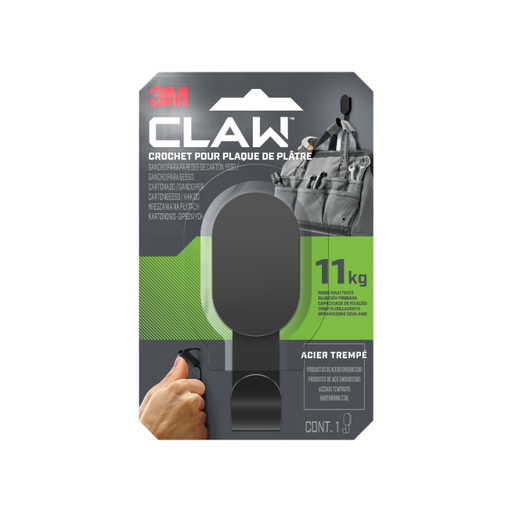
Why this choice suits this profile: It is suitable for coats, bags, towels or moderately heavy frames when the wall is a dry partition.
The 11 kg capacity is clearly stated: it is impossible to randomly choose an adhesive strip for an object that is too heavy.
Hardened steel claws, tool-free installation and stated indoor use on plasterboard.
For a decorative metal hook, such as the Flare Hook Sand, the product page states a maximum load of 5 kg when correctly installed. This model is fixed with screws: it is therefore not a strictly adhesive, no-drill solution.
We have compiled a comprehensive list, updated in real time, of products that fully meet these strict selection criteria and European safety regulations.
Yes, some products are designed for plasterboard. However, you need to distinguish between adhesive strips and claw hooks. Models like the 3M CLAW are specifically intended for dry partitions. Always respect the stated load and check the condition of the wall.
It all depends on the surface, the weight of the object, humidity, temperature and the quality of the installation. There is no universal duration. Regularly inspect the fixing if the object is heavy or placed in a high-traffic area.
It can be suitable if the product is designed for that load and for the surface in question. For a large mirror, choose several fixing points, keep a margin relative to the stated capacity and check that the wall has no cracks or peeling paint.