
Livraison le jour même ou le lendemain

Qualité garantie

Débloquez vos offres de bienvenue: Livraison GRATUITE | Jusqu'à -80 % | 30 jours d'essai gratuits à JoyPlus
Téléchargez l'application
A no-drill shower shelf lets you store shampoos, shower gels and accessories without reaching for the drill. It’s a particularly handy solution for tenants, students, travellers and anyone who’d rather avoid making holes in their walls. That said, you still need to choose a model that suits the surface, the weight it’ll carry and its exposure to water.
Before buying a suction-cup shower caddy or an adhesive shower shelf, it’s worth checking a few key points.
A suction cup only holds properly on a smooth, clean, non-porous surface. Uneven tiles, grout, painted walls, wallpaper or textured panels can all compromise adhesion. A fixing that works perfectly on a glass screen won’t necessarily give the same result on old ceramic tiles.
For a screwless shower storage solution, always check the compatible surfaces listed in the product description.
The maximum load stated usually applies to an installation carried out correctly on a suitable surface. It doesn’t guarantee the caddy will hold the same weight if it’s placed on grout or a dusty wall. And large bottles filled with water quickly become heavy.
Distribute your products evenly and keep the most accessible compartments for everyday items.
A shampoo caddy without effective drainage traps water underneath the bottles. Cleaning becomes more fiddly and residue builds up more easily. Go for models with plenty of drainage holes, a sloped base or an openwork structure.
A suction-cup shower caddy can be put up quickly and repositioned without leaving sticky marks, provided you stick to the recommended surfaces. It’s generally suitable for glass, polished metal, stainless steel, acrylic and certain smooth tiles.
An adhesive shower shelf can take over when suction cups aren’t suitable. However, do check the application time, the waiting period before first use and compatibility with your wall. “No drill” doesn’t necessarily mean removable, nor compatible with every surface.
In a wet room, compare materials and how easy they are to maintain:
Whatever the material, regular cleaning and proper drying are still essential.
Measure the width of your wall and the available depth before choosing a bathroom shelf. In a small shower enclosure, a corner shelf can free up walking space. For a family, two separate caddies make it easier to divide products between different users.
Dimensions given in inches should be converted to centimetres if needed. Also check the gap between shelves and whether the lip is high enough to stop bottles falling off.
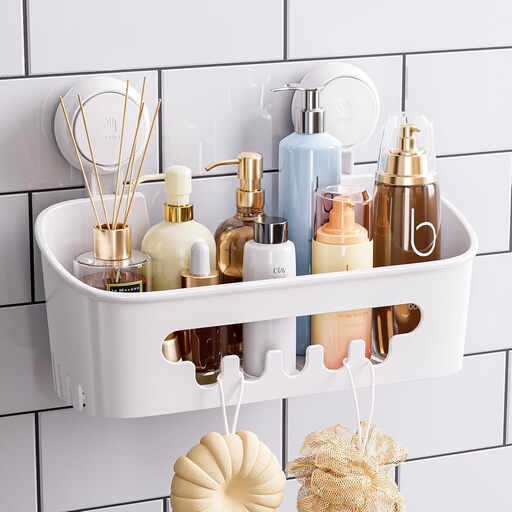
Why this choice suits this profile: This simple model is ideal for a first installation in a bathroom, studio or student room, with no screws or tools needed.
Its 22 drainage holes and sloped base reduce water pooling. The suction cups must, however, be placed on a smooth, non-porous surface.
An ABS caddy with TPE suction cups, a stated capacity of up to 22 lb and repositionable if you follow the instructions.
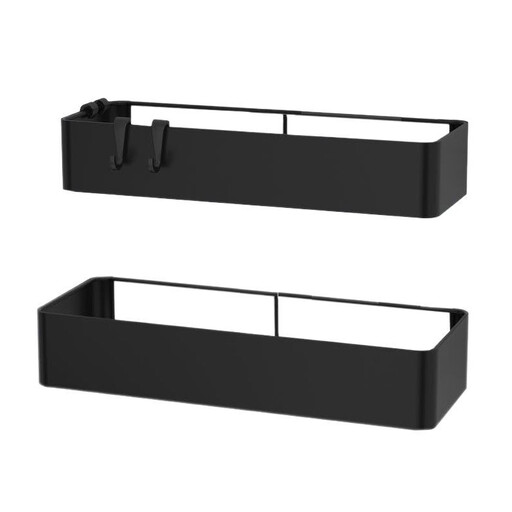
Why this choice suits this profile: Its two shelves, 38.6 cm and 40 cm, let you organise your products with a neater, more structured look.
The product description mentions a rust-resistant iron design. Nevertheless, check the fixing system supplied and, if needed, install the shelves away from direct splashes.
Two different lengths and a claimed rust-resistant treatment for storing several products.
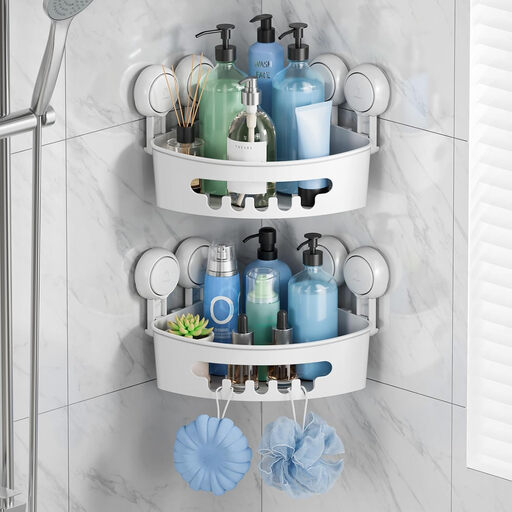
Why this choice suits this profile: Its corner design makes use of an area often left empty in a family shower enclosure or a busy wet room.
Its shape is designed for a 90° corner, not just any wall. By matching the geometry of your shower, you reduce the risk of an unstable installation.
Two caddies, peripheral drainage and a stated capacity of up to 22 lb per caddy, provided the installation conditions are met.
We’ve put together a comprehensive, up-to-date selection of products that meet these demanding criteria, while also taking European safety regulations into account.
To prevent the shelf coming loose and make your storage last longer:
How long it lasts depends on humidity, the weight placed on it, the quality of the surface and how often it’s handled. If the grip weakens, empty the caddy and check the fixing rather than immediately adding more weight.
No. Suction cups generally need a smooth, flat, non-porous surface. Wide grout lines, textured tiles and porous coverings significantly reduce adhesion. Always refer to the manufacturer’s recommendations.
There’s no universal lifespan. How well it holds depends on the surface, how often it’s cleaned, its exposure to water and the weight it carries. Regular maintenance and a well-distributed load reduce the risk of it coming off.
A corner bathroom shelf lets you make use of 90° angles without taking up as much walking space. For installation on a straight wall, go for a shallow caddy with a generously openwork base.