
Livraison le jour même ou le lendemain

Qualité garantie

Débloquez vos offres de bienvenue: Livraison GRATUITE | Jusqu'à -80 % | 30 jours d'essai gratuits à JoyPlus
Téléchargez l'application
A no-drill shower shelf lets you store shampoos, shower gels and accessories without touching the walls. It is a particularly practical solution for tenants, students, travellers and anyone who wants to reorganise their bathroom without taking on renovation work.
You still need to choose a model that suits your surface. A suction cup can lose its grip, a poorly designed caddy can trap water and a shelf that is too small may become unusable after just a few weeks. Before ordering, check three essential points: the type of wall, water drainage and the load capacity that genuinely suits your needs.
A no-drill shower organiser generally works on smooth, non-porous surfaces: even tiles, glass, mirrors, polished metal, stainless steel or acrylic. By contrast, grouting, uneven tiles, painted walls, wallpaper and textured surfaces can prevent proper adhesion.
The wording “screw-free installation” therefore does not guarantee that the caddy will hold on a raised or porous surface. Always check compatibility with your surface before placing your order.
The maximum load specified by the manufacturer depends on very specific conditions: a suitable surface, a suction cup pressed down correctly and weight distributed evenly. Full bottles often weigh far more than you might expect. You should also avoid placing a heavy item on the edge of the caddy, as this creates leverage that puts considerable strain on the fixing.
A closed or poorly ventilated caddy allows water to collect beneath your products. Cleaning then becomes more difficult and deposits build up more quickly. For a shampoo and shower gel caddy, choose a perforated base, a slight incline or enough openings to help water drain away.
For a suction-cup shower caddy, start by examining the available wall space. A corner model can be very practical in a cubicle with a 90° corner, but much less suitable for a flat surface or a rounded corner. Suction cups should be positioned away from grouting, on a clean, dry and completely degreased area.
Installation generally involves positioning the suction cup, then pressing firmly to expel the air. Once the caddy is attached, check that it is stable before placing bottles inside. A removable fixing is convenient for cleaning or moving home, but it must be repositioned in accordance with the manufacturer’s recommendations.
Measure the available width and depth before choosing a bathroom shelf. A caddy that is too deep can restrict movement in a small shower. Conversely, a shelf that is too narrow will only hold a few bottles.
For one person, a compact caddy may be perfectly adequate. A couple or family will generally benefit from distributing products across several levels or between two caddies. Also remember to check the number of compartments and the available height for conditioner or shower gel bottles.
ABS and TPE are commonly used for plastic caddies and their suction cups. ABS provides a lightweight, rigid structure, while TPE is generally used for the flexible parts of the fixing. For a rust-resistant stainless-steel shelf, however, examine the product details carefully: the word “stainless steel” alone does not describe the entire construction or the finish of every component.
A moisture-resistant material does not eliminate the need for regular maintenance. Removing soap residue, rinsing the caddy and allowing it to dry helps limit build-up and extend its lifespan.
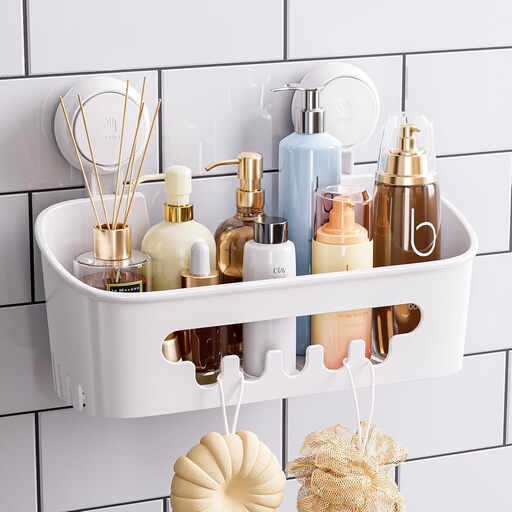
Why this choice suits this profile : This wall-mounted caddy is ideal for anyone looking for quick installation without screws, nails or glue. Its size accommodates everyday shower products and it can be removed without leaving residue, provided it is installed on a compatible surface.
Its 22 drainage openings and sloped base help prevent water from collecting. The product details state a maximum load of 22 lb, approximately 10 kg : it is best not to exceed this.
An ABS caddy, two TPE suction cups, removable parts for cleaning and installation in one second on a smooth surface, as stated.
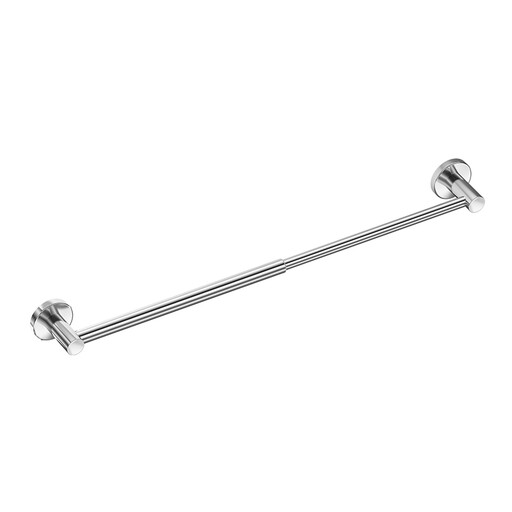
Why this choice suits this profile : With its silver finish, this adjustable shelf will appeal to anyone looking for understated, versatile bathroom storage.
Its adjustable design lets you tailor the storage to the available space, rather than relying on a fixed-size shelf without measuring the shower first.
The product details mention stainless-steel construction, an adjustable design and a brushed silver finish.
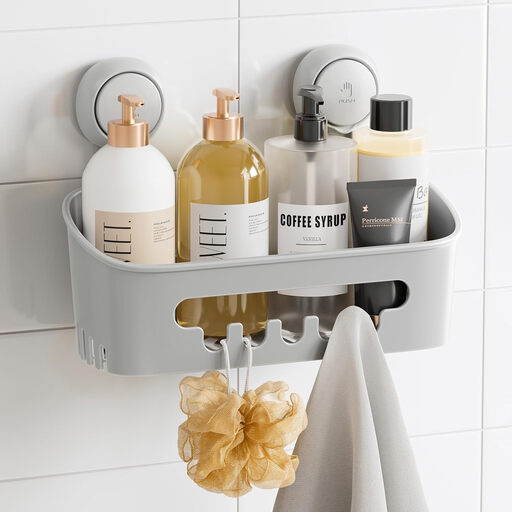
Why this choice suits this profile : With its two caddies, this model is suitable for families, house shares and anyone who prefers to keep toiletries separate from accessories such as sponges or razors.
The separate caddies prevent bottles from being stacked and make everyday access to your products easier. The drainage holes help reduce water retention, provided the whole unit is cleaned regularly.
Two ABS caddies, four TPE suction cups in total according to the product details, a stated capacity of 22 lb per caddy and a removable structure.
We have put together a complete, real-time updated list of products that fully meet these strict selection criteria and European safety regulations.
To prevent it from coming loose, follow these steps:
If the grip weakens, clean the suction cup with warm water, dry it thoroughly and reinstall it on a smooth surface. A suction cup should never be used on a surface excluded by the product details.
The fixing is generally more reliable on the smooth part of the tile than on the grout. Grouting is often uneven or porous, which can reduce adhesion. Look for a sufficiently large, continuous area before choosing where to place the caddy.
It depends on the material, exposure to water, supported weight and maintenance. A caddy that is cleaned regularly and used within its maximum load capacity will generally remain functional for longer than an overloaded model installed on an unsuitable surface. The manufacturer’s recommendations remain the key reference.
Suction-cup models are designed to be removed and repositioned without glue. However, detach the fixing carefully, clean the surface and check that the suction cup is still clean before putting it back in place. Adhesive systems may follow different rules, so always consult the relevant instructions.