
Livraison le jour même ou le lendemain

Qualité garantie

Débloquez vos offres de bienvenue: Livraison GRATUITE | Jusqu'à -80 % | 30 jours d'essai gratuits à JoyPlus
Téléchargez l'application
Hanging a picture, mirror or towel without getting the drill out is particularly appealing to renters, students and anyone who loves decorating. But not all no-drill wall-fixing solutions are created equal, and they won’t all work with every wall or item. An incorrectly sized adhesive strip can eventually come unstuck, while a hook designed for tiles may not hold securely on uneven paintwork.
To avoid any unwelcome surprises, check three things before you choose: the item’s actual weight, the type of surface and how the fixing can be removed. Here are the points to consider before buying adhesive picture strips, self-adhesive wall hooks or a nail-free wall fixing.
A stated maximum load doesn’t mean that any item of that weight can be hung on any wall. The load needs to be distributed properly across the strips or hooks. A heavy, deep or frequently handled picture puts more strain on a fixing than a flat decoration that never moves.
For a picture, weigh the whole thing, including its frame and any accessories. Allow a safety margin and follow the limit on the packaging to the letter. Don’t choose a fixing for heavy pictures just because its load rating looks high.
Adhesives designed for damage-free fixing are generally intended for smooth, clean, dry and stable surfaces. Depending on the product, they may work on painted walls, glass, metal, laminate and some tiles. Wallpaper, textured surfaces, dusty walls, untreated wood and freshly painted surfaces call for extra care.
Dust, grease and moisture can all affect adhesion. So, in a bathroom, an adhesive hook installed right next to a water supply may not hold as securely as it would in a dry room.
Removable strips are generally removed by pulling the tab slowly in the direction specified by the manufacturer — often downwards. Pulling the hook towards you or tearing off the strip can damage the paint. Read the instructions carefully before fitting, and test the fixing in an inconspicuous spot if the surface seems fragile.
For a no-drill picture hanging solution, check the maximum load per pair or per hook, as well as the recommended dimensions. Some products specify a load alongside a frame size, for example, up to 450 × 600 mm for a medium size or up to 600 × 900 mm for a large size.
Larger pictures are generally best secured at several points, distributed around the corners. For a lightweight decoration, self-adhesive hooks may be enough. For a bulky item, make sure the system also helps prevent it from tipping.
Before fitting an adhesive wall fixing, clean the area with a suitable product and let it dry completely. Avoid cleaners that leave a greasy film. Don’t apply strips to a freshly painted wall until the paint has fully cured, or to a damp surface.
Choose towel hooks and fixings for kitchens or bathrooms according to whether they’re compatible with tiles, glass or stainless steel. A suction cup, for example, works best on a perfectly smooth, non-porous surface.
Stainless steel can be a good choice for damp environments, while an adhesive plastic hook is often more discreet and lightweight. For a decorative hook, check its dimensions and how far it sticks out, so it won’t get in the way.
Finally, distinguish between repositionable systems and strips that need replacing. Some sets let you remove a picture and put it back using new strips. However, the tabs supplied aren’t necessarily reusable.
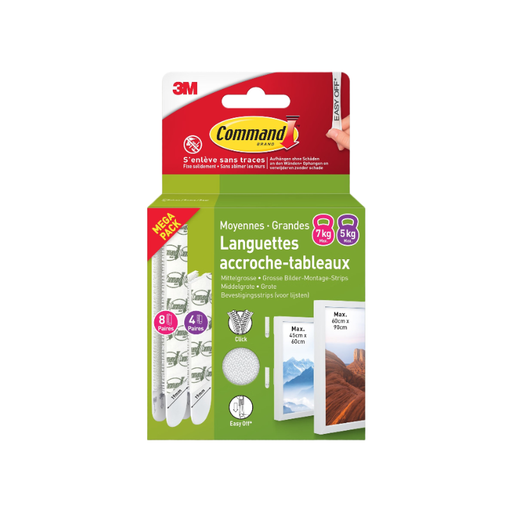
Why it suits this need : This pack includes several sizes, so you can hang pictures of different sizes around your home without having to buy several separate products straight away.
The load capacity varies by size: up to 5 kg for the medium strips and 7 kg for the large ones. This distinction makes it easier to choose the right size.
The pack contains 4 medium pairs and 8 large pairs. The product listing says they can be used on several smooth indoor surfaces and removed without leaving residue when the instructions are followed.
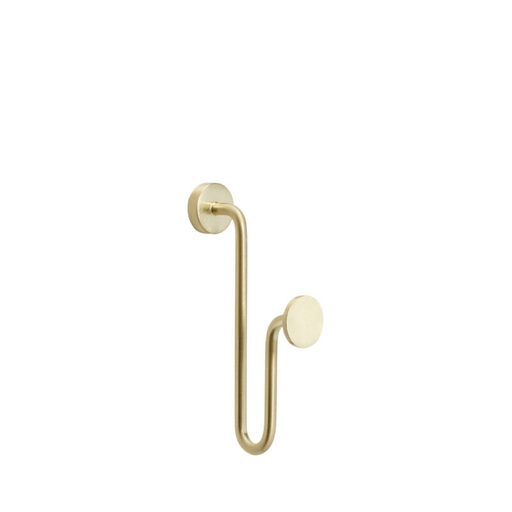
Why it suits this need : Its brass finish and compact design fit right into a hallway, kitchen or bathroom, where the fixing itself can also add a decorative touch.
The product listing recommends it for lightweight items. This helps prevent you from choosing it by mistake for a heavy picture.
This iron hook with a brass finish measures 7 × 2,5 × 13 cm and weighs 80 g. It’s suitable for keys, small bags, utensils and lightweight towels.
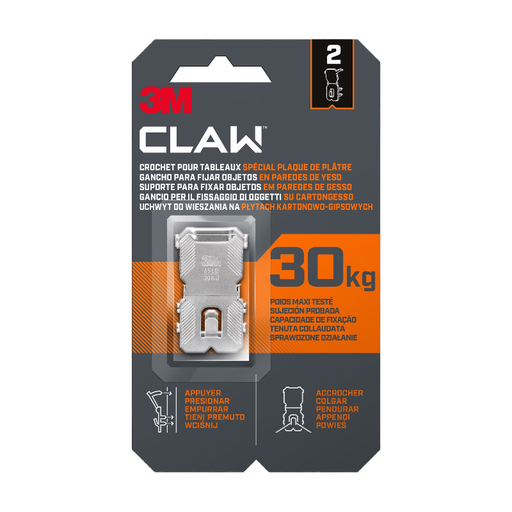
Why it suits this need : This system is designed for plasterboard walls and heavier items, when adhesive strips aren’t suitable because of the weight or texture of the surface.
This isn’t an adhesive fixing: its hardened steel claws go directly into the plasterboard. So, check that your wall is a dry-lined partition before fitting it.
The stated capacity is up to 30 kg with two hooks. Fit it without tools by pressing the hooks into the plasterboard, following the manufacturer’s instructions.
We’ve put together a comprehensive selection, updated in real time, of products that meet these demanding criteria and European safety requirements.
Start by weighing the picture, then check the maximum load stated for the fixing you’re considering. Adhesive strips are best suited to smooth surfaces and pictures that weigh less than the stated limit. For a heavy load on plasterboard, a specialist hook such as the 3M CLAW system may be a better choice. Never use a fixing above its maximum capacity.
Clean and dry the surface, apply the strips according to the diagram provided, then press firmly for the recommended time. Wait for the stated period before hanging the item. Fitting strips to wallpaper, a damp wall, fresh paint or a rough surface is generally not recommended unless the manufacturer says otherwise.
It depends on the weight they support, the temperature, humidity, surface and how often they’re handled. A hook holding a lightweight towel in a dry room will be under less strain than one fitted in a steamy bathroom. Check the adhesion regularly and replace the product as soon as it starts to come unstuck, becomes misshapen or shows signs of wear.