
Livraison le jour même ou le lendemain

Qualité garantie

Débloquez vos offres de bienvenue: Livraison GRATUITE | Jusqu'à -80 % | 30 jours d'essai gratuits à JoyPlus
Téléchargez l'application
Want to keep your bathroom, hallway or kitchen tidy without getting out the drill? A no-drill adhesive wall hook can be an excellent solution, provided you choose a model suited to the surface, the weight you want to hang and the level of humidity.
However, choosing too quickly can leave you with a hook that comes unstuck, paint that has been pulled off or an accessory that is unusable after just a few weeks. Here are the key points to check before comparing the available models.
A maximum capacity of 2,2 kg does not mean that any 2,2 kg object can be hung without taking precautions. The load must be distributed properly and the fixing installed on a compatible surface. A fully packed bag, damp towel or wet dressing gown can also exert more pulling force than its dry weight.
For a small accessory, a heavy-duty wall hook is not necessary. Conversely, a model limited to 450 g will not be suitable for a coat or several towels.
Adhesive fixings generally work on smooth, clean and dry surfaces, such as tiles, glass, certain painted walls, painted wood or metal. Grainy, porous, dusty, textured or wallpapered walls offer considerably less predictable adhesion.
A hook for painted or tiled walls should therefore be chosen according to the wall’s exact finish. Matt, delicate or recently applied paint requires particular care.
In a bathroom, steam and water splashes can reduce the hold of an adhesive that is not designed for this environment. It is better to look for a humidity-resistant bathroom hook and observe the setting time specified by the manufacturer before hanging anything from it.
Removal should also follow the recommended method. Pulling the hook towards you instead of slowly pulling the strip parallel to the wall increases the risk of damaging the surface.
Start by defining how you intend to use it:
An adhesive towel hook may be suitable for a bathroom, but only if the stated capacity covers the weight of the wet towel and the surface is suitable.
A Command adhesive hook can be installed without nails or screws on certain smooth surfaces. Clean the wall in accordance with the manufacturer’s recommendations, dry it completely, then press firmly on the adhesive strip. Avoid tile joints, crumbly walls and areas exposed to high heat.
On plasterboard, a claw hook such as the 3M CLAW belongs to another category of no-nail wall hook. It does not require screws, but its claws penetrate the plasterboard, so it is not technically a hole-free hook.
Translucent plastic remains discreet in a humid room. Nickel-plated or chrome-plated metal offers a more decorative finish, while coloured iron fits easily into contemporary décor.
A decorative wall hook should also be deep enough to prevent the item from slipping off. In a hallway, several hooks spaced apart can create a practical wall storage accessory. In a bedroom, choose a compact size for lightweight clothing and bags.
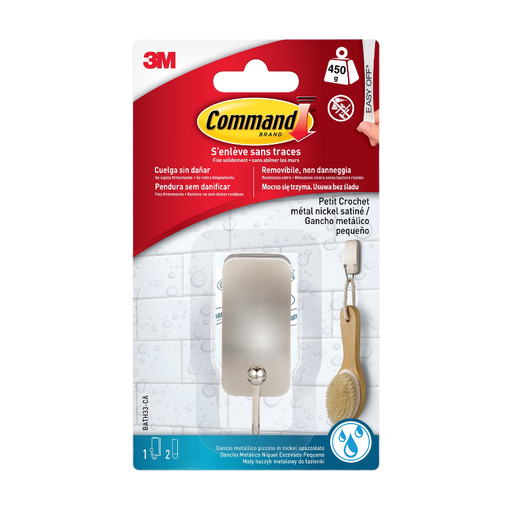
Why this choice suits this profile: its compact size and stated capacity of 0,450 kg make it suitable for small items and first-time installations without tools.
The clearly stated load limit reduces the risk of hanging an item that is too heavy. Its moisture-resistant design is suitable for environments such as bathrooms, provided it is installed on a compatible smooth surface.
Tool-free installation, tab removal and stated compatibility with tiles, wood and certain painted walls.
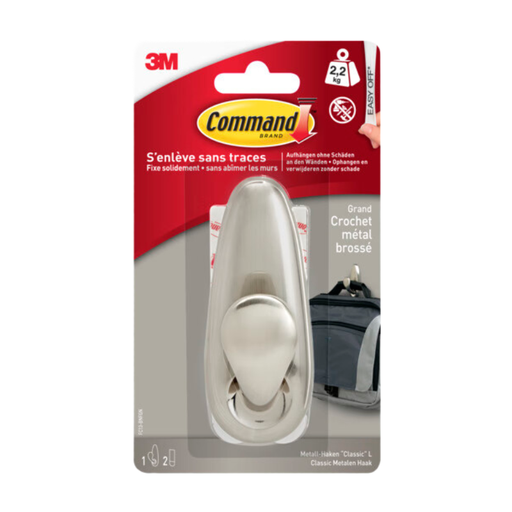
Why this choice suits this profile: its brushed nickel finish adds a more refined touch, while its stated capacity of 2,2 kg is suitable for items that are regularly used.
Its large size and clearly specified capacity prevent you from choosing a small hook for a more demanding use. However, the surface must remain smooth, clean and dry.
Brushed nickel-plated metal, screw-free installation and the option to reposition it using a new adhesive strip.
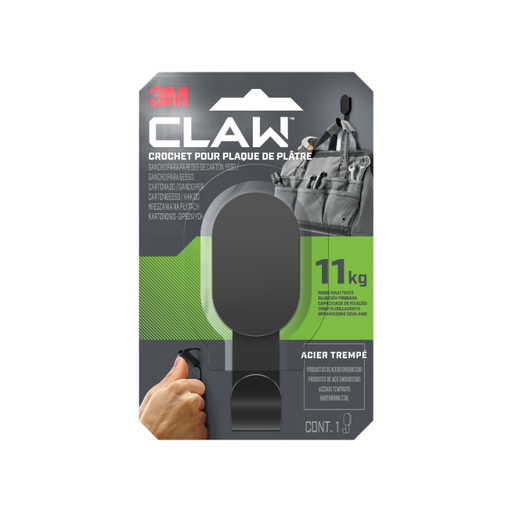
Why this choice suits this profile: this fixing is designed for heavier objects on plasterboard, with a stated capacity of up to 11 kg and a press-in installation method.
Do not confuse it with an adhesive hook or a hole-free hook: its steel claws anchor into the plasterboard. This distinction makes it easier to understand its intended use and limitations.
Stated capacity of 11 kg, tool-free installation and a design intended for plasterboard walls. Use only on suitable surfaces and for objects whose weight has been assessed correctly.
We have put together a complete, real-time updated list of products that fully meet these strict selection criteria and European safety regulations.
Even a repositionable wall hook will generally need a new adhesive strip after being moved. The hook may be reusable, but the adhesive should not be considered permanent.
Its lifespan depends on the surface, humidity, load and quality of installation. Installing it on smooth, clean and dry tiles provides more consistent conditions than installing it on a painted, textured wall. Inspect the surface regularly if the hook is installed in a humid room.
Yes, provided the instructions authorise installation on tiles and the area is smooth, degreased and dry. Avoid grout lines, dusty tiles and locations exposed to constant splashing. In a shower, check explicitly that the model is moisture-resistant.
Not always. Adhesive models are generally designed for light to medium loads. On plasterboard, a claw fixing such as the 3M CLAW may be considered for a heavier object, provided you accept that it will leave small marks in the surface. The stated capacity and the nature of the wall remain decisive.