
Livraison le jour même ou le lendemain

Qualité garantie

Débloquez vos offres de bienvenue: Livraison GRATUITE | Jusqu'à -80 % | 30 jours d'essai gratuits à JoyPlus
Téléchargez l'application
Want to hang keys, a tea towel or a decoration without getting the drill out? A no-drill adhesive wall hook can be a great solution for tenants, students, or anyone looking to reorganise their home without peppering the walls with holes. That is, as long as you pick a model suited to the job.
A stated maximum load doesn’t guarantee the same hold on tiles, matt paint or a textured wall. So before you order, take a close look at the surface, the actual weight of the item, and the conditions for fitting.
A hook rated for 1.3 kg shouldn’t necessarily hold a 1.3 kg bag. Repeated movements, sudden tugs and leverage all increase the strain on the adhesive. For something you handle several times a day, it’s wise to keep a safety margin.
Weigh the item with its contents: a kitchen hook loaded with utensils or an entryway hook for a bag will face very different stresses from a decorative one.
Most no-drill adhesive hooks are designed for smooth, clean, dry surfaces: compatible paint, painted wood, glass, metal or tiles. Wallpaper, porous surfaces, rough walls or fragile paint can reduce adhesion, and may even get damaged when you remove the hook.
So take the word “universal” with a pinch of salt. Always check the list of compatible surfaces on the packaging.
A removable wall hook only holds properly if you install it carefully. The usual process is to clean the area, let it dry, press the strip firmly for about 30 seconds, then wait one hour before hanging anything on it. Skipping this step can seriously weaken the hold.
To remove the hook, don’t pull it straight towards you. Where the system allows, slowly pull the strip in the direction shown, parallel to the wall. This method reduces the risk of peeling the paint.
The maximum load is the first thing to compare. In this selection, the models range from about 225 g for the mini transparent hooks to 1.3 kg for some medium-sized metal hooks. A model rated for 450 g can hold keys, a small accessory or a light decoration, but not necessarily a heavy coat.
For heavy-duty use, choose a capacity well above the measured weight. Also, avoid hanging a fragile or potentially dangerous item above a bed or a walkway.
A decorative adhesive hook in nickel-plated metal or stainless steel will easily find its place in a contemporary hallway, kitchen or bathroom. Clear plastic will be more discreet for a string of lights, a small decoration or a light accessory.
The finish doesn’t increase the weight capacity. It mainly affects the look, the perceived sturdiness, and how well it matches your furniture or fittings.
For a bathroom or kitchen, look for a strip that’s described as moisture-resistant. That doesn’t mean the hook can be submerged or placed on a soaking wet surface. Condensation, steam and heat can affect its hold.
A clear hook designed for outdoors won’t have the same features as a Command wall hook meant for indoors. Also check the temperature limits and the approved surfaces.
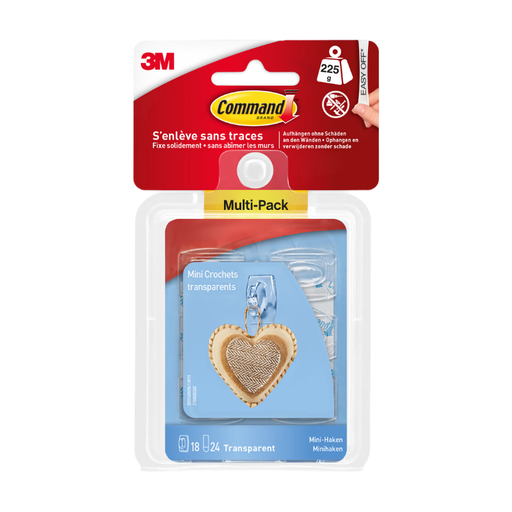
Why this choice suits this profile: This pack is ideal for small storage needs in a studio, office or bedroom. The transparent hooks blend into the background while letting you spread several light accessories around.
The stated capacity is 225 g per hook – impossible to mistake them for holders for heavy items. The listing recommends use on smooth indoor surfaces.
A pack of 18 hooks with strips included and a clear design, handy for light decorations, keys or small utensils.
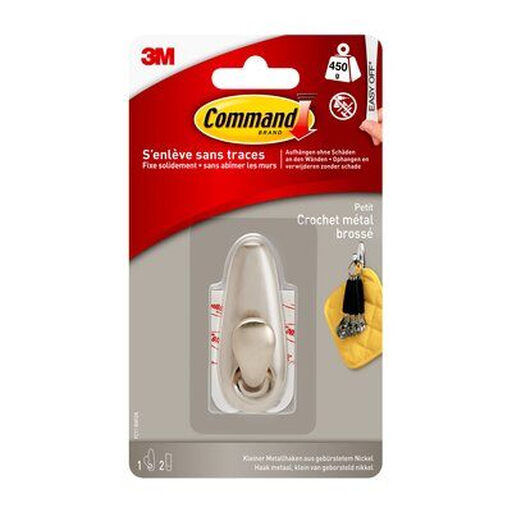
Why this choice suits this profile: Its brushed nickel metal finish complements a well-kept hallway, a modern kitchen or an office where the hook stays on show.
The 450 g limit is clearly stated – it’s suitable for small items and stops you mistaking a decorative hook for an adhesive holder meant for heavy loads.
Tool-free installation, removal claimed without holes or residue, and reusable with replacement strips.
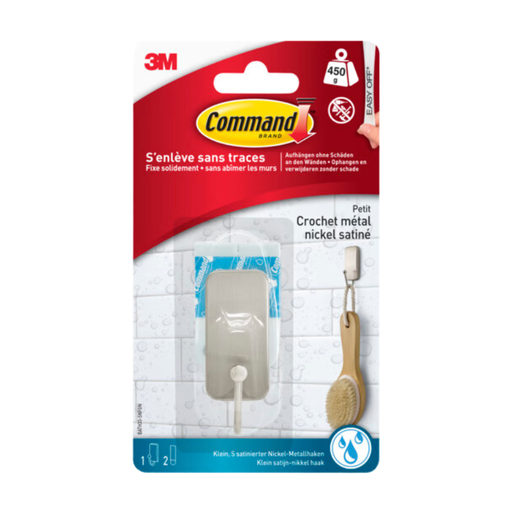
Why this choice suits this profile: This wall hook can find a place in a bathroom thanks to its moisture-resistant strips and its stated compatibility with glass, mirrors and tiles.
The listing states a 450 g capacity and indoor use in a humid environment – two useful benchmarks to avoid fitting a standard model in a shower or on a wet surface.
A satin nickel finish, water-resistant strips and the option to reuse the hook with replacement strips.
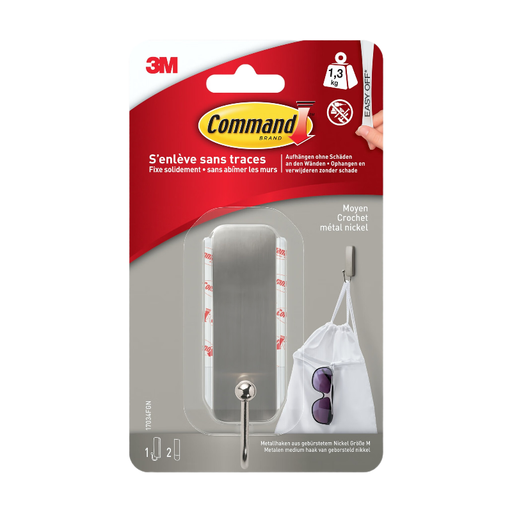
Why this choice suits this profile: With its stated capacity of 1.3 kg, it’s suitable for a hallway or a storage area for larger items.
Its load capacity is higher than the mini sizes, but it must still be strictly respected. Compatibility with the surface and the waiting time after fitting remain essential.
A decorative nickel-plated metal hook, tool-free installation and removal claimed without holes or adhesive residue.
We’ve put together a full, real-time updated selection of products that meet these demanding criteria and European safety regulations.
A “no trace” wall hook never lets you off following the fitting conditions. Paint that doesn’t adhere well can flake, even if the hook comes off without trouble.
Yes, some models use moisture-resistant strips and are designed for tiles, glass or mirrors. However, make sure the surface is clean, dry and compatible. Avoid constantly wet areas if the instructions don’t allow them.
It all depends on the weight hung, how often it’s used, the temperature, humidity and the condition of the wall. A hook that’s not heavily used can stay in place for a long time. However, the adhesive strips should be replaced when the hook is repositioned or after it’s removed.
Standard models are mainly intended for light or medium-weight items. For a heavy load, check the exact capacity of the hook and the characteristics of the surface. Claw hooks for drywall, such as the 3M CLAW range, are not adhesive – they fix into the wall using metal claws. Only choose these if that type of fixing is suitable for your wall.