
Livraison le jour même ou le lendemain

Qualité garantie

Débloquez vos offres de bienvenue: Livraison GRATUITE | Jusqu'à -80 % | 30 jours d'essai gratuits à JoyPlus
Téléchargez l'application
You want to organise the bathroom, kitchen or hallway without reaching for the drill? No-drill adhesive hooks are a practical solution – but only if you don't rely solely on a picture or the promise of "strong adhesion". A poorly chosen wall hook can peel off, leave marks, or simply not suit your surface.
Here are the criteria to consider before buying, along with a selection of models suited to different uses around the home.
A stated capacity of 2 kg doesn't necessarily mean the hook will hold any object of that weight. Weight distribution, repeated handling and humidity can all reduce adhesion. A bathrobe that's taken off several times a day puts far more strain on a towel hook than a decorative picture frame that stays put.
Always leave a safety margin and never exceed the manufacturer's recommended load. For heavier items, a standard adhesive hook isn't always the best option anyway.
Adhesives are generally designed for smooth, clean and dry surfaces. Freshly painted walls, wallpaper, uneven plasterboard or flaking paint can all compromise the hook's grip.
Before choosing a hook for a painted or tiled wall, check its compatibility with the surface. Smooth tiles, glass, metal and certain painted finishes often give better results than a textured wall.
A removable, damage-free hook must be taken off following the manufacturer's instructions. You should generally pull the adhesive tab slowly, in the direction intended, without yanking the hook towards you. Mishandling it can damage the paint or snap the tab.
The stated capacity helps you compare models, but it should always be considered alongside your intended use:
Products designed for plasterboard don't work like a metal adhesive hook. 3M CLAW models use steel claws that insert into the board – so they can't be removed without leaving a mark, unlike a removable adhesive strip.
For a bathroom or kitchen, look specifically for a moisture-resistant hook or one designed for humid environments. Being water-resistant doesn't mean the adhesive can be applied to a wet surface. The surface must be cleaned and then thoroughly dried before fitting.
Command hooks intended for the bathroom use strips that are advertised as water-resistant. They work on certain smooth indoor surfaces, but aren't necessarily suitable for outdoor use, areas directly exposed to splashes, or uneven walls.
Plastic is lightweight and discreet, while stainless steel or nickel-plated metal offers a more elegant finish. In a hallway or bathroom where the hook is on show, the look of a decorative wall hook can matter just as much as its weight capacity.
Also check what's in the box: some models are sold in multi-packs with adhesive strips, while others include just one hook and one or two strips. Repositioning usually requires a new compatible adhesive strip.
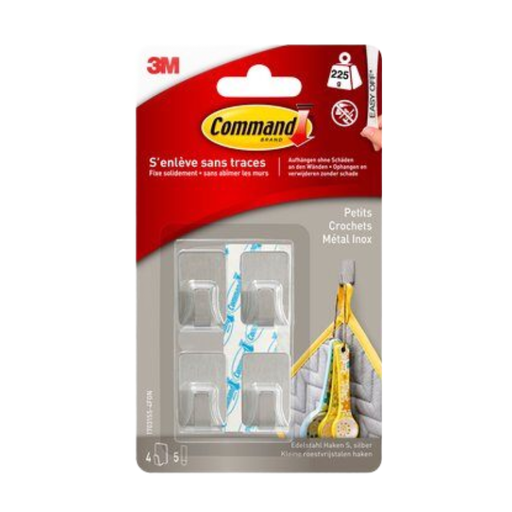
Why this suits this profile: With a maximum load of around 225 g, it's ideal for small everyday items. Sold in a pack of four, it lets you create multiple hanging points in the hallway, kitchen or bathroom.
Its clearly stated capacity reduces the risk of hanging something too heavy on it. It's designed for smooth indoor surfaces, which also limits fitting mistakes.
A polished stainless steel finish, tool-free installation and removal that's advertised as leaving no holes or residue on compatible surfaces.
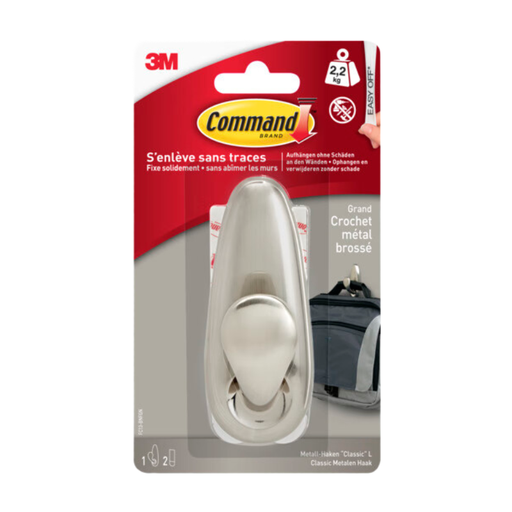
Why this suits this profile: Its brushed nickel finish blends easily into a well-decorated interior, while its stated capacity of 2.2 kg covers plenty of practical and decorative uses.
The maximum load, compatibility with wood, tiles and painted walls, as well as usage limitations, are all detailed on the product page.
A metal construction, nail-free and screw-free installation, and the option to reposition it with a new compatible adhesive strip.
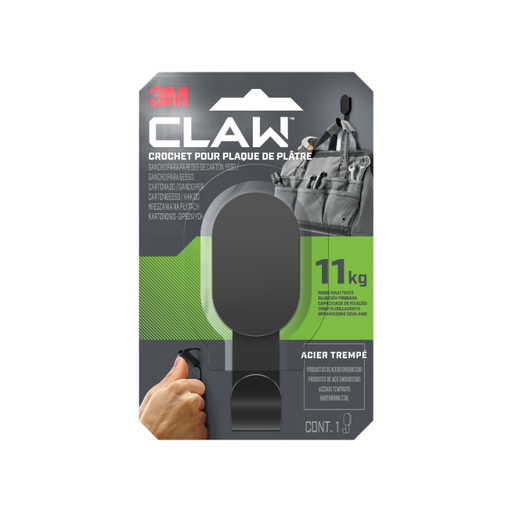
Why this suits this profile: This system is designed for plasterboard and heavier items, such as a coat, bag or wall decoration weighing up to 11 kg according to the product page.
It doesn't claim to suit all surfaces – its use is specifically intended for plasterboard. This means you avoid putting an adhesive strip on a surface it's not designed for.
Hardened steel claws, thumb-pressure installation and a stated capacity of up to 11 kg on plasterboard.
We've put together a comprehensive, real-time selection of products that meet these strict criteria and European safety requirements.
Yes, some models are designed for humid environments. Choose a bathroom hook whose product page mentions water resistance. However, fit it on a clean, dry surface – never directly onto uneven grout or a wall that's constantly wet.
It depends entirely on the surface, the weight hung, the temperature, the humidity and how often it's used. There's no universal lifespan that applies to all models. Check the hook's grip regularly and replace the strip as soon as it shows any signs of peeling.
A wall hook isn't automatically compatible with plasterboard. For a heavy load, choose a system specifically designed for this type of surface, such as a 3M CLAW hook. Always follow the maximum load and installation method stated on the product page.