
Livraison le jour même ou le lendemain

Qualité garantie

Débloquez vos offres de bienvenue: Livraison GRATUITE | Jusqu'à -80 % | 30 jours d'essai gratuits à JoyPlus
Téléchargez l'application
You want to hang a decoration, tidy up the bathroom, or put up a picture frame without reaching for the drill? No-drill adhesive hooks are a practical solution, especially in a rented property, a student room, or a temporary workspace. However, be warned: not all models are suitable for the same surfaces or the same weights.
A poor choice can lead to premature peeling, sticky residue, or paint coming away when you remove them. Here are the criteria to consider before buying, followed by a selection of models suited to different uses.
The capacity stated by the manufacturer usually applies to specific conditions: a smooth, clean, and dry surface, with installation carried out exactly as instructed. Even a heavy-duty adhesive hook won't necessarily support the same weight on a dusty, porous, or textured wall.
To stop an object from falling, always leave a margin between its weight and the maximum capacity stated. A hook rated for 225 g can hold a set of keys or a small ornament, but certainly not a framed picture with glass.
Adhesive wall hooks are generally designed for smooth indoor surfaces: tiles, glass, metal, painted wood, or properly prepared painted walls. Wallpaper, rough walls, freshly painted surfaces, and certain delicate finishes can reduce adhesion or become damaged when the hook is removed.
So a "no residue" claim doesn't mean "risk-free on every surface." Always check the compatible surfaces listed by the manufacturer.
A strip stuck onto a damp wall or one that's simply dusted off is likely to hold for much less time. For a drill-free wall fixing, clean the area as per the instructions, let it dry completely, apply firm, even pressure, and then wait the recommended time before hanging anything.
Removal also requires a bit of technique. With some adhesive hanging strips, the tab must be pulled slowly downwards, parallel to the wall, not towards you.
In a hallway, living room, or bedroom, standard no-nail hooks will usually do the job. For the bathroom, choose a model specifically designed to withstand moisture. Tiles and glass often provide a more even surface than matt paint or plaster.
In a shower, you also need to consider condensation, water splashes, and temperature changes. A bathroom hook with a water-resistant tab will be more suitable than a model intended only for dry rooms.
Start by defining your needs before you choose:
For a no-drill picture hanging solution, fixing strips generally distribute weight better than a single small hook. Also check the dimensions and weight of the frame, especially if it has glass.
Clear hooks easily blend into a light or minimalist décor. Stainless steel and nickel-plated metal offer a more visible finish, which can work well in a kitchen, hallway, or cloakroom.
Finally, distinguish between reusing the hook and reusing the adhesive. The hook can sometimes be repositioned with a new compatible strip, but a tab that has already been used should not be considered reusable without checking.
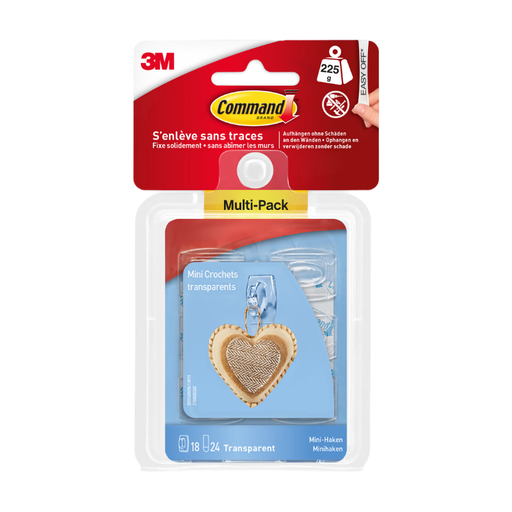
Why this choice suits this profile: With its 18 hooks, this set is ideal for everyday small items and lets you tackle several needs around the home without any special tools.
Its stated capacity of 225 g per hook encourages you not to overload it. Its mini size clearly marks it as intended for lightweight accessories.
Clear hooks, 18 pieces in the set, and stated compatibility with several smooth indoor surfaces.
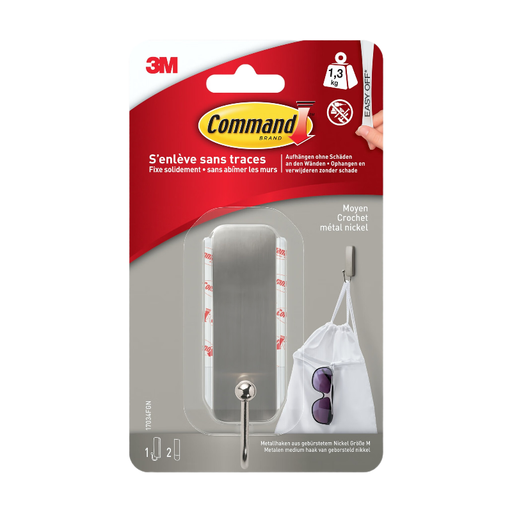
Why this choice suits this profile: Its nickel finish suits interiors where the hook remains on show, such as a well-appointed hallway or a stylish bathroom.
Its stated capacity of 1.3 kg is clearly marked, so in principle you can't mistake it for a support meant for heavy items.
Nickel-plated metal, tool-free installation, and removal that's said to leave no holes or residue on compatible surfaces.
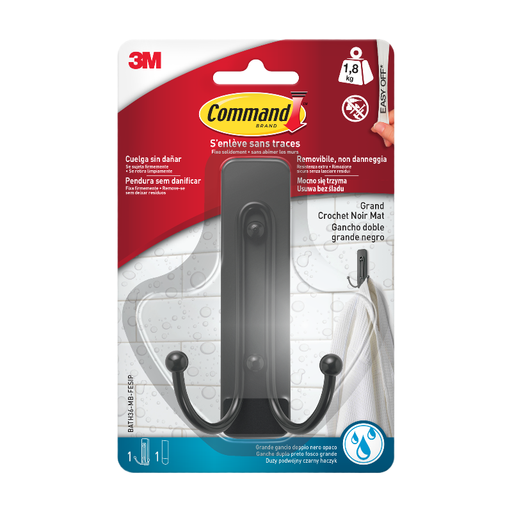
Why this choice suits this profile: This bathroom hook is designed to organise towels, bathrobes, and accessories in a damp environment.
Its tab is stated to be water-resistant, making it suitable for wet use. However, you must still respect the maximum load of 1.8 kg and use the hook on a recommended surface.
A double hook made from ABS, stated to be compatible with glass, mirrors, and tiles.
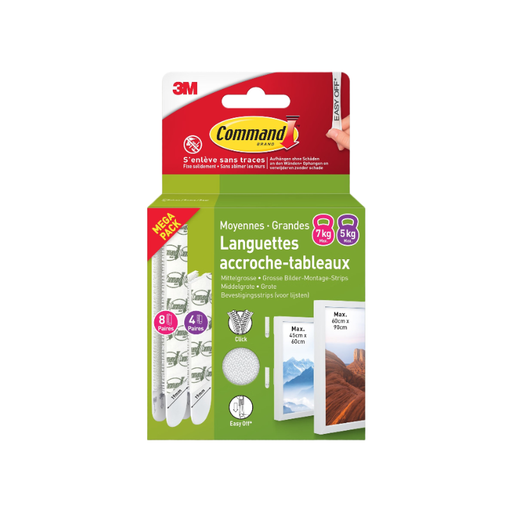
Why this choice suits this profile: The mix of medium and large strips lets you adapt the no-drill picture hanging solution to different frame sizes and decorations.
The capacities vary by size: up to 5 kg for the medium strips and up to 7 kg for the large ones, according to the product listing.
A set containing 4 medium pairs and 8 large pairs, with discreet fixing behind frames and removal that's said to leave no residue.
We've put together a comprehensive, real-time updated list of products that meet these demanding selection criteria and comply with European safety regulations.
No-drill adhesive hooks are not a replacement for mechanical fixings for a heavy shelf, a piece of furniture, or any object whose fall could injure someone. For drywall and heavy loads, claw hooks such as those in the 3M CLAW range belong to a different category: they insert into the surface and therefore are not completely free of perforations.
Yes, provided the model is stated as compatible with tiles and moisture. The tile must be clean, degreased, and perfectly dry. Avoid uneven grout lines and check that the adhesive is specifically designed for damp environments.
It all depends on the load, humidity, temperature, the condition of the wall, and the quality of the installation. Inspect the hook regularly and replace the strip if it starts to peel, deform, or show signs of wear. No manufacturer can guarantee the same duration in every home.
Clean removal is claimed on certain compatible surfaces, provided the installation and removal procedure are followed correctly. It is not guaranteed on wallpaper, fragile paint, a freshly painted surface, or a textured wall. In a rented property, it's therefore best to be cautious and keep the product instructions.