
Livraison le jour même ou le lendemain

Qualité garantie

Débloquez vos offres de bienvenue: Livraison GRATUITE | Jusqu'à -80 % | 30 jours d'essai gratuits à JoyPlus
Téléchargez l'application
A no-drill adhesive hook can sometimes be all you need to reorganise a bathroom, kitchen or hallway, without getting out the screwdriver or drill. But not all models are created equal: the surface, maximum load and humidity can completely change the picture. Make the wrong choice and the hook may come unstuck, pull off paint or leave your accessory on the floor.
Before clicking on “strong adhesion” or “universal”, it is therefore worth looking at the criteria that really matter: load capacity, the type of surface and the installation conditions.
The stated load usually corresponds to the limit that must not be exceeded under the conditions specified by the manufacturer. A hook rated for 1.8 kg may be perfectly suitable for a towel or lightweight dressing gown, but not necessarily for a fully loaded bag or an object that is pulled several times a day.
To choose a no-drill towel hook, weigh the item you intend to hang and allow a safety margin. Also avoid adhesive fixings for valuable or fragile items, or for anything installed above an area where people walk.
Whether it is intended for a painted wall, tiles, glass or varnished wood, an adhesive hook needs a smooth, clean, dry and sufficiently stable surface. Textured, porous, dusty or uneven walls greatly reduce the contact area available to the adhesive.
Wallpaper, fabric, untreated surfaces or delicate paint are often excluded from the manufacturer’s recommendations. A plasterboard partition can also have its limits. For a substantial load, a system specifically designed for plasterboard will generally be more suitable than an adhesive hook.
In a bathroom, steam, splashes and temperature changes put the adhesive under considerable strain. A bathroom adhesive hook should therefore be fitted with a strip advertised as water- or moisture-resistant.
Installation does not end once the hook has been stuck in place. The instructions for several Command models recommend pressing firmly for around 30 seconds, then waiting before hanging anything. During installation, the surface must remain completely dry.
Compare the maximum load with the item you plan to hang:
The load must also remain properly distributed. An item that pulls forwards, or one that is removed frequently, puts more strain on the fixing than its weight alone would suggest.
A no-hole wall hook is not magically compatible with every type of surface. Adhesive models are generally intended for tiles, glass, metal, painted or varnished wood, as well as certain smooth painted surfaces.
For a plasterboard hook, look instead at claw or mechanical fixing systems. They do not always require tools, but they do penetrate the surface slightly. So this is “no drill”, rather than “leaves no mark whatsoever”.
A removable hook should be taken down by carefully following the specified method. The tab is generally pulled slowly in the indicated direction, often parallel to the wall. If you pull the hook directly towards you, you risk tearing off paint or breaking the strip.
Some models allow you to keep the hook and replace only the adhesive strip. This does not mean that the original strip can be reapplied indefinitely: check its condition and replace it as soon as it becomes stretched, dirty or misshapen.
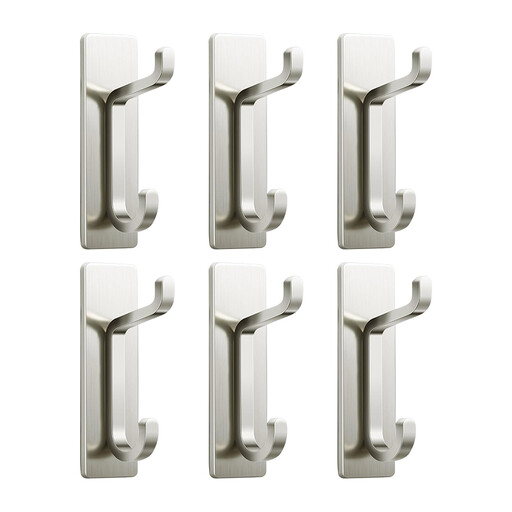
Why this choice suits this profile : With six hooks, this pack lets you organise your hallway, kitchen or bathroom gradually, without having to buy each piece separately.
The multipack format lets you assign each hook to a lightweight item, rather than placing the entire load on a single fixing.
Pack of six hooks, silver finish and no-drill installation, according to the product listing.
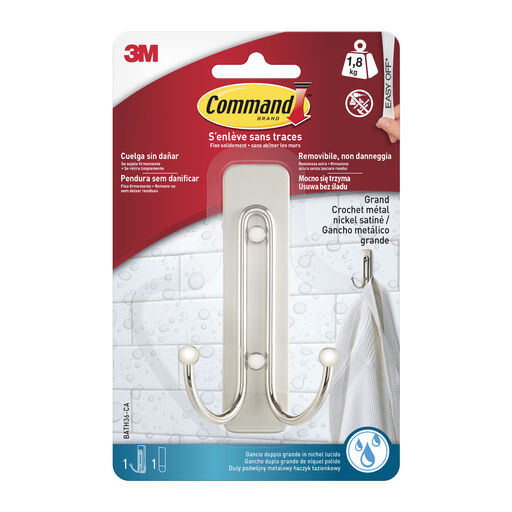
Why this choice suits this profile : Its satin nickel finish complements a stylish bathroom, while the double hook makes it easy to hang towels or a dressing gown.
The product listing states that it is water- and rust-resistant, with a clearly specified maximum load of 1.8 kg.
Double hook, indoor use, compatibility with smooth surfaces and removal advertised as leaving no holes or residue.
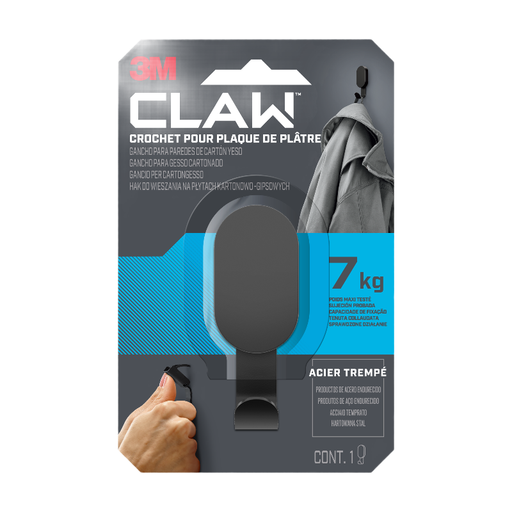
Why this choice suits this profile : This fixing is aimed at people with a plasterboard partition who need to hang items that are too heavy for a standard self-adhesive hook.
It does not claim to hold on every surface: its steel claws are specifically designed for plasterboard partitions.
Stated capacity of up to 7 kg and installation by simply pressing with your thumb, with no tools or additional reinforcement required.
We have put together a complete, real-time selection of products that meet these demanding criteria, as well as European safety requirements.
On freshly painted surfaces, wait at least for the period recommended by the manufacturer. For the Command Double Bathroom Hook Nickel Large, the product listing specifically states that it must not be installed on recently applied paint. The paint must have cured for at least seven days.
Some models are fitted with a water-resistant strip and designed for humid rooms. Even so, check the product listing: “moisture-resistant” does not necessarily mean that the hook can be installed under a direct spray, or on a surface that is wet at the time of installation.
There is no single lifespan that applies to every model. Its performance depends on the load, temperature, humidity, wall cleanliness and condition of the paint. Inspect the strip regularly and replace it if it starts to come away, swells or loses its elasticity.
On a smooth painted wall, choose an adhesive hook that is compatible with this type of surface and carefully follow the preparation steps. For a plasterboard partition carrying a heavy load, a claw fixing such as the 3M CLAW range may be more suitable. However, bear in mind that it leaves small perforations in the surface.