
Livraison le jour même ou le lendemain

Qualité garantie

Débloquez vos offres de bienvenue: Livraison GRATUITE | Jusqu'à -80 % | 30 jours d'essai gratuits à JoyPlus
Téléchargez l'application
Want to put up a hook in the bathroom, kitchen or hallway without reaching for the drill? A no-drill adhesive hook can be just the answer – as long as you pick a model that suits the surface, the weight you need to hang and the level of moisture.
A poor choice, however, can leave you with a hook that peels off after a few days, stubborn residue or a fix that’s too flimsy for what you had in mind. Here are the key factors to consider before you order, followed by a selection tailored to different uses.
The capacity stated on the packaging usually refers to a maximum load, measured under specific conditions. That doesn’t mean every wall, every surface and every item can be hung without risk.
A hook rated for 225 g is fine for a set of keys or small accessories, but not for a thick towel. For a bathrobe, a bag or something heavier, check the weight in kilograms and allow a safety margin.
Not all adhesive wall hooks are designed to withstand steam, splashes or temperature changes. In a bathroom, look clearly for the words moisture-resistant or a waterproof adhesive strip.
Even a hook intended for the bathroom must be applied to a clean, dry, smooth surface. Installing it directly onto a wet wall can significantly reduce adhesion.
A nail-free, screw-free hook works best on tiles, glass, metal, painted wood or smooth paintwork. Textured, porous, dusty, freshly painted or wallpaper-covered surfaces can compromise the hook’s hold, and may even be damaged when you remove it.
On plasterboard, a claw system designed for drywall can be a better choice than a simple adhesive.
Clean the area with a suitable product, then let it dry completely. For some models, the instructions recommend pressing the strip firmly for 30 seconds, then waiting about an hour before hanging anything.
Avoid products that leave a greasy film. Don’t put the hook on fresh paint until the drying time stated by the manufacturer has passed. To remove it, pull the tab slowly parallel to the wall, not towards you.
Here are some practical benchmarks from the products featured:
The load should be assessed with the item hanging, not just the hook alone. For something fragile or valuable, it’s best not to rely solely on the stated maximum capacity.
In a bathroom, a satin nickel, matt black or stainless steel finish can easily match your taps. A transparent hook is more discreet on glass or light-coloured tiles. A double hook works well for towels and bathrobes, while a small hook is handier for keys and accessories.
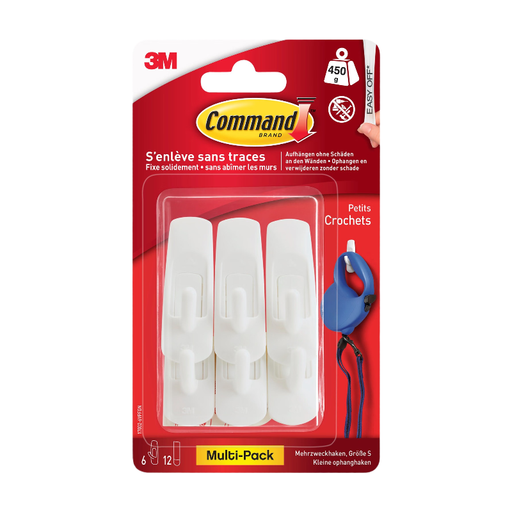
Why this suits this profile: This pack of six hooks is ideal for a student, a tenant or anyone looking to organise several spaces in a single purchase.
The listing states no-nail, no-screw fitting and removal by stretching the tab. However, you must respect each hook’s weight limit and use it on a smooth surface.
Six white pieces, tool-free installation and the option to use Command replacement strips.
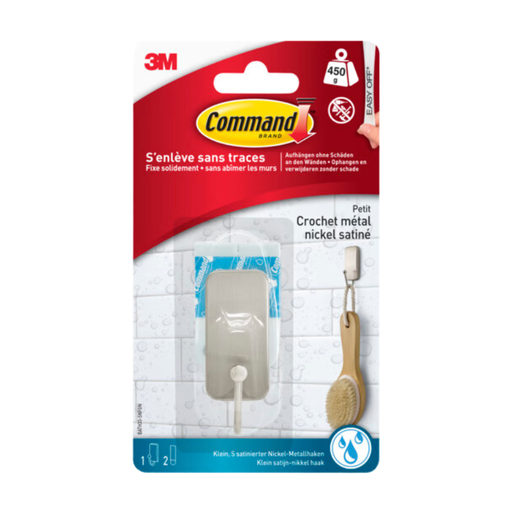
Why this suits this profile: Its satin nickel finish blends perfectly into a bathroom where the hook’s appearance matters as much as its everyday use.
The description states it can be used in damp environments and supports up to 0.45 kg. This indication prevents you from hanging a bathrobe that’s too heavy.
A metal hook, water-resistant strips and stated compatibility with glass, mirrors, tiles, wood and painted surfaces.
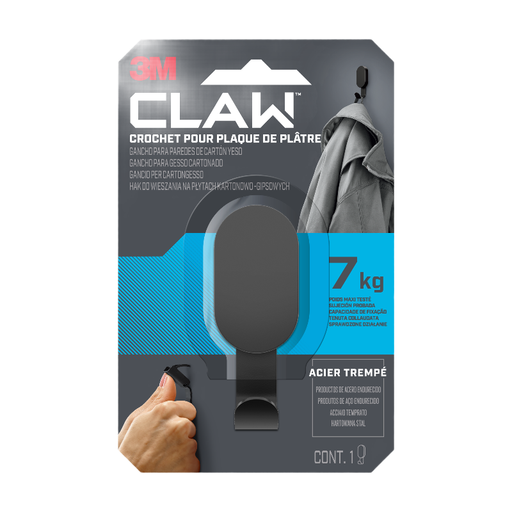
Why this suits this profile: This system is aimed at those looking for a picture hanger for plasterboard, especially for hanging a frame, bag or relatively heavy decoration.
This isn’t a simple wall adhesive: its hardened steel claws are designed to anchor into plasterboard. The stated load reaches 7 kg – a limit that must be strictly observed.
Fitting with a simple thumb press, no tools, no wall plugs and no need to find a stud in the wall.
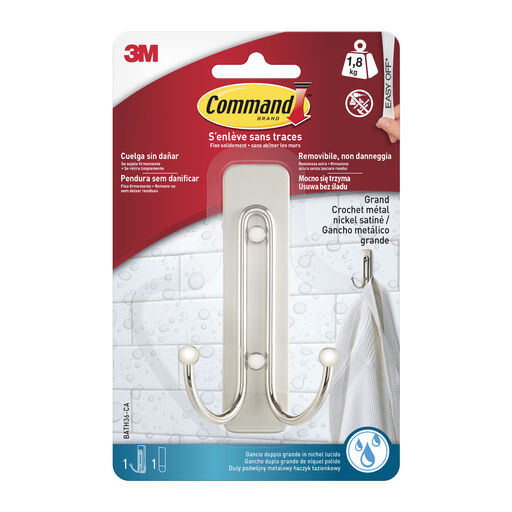
Why this suits this profile: Its double-hook design and satin nickel finish make it easy to organise towels and accessories in a damp room.
The listing mentions water and rust resistance, plus a maximum load of 1.8 kg. Fitting is still not recommended on a damp, uneven or textured surface.
A double hook, a stated capacity of 1.8 kg and removal designed to leave no hole or residue when the procedure is followed correctly.
We’ve put together a comprehensive, real-time updated list of products that fully meet these strict selection criteria and European safety regulations.
Clean and dry the surface, apply the strip without touching it with your fingers, then press firmly for the recommended time. Then wait the stated period before hanging anything on it. Fitting on smooth tiles, glass or perfectly dry paintwork will generally be more reliable than on a rough wall.
It all depends on the surface, humidity, temperature, load and the quality of the installation. Check the hook regularly to spot any peeling or a strip that’s starting to lift. In a damp room, choose a product explicitly designed for that environment.
Models with a stretchable tab are designed to come off cleanly when the tab is pulled slowly and parallel to the wall. This promise doesn’t remove the need to check compatibility with the paint or covering. On wallpaper, a porous surface or delicate paintwork, the risk of damage remains very real.