Shoppers looking to avoid added sugars
You’re looking for a recipe with no added sugar, while still wanting to know how much sugar it contains per 100 g. Sweetcorn with no added sugars can still contain naturally occurring sugars.


If you’re shopping for one or two people, compare the ingredients list, then check the ‘of which sugars’ and ‘salt’ values per 100 g. ‘No added sugar’ doesn’t mean the sweetcorn contains no sugars. Also check the drained weight per tin and the storage instructions once opened, so you can choose an amount that suits the meals you have planned.
You’re looking for a recipe with no added sugar, while still wanting to know how much sugar it contains per 100 g. Sweetcorn with no added sugars can still contain naturally occurring sugars.
If you’re cooking for one or two people, the drained weight per tin matters more than the total weight in a multipack. Storage instructions once opened can also help you decide between two sizes.
You may want to compare the salt content, an organic option, where the sweetcorn comes from or exactly what a claim about pesticide residues means. None of these criteria replaces checking the other product information.
For a smaller household, start with the factor that matters most for your recipe, then check whether the amount in each tin will suit your meals.
| What to consider | What to check | Who is it for? |
|---|---|---|
| Added sugars and sugars present | The ingredients list, then the ‘of which sugars’ value per 100 g. | I want a recipe with no added sugar, without assuming the sweetcorn contains no sugars at all. Avoiding added sugars would be the top priority for around 36% of shoppers concerned. |
| Salt | Whether salt is listed as an ingredient and the ‘salt’ value per 100 g. | If I prioritise a recipe with no added salt, I need to distinguish that claim from a salt value that I can compare. This would be the top priority for around 29% of shoppers concerned. |
| Size per tin | The drained weight per tin and the storage instructions once opened. | When I’m cooking for one or two people, I want to use the contents without leaving an opened tin for too long. Size would be the top consideration for around 21% of shoppers concerned. |
| Production and origin | Organic and origin details, or the exact scope of a claim about residues. | I want to choose based first on the production method, stated origin or a specific claim, while checking the recipe separately. This would be the top priority for around 14% of shoppers concerned. |
Sweetcorn can contain naturally occurring sugars. Bonduelle France states that its no-added-sugar option contains 5.1 g of sugars per 100 g.
Check the ingredients list for any added sugar, then compare the ‘of which sugars’ value per 100 g across the tins you’re considering.
Two recipes with no added sugars may have different salt levels. The product details from Bonduelle France and Auchan France list 0.28 g and 0.43 g of salt per 100 g respectively for the options reviewed.
If salt is your main consideration, check the ingredients list and the ‘salt’ value per 100 g. A Géant Vert option listed by Carrefour France is described as ‘no salt’.
In a smaller household, an opened tin may leave you with more sweetcorn than expected. Storage instructions once opened vary by product.
Compare the drained weight per tin and follow the storage instructions for the product you buy. If you’re planning several meals close together, factor this in before choosing a size.
A no-added-sugar tinned sweetcorn option, reviewed in a 285 g drained-weight size.
An organic sweetcorn option described by Carrefour France as having no salt and no added sugars.
An option with a claim about pesticide residues, which should be read in light of its precise scope.
An organic option with no added sugars, listed by Carrefour France as three tins, each with a drained weight of 140 g.
A no-added-sugar option with a drained weight of 285 g, listed by E.Leclerc.
These tins of sweetcorn let you compare sizes and product claims for a smaller household. For each one, check the ingredients list, the ‘of which sugars’ and ‘salt’ values per 100 g, then the drained weight per tin.
 Image unavailable
If you’re choosing this size for one or two people, check the drained weight to work out how much you can use.
The title states 285 g; this alone doesn’t tell you the drained weight. Check the product to see exactly what the residues claim covers.
 Image unavailable
The two tins may suit a household that prefers to open one tin at a time.
The title states two 140 g tins. Check the drained weight of each and compare the sugars per 100 g: ‘organic’ doesn’t tell you how much sugar they contain.
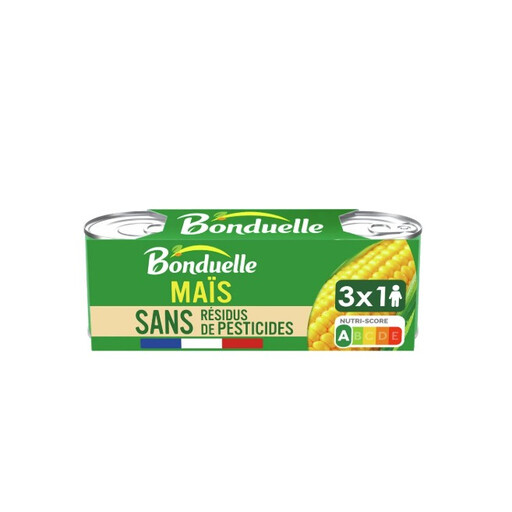 Image unavailable
Before choosing this pack for several meals, check how much each tin contains.
The ‘1/4 x 3’ description doesn’t state the drained weight per tin. Also check the storage instructions once opened and exactly what the residues claim covers.
 Image unavailable
If you’re cooking for one or two people, think about how much you’ll use before opening this tin.
The title states 400 g, but doesn’t specify the drained weight. Check this, the nutritional information and the storage instructions for the product you buy.
No. Sweetcorn can contain naturally occurring sugars even when no sugar has been added to the recipe. Bonduelle France states that the option reviewed contains 5.1 g of sugars per 100 g. Compare the ‘of which sugars’ value on this same basis.
Choose based on the drained weight you expect to use per meal and the storage instructions once opened. Some of the options reviewed have a drained weight of 140 g per tin, while others are 285 g. A multipack of smaller tins may suit you if you prefer to open them separately.
Follow the instructions for the product you buy. The Bonduelle France product details reviewed say to store it at a maximum of 4 °C and consume within 48 hours. The d’aucy product details reviewed recommend transferring it to an airtight container, refrigerating it and consuming it within two days.
No, these claims don’t give you the product’s ‘of which sugars’ value. Compare the nutritional information per 100 g separately. For the d’aucy option reviewed, Auchan France explains that its residues claim relates to a quantification limit of 0.01 mg/kg for more than 600 molecules tested.