Families avoiding added sugar
You’re preparing sweetcorn for several people and want to avoid added sugar without confusing this with the absence of naturally occurring sugars.


To avoid added sugar, look for the words “no added sugar” on the tin and check the ingredients list: sweetcorn may still contain naturally occurring sugars. For a family dinner, compare products by drained net weight, salt content and the type of corn you want to serve. Organic or growing-method claims are separate considerations.
You’re preparing sweetcorn for several people and want to avoid added sugar without confusing this with the absence of naturally occurring sugars.
You check the ingredients on the tin and compare the “salt” line in the nutrition information before choosing.
You’re also looking for an organic product or one with a specific growing-method claim, while checking separately whether sugar has been added.
Start with the claim and ingredients for the product you’re considering, then compare the nutrition information and the amount of sweetcorn you’ll be able to serve.
| What to consider | What to check | Who it matters to |
|---|---|---|
| Added sugars | Look for “no added sugar”, read the ingredients and distinguish this claim from the “of which sugars” line. | If I want to avoid added sugar, a non-zero value on the “of which sugars” line isn’t enough on its own to rule out a tin. Around 33% of consumers would prioritise making this distinction. |
| Ingredients and salt | Check the recipe and compare the “salt” value per 100 g using the same labelling basis. | If I’m also keeping an eye on salt in my meals, “no added sugar” doesn’t cover my only selection criteria. This would be the main concern for around 33% of consumers. |
| Pack size and texture | Compare the total drained net weight, the number of tins and the stated shape or texture. | I want to serve an amount that suits the number of people, with kernels or cobs to match the planned dish. Around 17% of consumers would put this need first. |
| Production | Check organic or growing-method claims on the exact product variant, separately from its sugar and salt content. | If how food is produced matters particularly to my household, I look for a specific claim rather than treating it as nutrition information. Around 17% of consumers would have this as a priority. |
The Carrefour Classic product information explains that naturally occurring sugars may still be present. So a value on the “of which sugars” line doesn’t, on its own, prove that sugar has been added.
Read the claim, ingredients and nutrition information together on the tin you choose.
Several no-added-sugar products include salt in their ingredients. These two criteria answer different questions.
Compare the “salt” value per 100 g on the labels of the products you’re considering.
The pack sizes listed on Carrefour, Auchan and E.Leclerc product pages include 3 × 285 g, 2 × 140 g and 3 × 140 g drained net weight. The same number of tins doesn’t necessarily mean the same amount to serve.
Work out the total drained net weight and choose a pack size that suits the meal and how you’ll use any leftover tins.
A claim made for an organic product or one with a growing-method statement doesn’t necessarily apply to the brand’s other pack sizes or recipes.
Check the claims and ingredients for the exact variant before choosing.
These product examples help you spot differences in recipes and pack sizes. Always check the label on the product you buy.
Bonduelle offers tinned sweetcorn labelled “no added sugar”, including a 2 × 285 g drained net weight pack listed by Auchan.
Carrefour offers no-added-sugar sweetcorn in a 3 × 285 g drained net weight multipack.
E.Leclerc offers Bio Village organic sweetcorn with no added sugar in a 2 × 140 g pack.
The E.Leclerc range includes Notre Jardin crunchy sweetcorn with no added sugar, including a 285 g tin and a 3 × 140 g multipack.
Carrefour offers a Géant Vert product described as extra-crunchy, with no added sugar and no pesticide residue.
These products include tinned sweetcorn kernels and a corn-on-the-cob option. For your dinner, check the “no added sugar” claim, ingredients and quantity for the variant you choose. Cobs aren’t a substitute for kernels in every recipe.
 Image unavailable
This two-tin pack may suit you if you prefer to open the sweetcorn in stages. Check the “no added sugar” claim and nutrition information on the variant you buy.
 Image unavailable
This 285 g tin is for shoppers looking for sweetcorn kernels with this growing-method claim. Check separately for a “no added sugar” claim and the “salt” value for this variant.
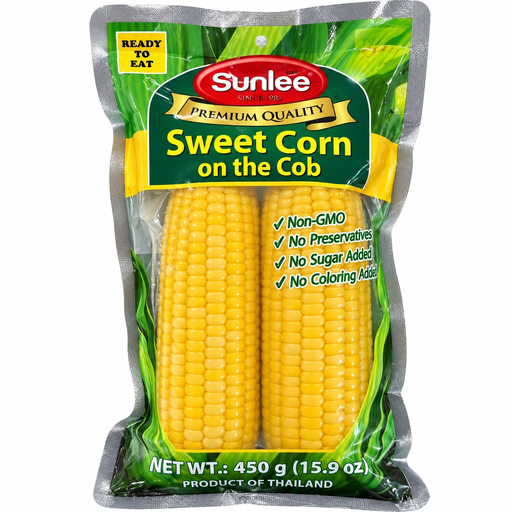 Image unavailable
Choose this style if you’d like to serve cobs rather than kernels. The stated weight is for the pack: check the drained net weight, any claim about added sugars and the instructions on the product.
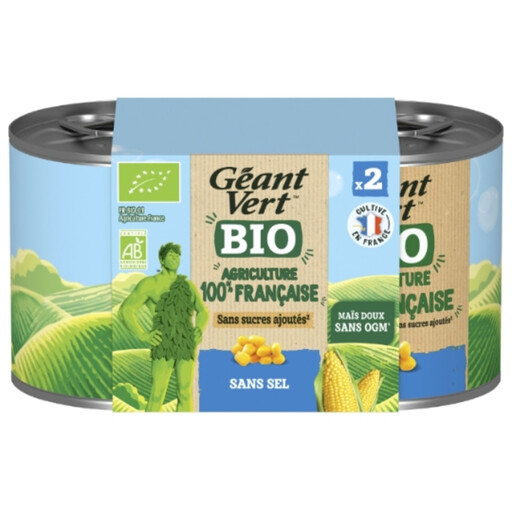 Image unavailable
This variant may appeal to shoppers looking for organic sweetcorn kernels. The quantity information in the product name needs confirming: check the pack contents and drained net weight on the packaging, as well as any claim about added sugars and the salt content.
No. Carrefour Classic’s product information explains that naturally occurring sugars may still be present in a product with no added sugar. Check the “of which sugars” line to see the value declared for the product you choose.
Read the ingredients list on the specific tin you’re thinking of buying. The Carrefour Classic, Bonduelle and Géant Vert product information cited here lists recipes made with sweetcorn, water and salt. Then compare the salt content separately.
Follow the instructions on the tin you buy. For its no-added-sugar sweetcorn, Bonduelle recommends storing it at a maximum of 4 °C and using it within 48 hours of opening.
This is a best-before date, not a use-by date, as explained by Anses. After this date, the taste or nutritional quality may change. Check that the tin is intact and follow the storage instructions on its label.
No. These claims relate to criteria that are separate from added sugar. Check each one on the exact product, then read its ingredients and nutrition information.