People avoiding added sugars
You prepare savoury meals in advance and want to distinguish a recipe with no added sugar from sweetcorn that naturally contains sugars.


To prepare several meals in advance without adding sugar to your recipes, choose sweetcorn labelled ‘no added sugar’, then check the ingredients and the ‘of which sugars’ figure per 100 g: sweetcorn also contains naturally occurring sugars. Next, choose a pack size that suits the portions you have planned and check the storage instructions on the tin. A large tin is only practical if you can use its contents within the stated time after opening.
You prepare savoury meals in advance and want to distinguish a recipe with no added sugar from sweetcorn that naturally contains sugars.
You divide sweetcorn between several recipes and need to choose between small tins and a larger pack, taking drained weight and storage after opening into account.
You’re looking for an organic option or one that makes a claim about pesticide residue checks, without confusing the two criteria.
When choosing tinned sweetcorn for several meals, start with your main priority, then check the recipe and how much you’ll actually use after opening.
| Criteria | What to check | Who is it for? |
|---|---|---|
| Added sugars and total sugars | Check the ‘no added sugar’ claim, the ingredients and the ‘of which sugars’ figure per 100 g for the product you’re considering. | I want to avoid adding a sweetening ingredient to my dishes, without assuming that sweetcorn contains no sugar at all. Around 44% of consumers would put this distinction at the top of their list of criteria. |
| Portions and storage | Compare the drained weight and read the storage instructions for after opening. Bonduelle states that its no-added-sugar sweetcorn should be kept at a maximum of 4 °C and used within 48 hours. | If I open a tin for several recipes, I need to be able to use its contents within the time stated on the tin. Portioning would be the main priority for around 33% of consumers. |
| Production method and residues | Look for an organic label or a residue claim on the specific tin; one does not replace the other. | I want to choose based on the production method or residue checks, rather than infer these characteristics from the sugar content. These criteria would come first for around 23% of consumers. |
The naturally occurring sugars in sweetcorn are still included in the nutrition information. Bonduelle France lists 5.1 g of sugars per 100 g for one no-added-sugar product, and 7.5 g per 100 g for its organic no-added-sugar option.
To compare two tins, check their ingredients and their ‘of which sugars’ figures on the same 100 g basis.
A larger pack could leave you with unused sweetcorn between meals. For its no-added-sugar product, Bonduelle France says to keep it refrigerated at a maximum of 4 °C and use it within 48 hours of opening.
Work out how many portions you’ll prepare before opening the tin, and follow the instructions on the one you buy. If you cook on several occasions, smaller tins can make it easier to open only what you need each time.
If you can’t use the contents within the stated time after opening, they may go to waste.
These claims describe different characteristics. According to Bonduelle, its ‘no pesticide residue’ claim refers to its testing protocol and a quantification threshold; it is not an organic certification and does not describe the nutritional values.
Choose the criterion that matters to you, then check the relevant claim and the ‘of which sugars’ figure for the specific product you’re considering.
Bonduelle France offers no-added-sugar sweetcorn, including an organic option, as well as products carrying a pesticide residue claim.
Carrefour offers no-added-sugar sweetcorn under its own brands, including a Carrefour Bio multipack of three tins, each with a drained weight of 140 g.
E.Leclerc offers crunchy sweetcorn with no added sugar in a 285 g tin and in a multipack of three 140 g tins.
ALDI France offers an organic sweetcorn product and crunchy sweetcorn described as having no added sugar.
These tinned sweetcorn options come in different pack sizes to help you prepare several meals. Before choosing a size, compare the ingredients, nutrition information, drained weight and instructions for after opening.
 Image unavailable
This size could suit you if you plan to use the sweetcorn in several meals close together. The title lists 285 g; check the drained weight to work out your portions, as well as the scope of the residue claim and the instructions for after opening on the tin.
 Image unavailable
The two tins could suit you if you prefer to open sweetcorn as you need it for your recipes. The title lists 2 × 140 g; check the drained weight of each tin and its ‘of which sugars’ figure before comparing this pack with another.
 Image unavailable
This tin could suit you if you’re making several portions from a single opening. The title lists 570 g; check the drained weight and plan to use the contents in line with the storage instructions on the packaging.
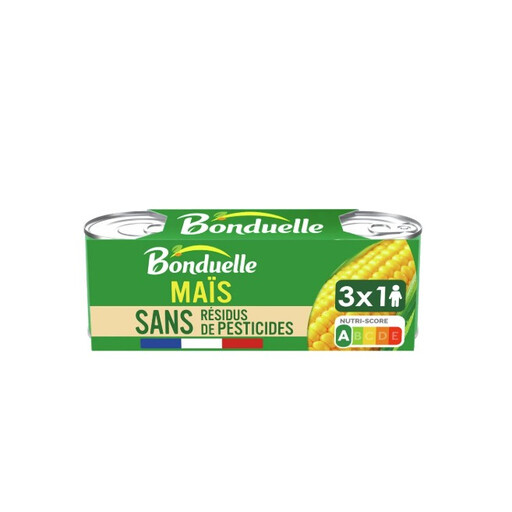 Image unavailable
This product is worth considering if you want to open several units as you prepare your meals. The variant is labelled ‘1/4 x 3’: confirm the number of tins, their contents, drained weight and instructions for after opening before planning your portions.
No: the claim doesn’t remove the sugars that occur naturally in sweetcorn. For example, Bonduelle France lists 5.1 g of sugars per 100 g for one no-added-sugar product and 7.5 g per 100 g for its organic no-added-sugar option. Compare the ‘of which sugars’ figures on the tins you’re interested in.
For its no-added-sugar sweetcorn, Bonduelle France says to keep it at a maximum of 4 °C and use it within 48 hours of opening. Follow the instructions printed on the tin you’re using, as they may vary by product.
Choose according to how much you expect to use after each opening. Small tins let you open one at a time; a larger pack works if your recipes use its contents quickly. Compare the drained weight, not just the stated weight or number of tins.
No: organic refers to a certified production method, while ‘no pesticide residue’ is a claim to check on the product in question. According to Bonduelle, its claim is based on residues not quantified above 0.01 mg/kg using the testing methods it describes; it is not a promise that pesticides are absolutely absent.
If you want to avoid added sugar in your recipe, look instead for the French claim ‘sans sucres ajoutés’ on the tin you’re considering. Then check the ingredients list and the ‘of which sugars’ figure per 100 g: these details answer two different questions.