Someone living alone who wants to avoid leftovers
If you’re making just one plate, start with the amount you plan to eat and compare it with the drained net weight. A pack of smaller tins lets you keep one unopened for another meal.


For a single meal, start by choosing a drained weight close to the amount you plan to serve. Several small tins mean you only need to open one, while a larger pack means you’ll need to use the remainder soon. If you want to avoid added sugar in the recipe, check the ingredients and the ‘of which sugars’ line: ‘no added sugar’ does not mean the sweetcorn contains no sugar at all.
If you’re making just one plate, start with the amount you plan to eat and compare it with the drained net weight. A pack of smaller tins lets you keep one unopened for another meal.
If the recipe is your priority, read the ingredients list rather than relying on the front of the pack. The ‘of which sugars’ line is still useful for comparing products, as sweetcorn naturally contains sugars.
If you’re looking for an organic product or a claim about pesticide residues, check that it appears on the specific product you’re buying. These claims are no substitute for checking the ingredients and nutritional information.
For a single plate, start with the drained net weight and what you plan to do with any leftovers. Then check the recipe and nutritional information for the product you’ve chosen.
| What to consider | What to check | Who it matters to |
|---|---|---|
| Portions and leftovers | Drained net weight per tin and storage instructions after opening. | For a single plate, I’d rather open just the amount I need than find a use for the leftovers. Around 33% of consumers prioritise getting the right portion size. |
| Added sugars | Ingredients list and ‘of which sugars’ per 100 g. | I want to know whether sugar is included in the recipe, without confusing this with the sugars naturally present in sweetcorn. Around 27% of consumers say this is their top priority. |
| Ingredients and production | Ingredients, salt content and any organic or pesticide-residue claims on the specific product. | If how a product is made guides my choice, I want to understand exactly what the label means. Around 20% of consumers put this first. |
| Available pack sizes | Number of tins in the pack and the drained quantity of the product available at your shop. | I’m looking for a product I can buy where I normally shop, in a quantity that suits the meals I have planned. Availability and pack size come first for around 20% of consumers. |
Sweetcorn can contain naturally occurring sugars. For example, Bonduelle’s ‘No Added Sugar Sweetcorn’ lists 5.1 g of sugars per 100 g.
Compare the ‘of which sugars’ figures per 100 g for the products you’re considering, then take account of the amount you’ll actually serve.
An opened tin or jar won’t keep for as long as the date shown for the unopened product. For the products mentioned here, Bonduelle and Auchan Bio advise refrigerating the contents and using them within two days of opening.
If you’re not planning another meal soon, compare smaller packs before choosing a larger one.
Any leftovers not used within the stated time may end up in the bin.
The drained net weight helps you estimate how much sweetcorn will be on your plate. The number of items in a multipack doesn’t tell you the portion size in each tin, either.
Check the drained net weight per tin on the packaging, especially when comparing a single tin with a multipack.
According to RappelConso, a recall published on 30 April 2025 affected specific batches of Bonduelle no-added-sugar sweetcorn due to a potential sealing defect. It did not apply to every tin from the brand.
Do not use a damaged tin. If you have a product that may be affected, check its brand, product code, batch and date against the official recall notice. Do not eat a recalled batch.
The details below apply to specific products. Check the size and label of the one you’re thinking of buying.
The no-added-sugar sweetcorn product reviewed lets you compare its ingredients and nutritional values.
The product reviewed is sold as a pack of three tins, each with a drained net weight of 140 g, so you can open them separately.
The 230 g jar of sweetcorn is a good option if you plan to use its contents across meals close together.
E.Leclerc sells a 285 g pack of crunchy no-added-sugar sweetcorn under its Notre Jardin brand.
These Bonduelle packs give you a choice of smaller tins and larger sizes to use across several meals. To work out how much to open, compare the drained net weight shown on the packaging.
 Image unavailable
The two tins mean you can open just one for a meal. Check the drained net weight of each tin and the nutritional information for this product on the packaging.
 Image unavailable
This 285 g pack is worth considering if you plan to use the contents over meals close together. Check the drained net weight, storage instructions after opening and what the pesticide-residue claim means on the packaging.
 Image unavailable
With a 570 g pack, you’ll need to think about what to do with the rest if you’re making just one plate. Check the drained net weight and storage instructions after opening.
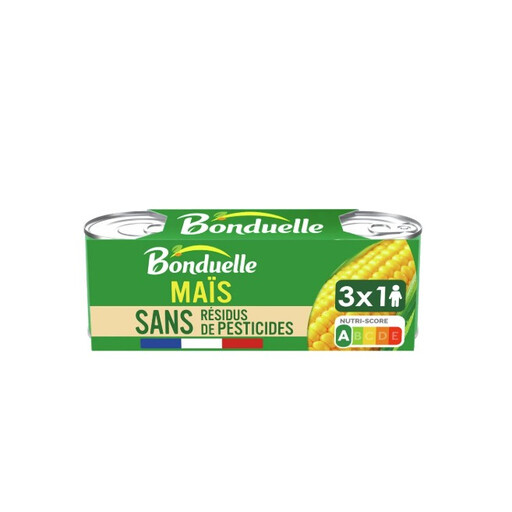 Image unavailable
If you’re looking for tins you can open separately, check what ‘1/4 × 3’ means on the packaging. Before choosing this pack, also check the quantity per tin, the drained net weight and what the pesticide-residue claim covers.
No: naturally occurring sugars are still shown on the ‘of which sugars’ line. The Bonduelle product reviewed lists 5.1 g of sugars per 100 g despite its ‘no added sugar’ claim. Compare products on the same basis, then take account of the portion you plan to serve.
Follow the instructions for the product you’ve bought, as the date on an unopened tin doesn’t tell you how long the leftovers will keep. For the products mentioned here, Bonduelle advises refrigerating the sweetcorn and eating it within 48 hours. Auchan Bio says to keep it in its juice in the fridge and eat it within two days.
No, a best-before date doesn’t automatically mean a tin is unsafe to eat once that date has passed. The Ministry of Agriculture explains that qualities such as taste and texture may change, though. This doesn’t mean you can skip checking the condition of the tin or following any recall notice.
Check the details on your tin against the official RappelConso notice rather than relying on the brand name alone. The recall published on 30 April 2025 affected specific batches of no-added-sugar sweetcorn in 140 g and 3 × 140 g packs, sold from 14 February to 26 March 2025, due to a potential sealing defect. Do not eat any batch identified as recalled.