People avoiding added sugars
You’re looking for a cocoa and hazelnut spread for an occasional snack, and want to distinguish between no added sugars and no sugars at all. The amount listed per 100 g is still worth comparing.


For a movie-night snack, a spread labelled ‘no added sugar’ isn’t necessarily what you’re looking for if you want a ‘sugar-free’ product. Check the ‘of which sugars’ figure per 100 g. If you’re considering a maltitol recipe, look at the polyols content and the manufacturer’s warning too. For a jar to share, allergens and storage instructions may be just as important.
You’re looking for a cocoa and hazelnut spread for an occasional snack, and want to distinguish between no added sugars and no sugars at all. The amount listed per 100 g is still worth comparing.
You’d rather choose a recipe without sweeteners, or you’re happy with maltitol as long as you know the polyol content and the warning about excessive consumption.
When sharing a snack, the presence of milk or hazelnuts may matter more than the sugar claim. Check the jar you choose for any ‘may contain’ warnings too.
Start with the ingredients and nutrition information, then check how to serve and store the jar.
| What to check | Look for | Who is it for? |
|---|---|---|
| Sugar claim | Compare the claim on the jar with the ‘of which sugars’ figure per 100 g. | To choose a no-added-sugar recipe without assuming it contains no sugars, check its nutrition information. Around 36% of consumers put this distinction at the top of their list. |
| Sweeteners and polyols | Read the ingredients list. For a maltitol recipe, check the polyol content and the warning on the packaging. | If you’d rather avoid sweeteners, or want to know what a maltitol recipe involves before sharing it, make this your first priority. This matters to around 29% of consumers. |
| Allergens | Check the ingredients, any declared allergens and any ‘may contain’ warnings on the jar you buy. | When several people are sharing a snack, making sure it meets their dietary requirements matters more than choosing a particular recipe. Around 21% of consumers prioritise this. |
| Serving and storage | Check the instructions for after opening and whether the spread needs stirring. | If you only use a jar occasionally, it’s especially important to be able to store and serve it as directed. Around 14% of consumers put this need first. |
According to Lucien Georgelin, its no-added-sugar spread contains 8.5 g of sugars per 100 g. So the first claim doesn’t mean the ‘of which sugars’ figure is zero.
Check the figure per 100 g rather than relying only on the words on the front of the jar.
The Klasik recipe from Pâte à Tartiner / Charles Chocolartisan lists 40 g of polyols per 100 g. The manufacturer warns that excessive consumption may have a laxative effect.
Check the ingredients and warning, then serve the amount you want rather than letting everyone help themselves from the jar.
The cocoa and hazelnut recipes described by Lucien Georgelin and Pâte à Tartiner / Charles Chocolartisan contain milk and hazelnuts. Their sugar claims don’t tell you whether they’re suitable for someone with dietary restrictions.
Before serving a group, check the ingredients and any ‘may contain’ warnings on the packaging you receive. The manufacturer also offers a dark recipe with no milk or hazelnuts, but you should still check its label.
The French Ministry of the Economy explains that displaying Nutri-Score is voluntary in France. Its absence alone isn’t enough to judge a recipe.
If it isn’t displayed, use the nutrition declaration to compare energy, sugars and fat per 100 g, among other values.
The brand offers a cocoa and hazelnut spread with no added sugars or sweeteners, in a 400 g jar.
Nutripure describes its Pure Pâte à Tartiner Bio as a recipe with no added sugar, no sweeteners and no added oil. Its ingredients include organic red kidney beans.
The range includes a milk and hazelnut recipe made with maltitol, and a dark chocolate recipe that the manufacturer describes as free from milk and hazelnuts.
If you’d prefer a fruity, no-added-sugar topping to a cocoa and hazelnut spread, this blueberry preparation could be worth considering for a spreadable snack.
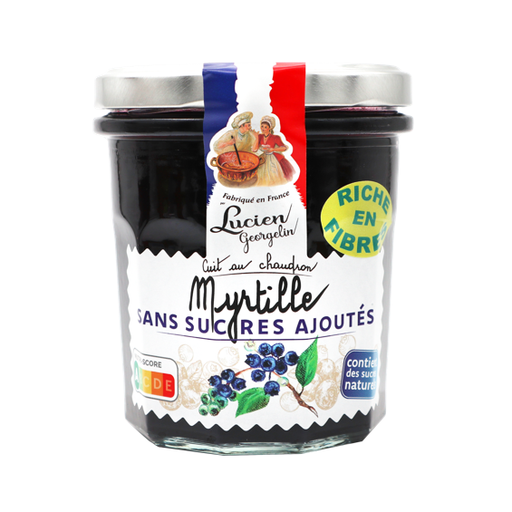 Image unavailable
This fruity preparation is a good choice if you’d like a blueberry topping rather than a cocoa and hazelnut spread.
320 g jar. ‘No added sugar’ doesn’t mean ‘sugar-free’: check the ‘of which sugars’ figure on the packaging if this affects your choice.
After opening, keep refrigerated and use within 10 days.
No. The French Ministry of the Economy says that displaying it is voluntary in France. The DGCCRF, however, states that prepacked foods must carry a nutrition declaration, which lets you compare the values listed per 100 g.
No. A recipe with no added sugars may still contain naturally occurring sugars. For example, Lucien Georgelin states that its no-added-sugar spread contains 8.5 g of sugars per 100 g. Check the ‘of which sugars’ line for the product you’re considering.
Look for maltitol in the ingredients, then check the polyol content and the warning on the packaging. Pâte à Tartiner / Charles Chocolartisan warns that excessive consumption of its relevant recipes may have a laxative effect.
Follow the instructions for the recipe you’ve chosen. For its Pure Pâte à Tartiner Bio, Nutripure recommends refrigerating the jar after opening and using it within 7 to 10 days. Other spreads may have different instructions.