Taking a portion to uni
If you want to finish your drink at lunchtime, look at 20 cl or 50 cl bottles. Carrefour and Auchan offer orange juice in these sizes, so choose a volume that matches how much you’ll actually drink.


For lunch at uni, choose an orange juice whose ingredients meet your no-added-sugar requirements, in a size you can finish or store according to the product instructions. ‘No added sugar’ doesn’t mean ‘sugar-free’: if you’re looking to limit your total sugar intake, compare the ‘of which sugars’ figure per 100 ml with the amount you plan to drink.
If you want to finish your drink at lunchtime, look at 20 cl or 50 cl bottles. Carrefour and Auchan offer orange juice in these sizes, so choose a volume that matches how much you’ll actually drink.
Check the ingredients list and the claim on the specific product. Orange juice with no added sugar still contains sugars naturally present in the fruit.
If that’s what you mean by ‘diet’, start with the ‘of which sugars’ figure per 100 ml, then factor in how much you’ll drink. The orange juices featured here are not sugar-free drinks.
For lunch at uni, first distinguish between no added sugars and total sugar content. Then choose a size that’s easy to carry and can be stored properly after opening.
| What to consider | What to check | Who is it for? |
|---|---|---|
| Added sugars | The ingredients list and the ‘of which sugars’ figure per 100 ml: they answer two different questions. | I want to avoid added sugar without mistaking this claim for a complete absence of sugars. Around 40% of consumers would put this first. |
| A portion to take with you | The net quantity, particularly 20 cl or 50 cl, and the storage instructions after opening if you won’t finish the bottle. | I’d rather drink my juice at lunch than carry an opened bottle around in my bag; around 40% of consumers would prioritise a size that’s easy to finish. |
| More than one serving | The bottle size and whether you can follow the storage instructions after opening. | If I’m having it with several meals and have access to a fridge, I’d prefer a bottle that can be stored after opening. This would be a priority for around 20% of consumers. |
Sugars naturally present in oranges are still listed in the nutritional information. Auchan’s product pages for Joker juice and its own individual bottle list 8.6 g and 8.7 g of sugars per 100 ml respectively.
If you’re comparing total sugars, check the ‘of which sugars’ figure per 100 ml and relate it to the amount you’ll drink.
Once opened, a 1 L bottle needs to be stored according to the product instructions. This can be tricky at lunchtime if you don’t have access to a fridge.
Choose an amount you can finish, or check before you buy where you can store the rest and for how long.
These names don’t necessarily describe the same ingredients. A name or picture of an orange on the front doesn’t replace checking the ingredients list.
Before choosing a product as a no-added-sugar option, check its exact product name, ingredients list and nutritional information.
Carrefour offers, among other options, a 50 cl bottle of pure orange juice without pulp, labelled as containing no added sugars, as well as a 1.5 L size.
Auchan offers pure orange juice with no added sugars in an individual 20 cl bottle.
Auchan’s product page for Joker describes a 1 L bottle of pure orange juice without pulp, with orange juice listed as the ingredient.
The Joybuy product page features 1 L of Tropicana orange juice with pulp, made from squeezed oranges.
E.Leclerc offers Marque Repère orange juice in several sizes, including 4 × 20 cl, 50 cl and 1 L.
This 1 L bottle with pulp is better suited to people who can refrigerate it after opening than to those looking for a small portion to finish on campus.
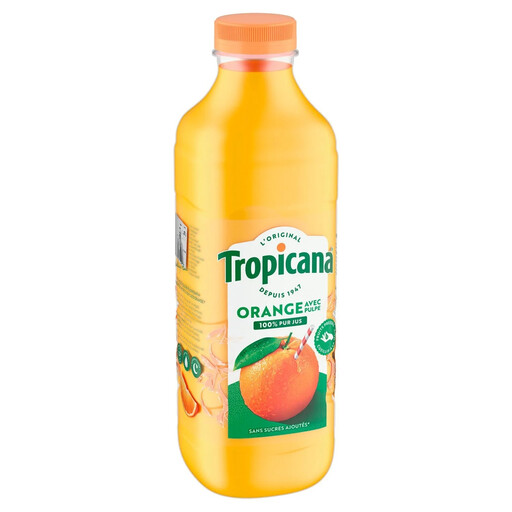 Image unavailable
Worth considering for several servings if you can refrigerate the bottle after opening. The Joybuy product page states that it’s made from 100% squeezed oranges and contains 9.8 g of sugars per 100 ml, so this juice isn’t sugar-free. It must be kept in the fridge and consumed within three to four days of opening. The title flags that it’s short-dated; check the date on the product you receive.
No. Orange juice with no added sugars still contains sugars naturally present in the fruit. To compare two bottles, check the ‘of which sugars’ figure per 100 ml, then factor in how much you’ll drink.
First, decide whether you want to avoid added sugars or compare total sugars: these are different things. Then check the ingredients and nutritional information per 100 ml; the DGCCRF says that presenting information this way makes it possible to compare products.
Yes, as long as you follow the product’s storage instructions after opening. The product page for the 1 L Tropicana featured here says to refrigerate it and consume it within three to four days. Check the instructions on any other bottle before planning to finish it later.