People looking to avoid added sugars
You’re looking for a short ingredients list, while bearing in mind that orange juice contains naturally occurring sugars. The ingredients list and nutrition information answer two different questions.


For your weekly shop, if avoiding added sugars is a priority, start by looking for an orange juice whose ingredients list contains only orange juice. Then check the ‘of which sugars’ line: no added sugars doesn’t mean the juice is sugar-free. Finally, choose a size and texture that suit what your household will actually drink after opening.
You’re looking for a short ingredients list, while bearing in mind that orange juice contains naturally occurring sugars. The ingredients list and nutrition information answer two different questions.
You’re deciding between a small carton and a bottle to share. How many people will drink it, and the instructions for storing it after opening, matter more than choosing a large size out of habit.
You prefer your juice with or without pulp. This can determine which bottle actually gets finished, but it doesn’t replace checking the ingredients and sugar content.
When choosing orange juice for the week, check the ingredients and sugar content first, then match the size and texture to your drinking habits.
| Criteria | What to check | Who is it for? |
|---|---|---|
| Ingredients and sugars | Check the product description, ingredients list and ‘of which sugars’ line per 100 ml. | I want to avoid added sugars without assuming the juice contains no sugar at all; around 33% of consumers would make this their priority. |
| Size | Match the volume to the number of glasses planned for your household and the storage instructions after opening. | I’m looking for a size that suits how much we drink, so we don’t leave a bottle unfinished; around 27% of consumers would prioritise size. |
| Pulp | Choose the texture you prefer for the specific product, without assuming it tells you anything about its sugar content. | If I don’t like the texture, I may not finish the juice; around 20% of consumers would prioritise whether or not it contains pulp. |
| Portions and storage | Plan the portions you’ll serve and check the bottle for how long it can be kept after opening. | I want to plan how many glasses we’ll have without keeping an opened bottle for too long; around 20% of consumers would prioritise portions and storage. |
Naturally occurring sugars are still listed in the nutrition information. For example, Auchan’s product page for Joker pure orange juice without pulp lists 8.6 g of sugars per 100 ml.
Check both the ingredients and the ‘of which sugars’ line on the bottle you choose.
The ingredients can be different: the Jus de Fruits Caraïbes page for Pampryl Orange Mandarine, for example, lists water, sugar and a natural flavouring.
Check the product description and ingredients before comparing this drink with pure orange juice.
Once opened, a bottle should be consumed according to the instructions for that product. A bottle that’s too large for your household’s usual consumption may be left unfinished.
Count the glasses you’re actually planning to serve and check the storage instructions before choosing a size.
Manger Bouger recommends limiting fruit juice to no more than one glass a day and choosing whole fruit instead.
Bear this in mind when planning drinks and fruit for the week.
Ingredients, sugar content and size should be checked for each product: they don’t necessarily apply to an entire brand.
The 1 L Pur Jus Engagé product without pulp may suit you if you’re looking for orange juice with just one ingredient.
The 2 L pure orange juice without pulp and with no added sugars may suit a household that will finish the whole bottle.
The 1 L product with pulp is a good fit if you prefer this texture.
The 20 cl pure orange juice is a small size worth considering for occasional consumption.
The Orange Mandarine drink described by Jus de Fruits Caraïbes should be considered as a different type of drink from pure orange juice.
This product is for people who prefer orange juice with pulp. As it has a short use-by date, it’s particularly important to choose a size your household can finish in time.
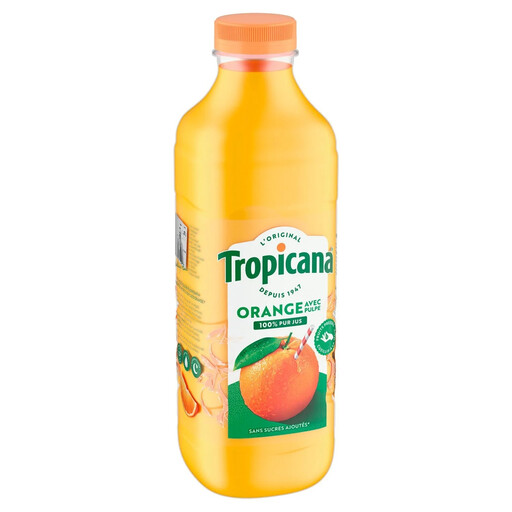 Image unavailable
Worth considering if you like pulp and plan to finish a 1 L bottle within the stated time.
The Joybuy product page describes it as juice made from 100% squeezed oranges, with no added sugar and 9.8 g of sugars per 100 ml.
Check the date on the packaging before buying. According to the Joybuy product page, refrigerate the juice after opening and consume it within 3 to 4 days.
No: it can contain sugars that occur naturally in oranges. As well as checking the ingredients list, look at the ‘of which sugars’ line per 100 ml for the product you’re buying.
Choose a size based on how many people will drink it and how many glasses you’re actually planning to serve, while keeping storage after opening in mind. Manger Bouger recommends limiting fruit juice to no more than one glass a day and choosing whole fruit instead.
Start by checking the product description and ingredients, rather than relying on the word ‘orange’ alone. If you’re looking for a product made only with orange juice, check that the bottle you choose matches this: an orange and mandarin drink may also contain water, sugar or flavourings.
Follow the instructions on the bottle you’ve bought, as the storage time varies by product. For example, Auchan’s product page for its 20 cl pure orange juice says to refrigerate it after opening and consume it within five days.