Runners planning a snack
You’d like to have orange juice at breakfast or as a snack around your training session. The ‘no added sugar’ claim appeals to you, but you should also check how much sugar the juice contains.


No-added-sugar orange juice can be enjoyed as a snack before or after a workout, provided you choose a suitable portion and know how well you tolerate it. It still contains the sugars naturally present in the fruit. Don’t automatically treat it as a complete source of fuel during a marathon: consider the amount of carbohydrate, how much you’ll need to drink and your other nutritional needs together.
You’d like to have orange juice at breakfast or as a snack around your training session. The ‘no added sugar’ claim appeals to you, but you should also check how much sugar the juice contains.
You prefer to choose the texture and amount you drink before a run. A small pack makes it easier to stick to a set portion, but you should still see how your digestion responds during training.
You’re considering drinking juice during a long effort and want to know how much carbohydrate it provides, without assuming it will meet all the other needs in your race plan.
First, distinguish between a snack to have around your training session and a drink you might have during a marathon. Then check the exact product’s label to compare the portion size, carbohydrate content and texture.
| Factor | What to check | Who it matters to |
|---|---|---|
| Sugars and carbohydrates | Check the carbohydrate content, including sugars, per 100 ml and per planned portion. Also check the product description and ingredients. | For a snack, I want to know how much carbohydrate I’m drinking without confusing ‘no added sugar’ with ‘sugar-free’. Around 40% of consumers make this their priority. |
| Pulp and pack size | Compare whether the juice contains pulp and the size of the container; try your chosen option during training. | Before a run, I prefer to control how much I drink and choose a texture I can tolerate. This matters to around 30% of consumers. |
| Use during a race | Compare the carbohydrate content of your portion with your fuelling plan; consider hydration and sodium separately. | If I take juice with me during a marathon, I want to know how it can fit into my fuelling plan rather than relying on it alone. Around 30% of consumers put this need first. |
The sugars naturally present in oranges remain in the juice. According to the DGCCRF, the claim ‘contains naturally occurring sugars’ is reserved for fruit juices.
Compare the ‘carbohydrate’ and ‘of which sugars’ figures in the nutrition information, both per 100 ml and for the amount you plan to drink.
A small bottle can provide carbohydrates, but it may not provide the amount you’ve planned for your race on its own. Drinking several bottles also increases the volume you need to take in.
Check the total carbohydrate content of your race fuel and consider hydration and electrolytes in light of the race conditions. Test your plan on long runs.
Juice with or without pulp, or a different portion size, might not suit you during exercise. ‘No pulp’ doesn’t guarantee digestive comfort.
Try the product and an amount similar to what you plan to have on race day during training.
Two orange drinks may have different product descriptions and ingredients. A different pack size doesn’t guarantee the same recipe either.
Before buying, check the availability, product description, ingredients and nutritional values of the exact product.
These products show how recipes, textures and pack sizes can differ. Always check the label of the product you choose.
Carrefour lists a 1 L Joker orange juice with no pulp and no added sugar, made from concentrate and containing vitamin C.
Carrefour’s product information describes its 1 L fresh orange juice with no pulp as being made from orange juice.
Carrefour’s range includes a 2 L Carrefour Extra orange juice with no pulp and no added sugar, as well as other pack sizes and Carrefour Bio products.
Auchan’s 20 cl bottle of pure orange juice with no added sugar offers a set portion size.
This 1 L orange juice with pulp is an option to consider around your training sessions. If you’re specifically looking for juice with no added sugar, check this claim and the nutritional information on the label before choosing.
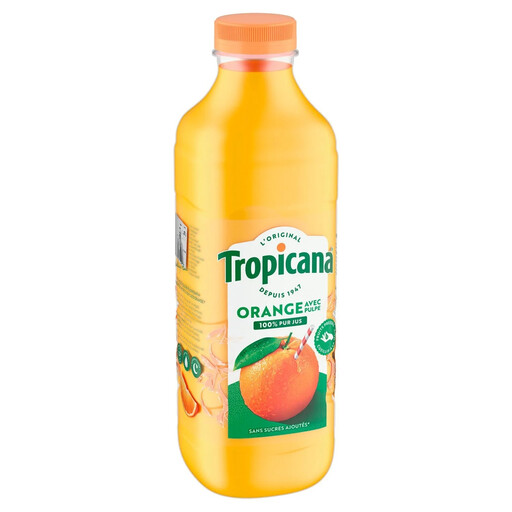 Image unavailable
Worth considering as a snack if you prefer juice with pulp; check its ingredients and choose a portion that suits you.
The product title indicates that it is short-dated. Check the best-before date on the packaging before buying.
No. Juice with no added sugar still contains the sugars naturally present in the fruit. For this product, Carrefour’s product information for Joker orange juice with no pulp lists 8.6 g of carbohydrate, including 8.6 g of sugars, per 100 ml.
Don’t assume it will provide everything you need. Juice provides carbohydrates, but the amount you need, how much you’ll have to drink, your tolerance and your other nutritional needs should all be considered as part of your race plan, then tested during training.
Auchan’s 20 cl bottle of pure orange juice with no added sugar lists 17 g of carbohydrate, including 17 g of sugars. For another product, check the nutritional values on the exact bottle rather than relying on this figure.
Choose a texture you’ve already tried in conditions similar to how you plan to use it. Juice without pulp doesn’t, on its own, guarantee digestive comfort.
Follow the instructions for the exact product. For its 20 cl orange juice bottle, Auchan recommends refrigerating it after opening and drinking it within five days.