Cyclists preparing for a demanding ride
You want to know how many carbohydrates are in the portion you plan to drink, without confusing “no added sugar” with “sugar-free”.


When choosing an orange juice to have around a bike ride, start by checking its product name and ingredients: pure juice and an orange drink are not the same thing. “No added sugar” does not mean there are no naturally occurring sugars. Check the carbohydrates per 100 ml, then choose your portion and pack size based on when you plan to drink it.
You want to know how many carbohydrates are in the portion you plan to drink, without confusing “no added sugar” with “sugar-free”.
You’re looking for a pack size that suits breakfast or a drink after your ride, taking into account the portion served and how long it keeps once opened.
You want to compare the product name, fruit content and ingredients before choosing a product with the word “orange” on the label.
| Criterion | What to check | Who it’s for |
|---|---|---|
| Carbohydrates per portion | Check the carbohydrates and “of which sugars” per 100 ml, then calculate the amount for the volume you plan to drink. | If I’m planning to have juice around a demanding ride, I want to know what’s in my portion rather than relying on the claim on the front of the pack. Around 36% of consumers put this carbohydrate calculation first. |
| Ingredients and product name | Compare “pure juice” with “orange drink”, check the ingredients list and look for the “no added sugar” claim. | I want to choose orange juice without assuming that no added sugar means there’s no sugar in my glass. Ingredients are the main priority for around 36% of consumers. |
| Pack size and storage | Check the volume and storage instructions after opening for the specific product. | When I only drink juice occasionally, I prefer a container I can finish within the stated time. For around 28% of consumers, pack size and when they plan to drink it come before other criteria. |
Anses clarifies that this claim does not rule out sugars naturally present in the ingredients. The Auchan product listing for Joker Pur Jus sans pulpe, for example, states that it contains 8.6 g of sugars per 100 ml.
Check the “of which sugars” line and calculate the amount in your portion.
Joker’s products are not interchangeable: Auchan describes one as a pure juice made from orange juice, while another is labelled as a flavoured orange drink containing 60% fruit.
Check the exact product name and ingredients on the bottle you choose, even if you already know the brand.
How long a product keeps once opened depends on the product. The Auchan and Andros listings consulted advise keeping the juice in the fridge and drinking it within five days.
Choose a volume that suits the portions you’re planning and follow the instructions on your bottle.
A bottle that’s too large could leave you throwing away leftover juice once it’s past its use-by period.
The carbohydrates shown on the label help you work out your intake, but they don’t tell you how to hydrate or cover all your fuelling needs on a ride.
Plan your hydration separately and try the volumes you’re considering during training.
The Auchan listing for Joker Pur Jus sans pulpe 1 L describes a product made from orange juice and labelled “no added sugar”.
The Joybuy listing for a 1 L Tropicana product describes a juice with bits, made from 100% squeezed oranges and with no added sugar.
Carrefour sells orange juice with no bits and no added sugar under this range, including 50 cl and 2 L packs.
Auchan’s listings for pure orange juice with no bits in 1.5 L and 2 L packs list orange juice as the ingredient.
The E.Leclerc listing for a 90 cl Bio Village pure orange juice with no bits lists organic orange juice as the ingredient.
This product with bits may suit shoppers who want to check the carbohydrates in a portion to have around a bike ride. As it’s marked “short-dated”, the batch date is especially important when choosing it.
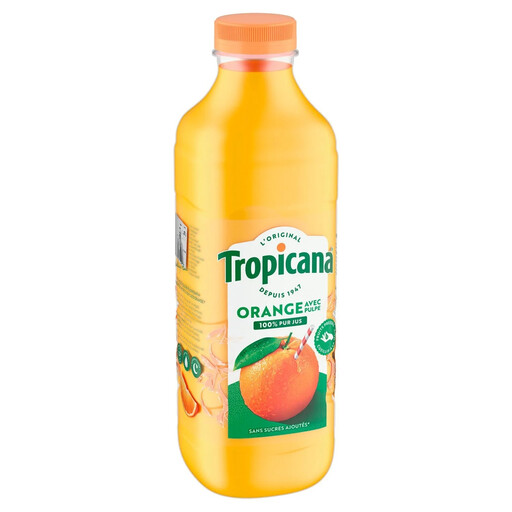 Image unavailable
For anyone who prefers juice with bits and wants to calculate the carbohydrates in their portion to have around a ride.
According to the Joybuy listing, this juice is made from 100% squeezed oranges and contains no added sugar. It has 10 g of carbohydrates, of which 9.8 g are sugars, per 100 ml.
Check the date on the batch marked “short-dated”. Once opened, the listing advises keeping it in the fridge and drinking it within three to four days.
No. According to Anses, the claim means no sugar has been added; it doesn’t rule out naturally occurring sugars. To find out how much sugar is in the juice you choose, check the “of which sugars” figure in the nutritional information.
For Joker Pur Jus, which Auchan lists as containing 8.6 g of carbohydrates per 100 ml, you’d need around 350 ml to get 30 g of carbohydrates. The volume depends on the product, so always use its nutritional information and the portion you’ll actually serve.
Don’t base your hydration plan solely on the juice’s carbohydrate content. If you’re thinking of drinking it during exercise, consider how much you’ll need and try it during training. Plan your hydration and the rest of your fuelling separately.
Follow the storage time on the product you buy and keep it according to the instructions. The Auchan and Andros listings consulted advise keeping the juice in the fridge for five days after opening; instructions may differ for other products.
No, it shouldn’t be treated as a regular replacement. Manger Bouger recommends choosing whole fruit and limiting all fruit juice to a maximum of one glass a day as part of your usual diet.