People in a hurry in the morning
If you want a muesli you can quickly pour into a bowl before heading out, check that your chosen recipe is labelled “no added sugars”. Total sugars and allergens should still be checked separately.


For a quick weekday breakfast, start with a specific muesli product labelled “no added sugars”, then compare the “of which sugars” figures per 100 g: dried fruit can contribute naturally occurring sugars. Next, choose a recipe that suits your priorities — wholegrains, fruit and seeds, or a higher-protein option — and check the ingredients and allergens listed on the packaging.
If you want a muesli you can quickly pour into a bowl before heading out, check that your chosen recipe is labelled “no added sugars”. Total sugars and allergens should still be checked separately.
Compare the fibre and wholegrain content in the nutritional information, while also checking the sugars per 100 g. These figures give you a more accurate picture than the impression created by the front of the pack.
If protein is your main priority, compare the amount per 100 g and the ingredients in each recipe. A high-protein recipe may contain soya or wheat, for example, so check the exact product if you need to avoid certain ingredients.
For weekday muesli, first distinguish between no added sugars and the total sugar content. Then compare recipes based on what matters most to you.
| Criteria | What to check | Who is it for? |
|---|---|---|
| Added sugars and total sugars | The exact “no added sugars” claim, followed by the “of which sugars” figure per 100 g and whether the ingredients include dried fruit. | I want to avoid added sugars without assuming that fruit muesli contains no sugars at all. Around 33% of consumers say this distinction is their top priority when choosing. |
| Ingredients to avoid | Allergens in the ingredients list and any “may contain” warnings on the pack of the specific recipe. | If I need to avoid certain ingredients, a recipe with nuts or cereals isn’t suitable just because of its name. Ingredient suitability is the main concern for around 27% of consumers. |
| Protein | Protein per 100 g, the portion you eat and the ingredients in the recipe. | If I want my muesli to add more protein to my bowl, I compare recipes while keeping their ingredients in mind. This is a priority for around 20% of consumers. |
| Pack size and repeat purchases | The pack weight, storage instructions after opening and whether you can find the same product again when doing your usual shop. | For weekday mornings, I prefer a pack size my household can finish and store according to the product instructions. Around 20% of consumers make convenience their main criterion. |
Mueslis labelled “no added sugars” can still contain sugars according to their nutritional information, particularly when the recipe includes dried fruit.
Read the ingredients list and compare the “of which sugars” figures on the same per-100 g basis.
A recipe with no added sugars may contain tree nuts, wheat or soya, or carry a warning that it may contain traces of other ingredients.
If you need to avoid an ingredient, check the packaging for the exact product, including any “may contain” warnings.
The French product listing for Kellogg’s Country Store includes sugar in the ingredients, so the brand name alone doesn’t tell you whether a muesli has no added sugars.
Check the ingredients list and nutritional information for every recipe you’re considering.
Bjorg offers a classic no-added-sugar muesli in a 750 g pack, as well as a Protein recipe. Compare the two products to find the ingredients that suit you.
The organic Fruit and Nut recipe with no added sugars combines fruit and nuts for anyone looking for this type of mix.
The 375 g Organic Fruit Muesli with No Added Sugars is worth considering if you’re looking for a fruit mix.
If no added sugars is your starting point, consider each Kellogg’s recipe individually.
This selection features a 375 g pack of Bjorg muesli for weekday breakfasts. Check the claims and nutritional information on this specific pack before choosing.
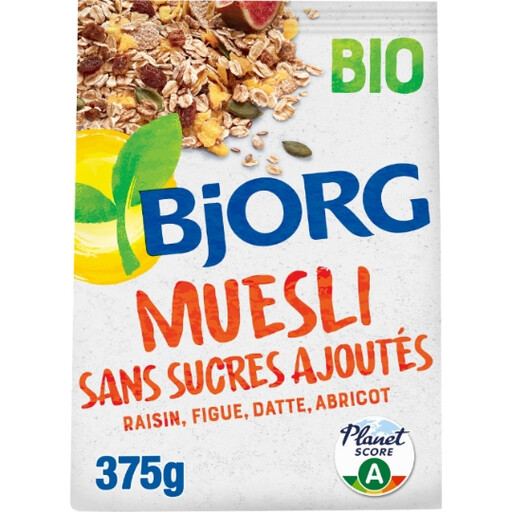 Image unavailable
This pack size may suit you if you want a muesli that’s quick to prepare on weekday mornings. For this 375 g product, check the pack for the claim about added sugars, the “of which sugars” figure and the allergens. Don’t assume it has the same values as another Bjorg recipe or pack size.
No. The Bjorg and Jordans recipes mentioned here list sugars per 100 g despite carrying this claim. To compare two packs, check the “of which sugars” figure as well as the ingredients list.
First, compare the “no added sugars” claim and sugars per 100 g, then check the ingredients, allergens, fibre or protein, depending on your priorities. Finally, compare these figures with the portion you actually serve.
No. Two mixes made with wholegrains can differ in their fruit, total sugars and allergens. Check for wheat, soya or tree nuts, as well as any warnings about traces, on the product you choose.
No. A rating or claim on the front of the pack doesn’t replace checking the ingredients and nutritional information for the specific product. The DGCCRF notes that nutrition claims are regulated; they don’t remove the need to check the sugars and allergens that matter to you.
Choose a pack size that suits how quickly you’ll use it, and follow the storage instructions on the packaging after opening. A large pack is only convenient if you can reseal it and use it as directed for that product.