Households avoiding added sugar
When several people are eating the same cereal, the priority may be a recipe with no added sugar, rather than simply less sugar. If it contains dried fruit, it’s also worth checking the total sugar content.


When shopping for a large family and looking to avoid added sugar, check for the exact wording “no added sugar”, then look at the ingredients and the “of which sugars” line per 100 g. This claim does not mean “sugar-free”. Plain oats make a versatile base that everyone can customise in their own bowl; ready-to-serve muesli takes less preparation, but its dried fruit may contain naturally occurring sugars.
When several people are eating the same cereal, the priority may be a recipe with no added sugar, rather than simply less sugar. If it contains dried fruit, it’s also worth checking the total sugar content.
Plain oats let everyone add their own toppings, although they take a little preparation. Quaker France, for example, describes its Quaker Oats as a no-added-sugar base.
A reduced-sugar recipe or one with a fibre content that appeals to you may suit this different priority. However, neither of these features tells you whether the product contains added sugar.
If several people in your household eat the same cereal, first decide what “no sugar” means for you. Then choose the recipe and format.
| Criteria | What to check | Who is it for? |
|---|---|---|
| Added sugar | The exact wording, the ingredients and the “of which sugars” line per 100 g. | If I want to avoid added sugar, a recipe containing dried fruit may still have naturally occurring sugars. Around 31% of consumers put no added sugar at the top of their list of needs. |
| Family-size pack | The net weight and how much the household will use after opening. | When we regularly make several bowls, I look for a pack that suits the household’s routine, rather than buying a large size that only a few people enjoy. Pack size is the top priority for around 25% of consumers. |
| Taste and preparation | The choice between oats to top yourself, ready-to-serve muesli and reduced-sugar cereal. | If everyone at the table has different tastes, I prefer to customise each bowl or choose a recipe everyone likes. Around 19% of consumers put taste and ease of preparation first. |
| Fibre and allergens | The fibre content and allergen information for the specific variant you’re buying. | When the ingredients need to suit everyone eating, I check the exact pack rather than relying on the recipe name alone. For around 25% of consumers, fibre and ingredient suitability are the top priority. |
A recipe with no added sugar may still contain naturally occurring sugars, particularly if it includes dried fruit.
If you’re concerned about total sugar, check the “of which sugars” line per 100 g as well as the claim on the pack.
A reduction compares a recipe with another reference; it doesn’t mean that sugar has been removed from the ingredients. For example, Nestlé Céréales lists sugar, invert sugar syrup and molasses in Cheerios Avoine.
Check the ingredients before choosing a reduced-sugar cereal if you’re buying it to avoid added sugar.
Fibre content and the presence of added sugar are two separate considerations. Kellogg's France’s published ingredients list for All-Bran Fibre Plus includes sugar.
If added sugar is your priority, check the recipe first, then compare the fibre values you’re interested in.
The Carrefour Bio Corn Flakes listing says “no added sugar”, but also gives an added sugar figure of 2,172 g per 100 g. With these two claims in conflict, you can’t rely on this listing alone to assess the product against this criterion.
Check the packaging for the product in question or ask the manufacturer or retailer to clarify before deciding.
Worth considering if you want to build your bowls around plain oats.
A brand to consider for muesli with dried fruit, rather than for a product with no sugar at all.
A corn flakes option whose labelling needs clarifying before choosing it on the basis of no added sugar.
Cheerios Avoine is an option for those looking for reduced-sugar cereal, which is different from looking for cereal with no added sugar.
All-Bran Fibre Plus highlights the difference between prioritising fibre and choosing a product with no added sugar.
This selection includes oats to prepare to suit your household’s tastes, as well as ready-to-serve muesli. If you’re choosing based on added sugar, check the claim and ingredients for each variant. These products are not a selection of cereals entirely free from sugars.
 Image unavailable
For making bowls with different toppings. Before choosing it for the whole family, check the pack for the sugar claim, ingredients and allergen information.
 Image unavailable
An oat base to prepare and top separately to suit everyone’s preferences. Check the nutritional information and allergen details on this specific pack.
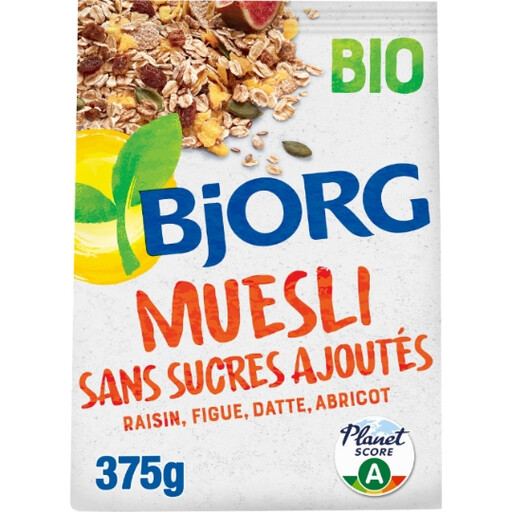 Image unavailable
For households that prefer a ready-to-serve mix. Consider this 375 g pack in relation to how quickly your family gets through it, and check the sugar content and allergens for this recipe.
 Image unavailable
A size to consider if you’re making several bowls of oats. If no added sugar is essential, check the claim, ingredients and “of which sugars” line on the packaging.
No. European regulations govern the claim that no sugars have been added, but cereal may still contain naturally occurring sugars. If you’re concerned about total sugar, also check the “of which sugars” line per 100 g.
Compare their nutritional values per 100 g, then check the ingredients, allergens and pack sizes. Where displayed, Nutri-Score can be a useful additional guide: Santé publique France explains that manufacturers choose whether or not to display it.
Not on the basis of that claim alone: a reduction doesn’t mean there is no added sugar. For example, Nestlé Céréales lists sugar, invert sugar syrup and molasses in Cheerios Avoine; check the ingredients of the recipe you’re considering.
Read the ingredients list and any precautionary allergen information on the pack for the variant you’ve chosen. Don’t assume the information for one muesli applies to another recipe, even if their names are similar.