People avoiding added sugars
You’re looking for a bar with this claim and want to know what it does — and doesn’t — tell you about the sugar content shown in the nutritional information.


When choosing a bar to serve with Candlemas pancakes, look for the exact claim that matches what you’re after: “no added sugars” does not mean “sugar-free”. Anses distinguishes between these two claims. Then compare the “of which sugars” figure, ingredients, allergens and pack size of the product you plan to serve.
You’re looking for a bar with this claim and want to know what it does — and doesn’t — tell you about the sugar content shown in the nutritional information.
If you’re cutting up a bar to serve with pancakes, its ingredients and allergens matter just as much as its size.
You want to find a product that meets your criteria, then check its variant and availability at your chosen shop or online grocery service.
When choosing a bar for Candlemas, start with your main priority, then check the other details on the exact product you’re considering.
| Criteria | What to check | Who is it for? |
|---|---|---|
| Claim and sugars | The exact claim, then “of which sugars” per 100 g and per serving. | If avoiding added sugars is my main concern, I want to distinguish this claim from a bar containing no sugars at all. Around 50% of consumers are said to prioritise this criterion. |
| Ingredients for sharing | The ingredients, sweeteners and allergens in the chosen variant. | If I’m serving the bar with pancakes for a group, I need to know whether its ingredients are suitable for my guests. This compatibility is said to be the main priority for around 30% of consumers. |
| Pack size and availability | The number of bars, the stated weight and availability through your chosen shopping channel. | If I’m planning my Candlemas food shop, I want to find a suitable pack size without accidentally swapping my chosen product for a standard bar. Around 20% of consumers are said to put this choice first. |
According to Anses, “sugar-free” means containing less than 0.5 g of sugars per 100 g or 100 ml. A bar labelled “no added sugars” may still contain naturally occurring sugars.
Read the claim, then check the “of which sugars” figure on the wrapper of the bar you’ve chosen.
Carrefour France lists Mars and Twix in its standard chocolate bar aisle, while its search results separately show Dukan “no added sugars” bars. So the aisle alone won’t confirm whether a bar has this claim.
Open the product listing for the variant you’re interested in and check its claim before choosing it.
The Canderel and Joyfuel product listings mentioned here include milk and soya, as well as almonds or hazelnuts depending on the bar. They also list sweeteners.
Check the ingredients and allergens for the flavour and pack size you plan to serve.
The European Commission says that, under current EU rules, front-of-pack nutrition information can be provided voluntarily. The Ministry of the Economy and Finance describes the contribution in question as applying to non-alcoholic drinks, not as a way to choose chocolate bars.
Instead, compare the nutritional information, ingredients and allergens. If a Nutri-Score appears on the packaging, treat it as additional information. Its absence doesn’t mean the bar is non-compliant.
The dark chocolate and hazelnut product listed on Joybuy is a protein bar labelled “no added sugars”, rather than a standard chocolate bar.
Carrefour France lists oat bran bars in chocolate and hazelnut flavours, labelled “no added sugars”.
A Carrefour France listing features a milk chocolate bar with crunchy almonds, labelled “no added sugars”.
This selection features a chocolate and hazelnut protein bar for an individual snack. If you’re mainly looking for a topping to cut up and serve with pancakes, check that its ingredients and size are suitable for this purpose.
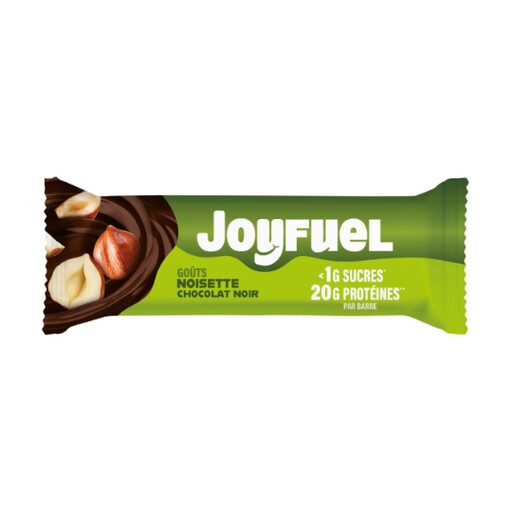 Image unavailable
Worth considering if you’re looking for an individual chocolate snack labelled “no added sugars”, rather than a “sugar-free” bar under the threshold set out by Anses.
The Joybuy listing gives 0.6 g of sugars, 26 g of polyols and 36 g of protein per 100 g. It mentions maltitol, as well as milk, soya and hazelnuts; check the allergens before sharing.
No. Anses distinguishes between not adding sugars and the claim “sugar-free”, which means containing less than 0.5 g of sugars per 100 g or 100 ml. For a specific bar, also check the “of which sugars” figure in the nutritional information.
No. Under current EU rules, the European Commission says that front-of-pack nutrition information is voluntary. If a Nutri-Score is shown, it can help you compare products; its absence alone says nothing about the bar’s ingredients.
No. The Ministry of the Economy and Finance describes the contribution in question as applying to non-alcoholic drinks. When choosing a chocolate bar, check its claim, ingredients and nutritional information instead.
Check the allergens for the exact product and consider the people you’ll be serving. The Carrefour and Joybuy listings featured here mention milk, soya, almonds or hazelnuts, depending on the bar. The claim “no added sugars” tells you nothing about these allergens.
A product listed in a catalogue may not be available at your local shop or through its online grocery service. For example, Carrefour France marks the Canderel bar in the listing mentioned here as unavailable. Check the variant, pack size and availability through your chosen shopping channel.