People looking to limit added salt
You want a tomato base that lets you control how much seasoning goes into your dish. The ‘no added salt’ label, ingredients list and ‘salt’ value per 100 g can help you compare products.


To limit added salt, choose a product labelled ‘no added salt’, then check the ingredients and the ‘salt’ entry in the nutrition information. For a meal that’s easy to chew, whole peeled or chopped tomatoes may need to be cooked and mashed or blended. Purée provides a smoother base, but that alone doesn’t guarantee a texture suited to someone’s needs.
You want a tomato base that lets you control how much seasoning goes into your dish. The ‘no added salt’ label, ingredients list and ‘salt’ value per 100 g can help you compare products.
You’re cooking for someone who finds chewing difficult, so you need to consider the texture after cooking, mashing or blending, rather than relying on the product name alone.
You want to choose an amount that suits the meals you’re planning, avoid leftovers and check that the product you want is available at your local shop.
First, choose between whole tomatoes, chopped tomatoes and purée based on the texture you can prepare or use. Then check the salt information for the specific product.
Consider these if: you want to start with whole tomatoes and can cook them before mashing or blending.
Bear in mind: the pieces won’t automatically be easy to chew. Auchan lists a Jardin BiO étic organic product of whole tomatoes labelled ‘no added salt’.
Consider these if: small, soft pieces will work in the dish you’re planning.
Bear in mind: chopped tomatoes may still need blending. Carrefour lists chopped peeled tomatoes from Jardin BiO étic labelled ‘no added salt’.
Consider this if: you want a smooth base for a sauce or soup.
Bear in mind: purée is not the same as canned peeled tomatoes. Check the ingredients and the texture of the finished dish.
| Criteria | What to check | Who it matters to |
|---|---|---|
| Added salt | Look for the ‘no added salt’ label, then check the ingredients and the ‘salt’ value per 100 g. | If I want to decide how my meal is seasoned, I distinguish a ‘no added salt’ label from a simple declared salt value. Around 42% of consumers would make the absence of added salt their top priority. |
| Texture | Check the size of the pieces and whether the product can be cooked, mashed or blended. | When chewing pieces is difficult, the texture of the finished dish matters more to me than the original form of the tomatoes. Texture would be the top criterion for around 33% of consumers. |
| Pack size | Compare the net weight with the amount you need and check the storage instructions after opening. | If I’m preparing just a few portions, I prefer a pack that helps limit leftovers and is available at my local shop. Pack size would be the top priority for around 25% of consumers. |
The amount of salt shown in the nutrition information and whether salt appears in the ingredients are two different things.
If you want to limit what you add to your recipe, check the product label, the ingredients and the ‘salt’ value per 100 g.
Whole or chopped tomatoes may still contain pieces after cooking. The texture needed depends on the person’s ability to chew and swallow.
Plan to mash or blend them to suit the dish. If the person has dysphagia, follow the texture guidance provided by their healthcare professional.
If the pack contains more than you need for the meal, you’ll have tomatoes left to store after opening.
Choose a pack size to suit the portions you’re planning and check the storage instructions on the packaging.
Auchan and Carrefour list two types of peeled tomatoes labelled ‘no added salt’.
Mutti’s French product listing for Pelati peeled tomatoes specifies whole peeled tomatoes and tomato juice.
Carrefour lists 400 g tins of Cirio peeled tomatoes, described as coming from Puglia.
The retailer lists, among other products, chopped Jardin BiO étic tomatoes labelled ‘no added salt’, as well as peeled tomatoes from other brands.
E.Leclerc lists 400 g packs of Bio Village organic whole peeled tomatoes.
The retailer lists 240 g of Jardin BiO étic organic whole peeled tomatoes labelled ‘no added salt’.
These two products are tomato purées to consider as bases for sauces or soups, rather than as whole or chopped peeled tomatoes. Check the salt information for each product and adjust the texture of the dish to suit the person’s needs.
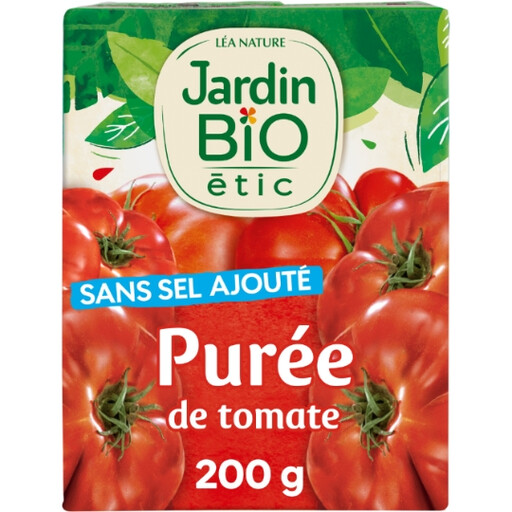 Image unavailable
This purée can be used as a base for a sauce or soup if you’d rather work with a preparation that doesn’t contain pieces of whole tomato. The Joybuy France listing shows a 200 g pack labelled ‘no added salt’. Check that the texture of the finished dish is suitable for the person.
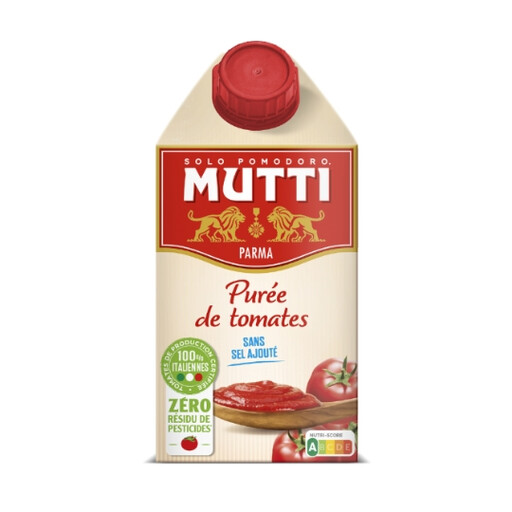 Image unavailable
This 500 g tomato purée can be used as a base for a sauce or soup. If no added salt is important to you, check the label, ingredients and ‘salt’ value on the product you buy. Also check that the texture of the finished dish is suitable.
No. The label refers to salt being added, while the ‘salt’ entry in the nutrition information gives the amount per 100 g. Check both if you’re comparing canned products for a recipe where you want to control the seasoning.
Not necessarily as they are: whole tomatoes can still contain pieces. Cook them, then mash or blend them to achieve the consistency you need. Geneva University Hospitals emphasises that the texture should match the person’s ability to chew and swallow.
No. The word ‘purée’ alone doesn’t tell you whether the finished dish has the right texture. If someone has dysphagia, follow the level and guidance given by their healthcare professional. The IDDSI texture descriptions don’t replace an individual assessment.
Follow the packaging instructions, put any leftovers in the fridge and, if needed, use a clean, sealed container. The French Agency for Food, Environmental and Occupational Health & Safety (Anses) says the coldest part of the fridge should be between 0 and +4 °C.
Not necessarily: availability can depend on the shop or local store. Before planning a meal around a specific product, confirm the version, pack size and collection or delivery options with the retailer.