
Livraison le jour même ou le lendemain

Qualité garantie

Débloquez vos offres de bienvenue: Livraison GRATUITE | Jusqu'à -80 % | 30 jours d'essai gratuits à JoyPlus
Téléchargez l'application
Waking up to a wet bed? It's an exhausting daily reality for many parents. Between the laundry piling up and your child's discomfort, finding a reliable solution becomes urgent. The night-time diaper market is vast, but be warned: not all absorption promises are created equal. Choosing the right product is the key to getting back to peaceful nights, for both your child and you.
As a product expert at Joybuy, my role is to help you see things more clearly. Let's forget the marketing jargon and focus on what really matters for keeping your child dry all night long.
Before you start shopping, here are the three classic mistakes that lead to a disappointing purchase (and wet sheets).
To make the right choice, here are the three technical points that truly make a difference.
A good anti-leak night-time diaper is more than just its absorbent core. Its true effectiveness relies on a complete system:
The choice of format depends on your child's age and independence.
Your child's skin is in contact with the diaper for long hours. It's therefore essential to take a look at the composition:
Let's get practical. Here is a selection of products that meet specific needs, based on the criteria we've just established.

Why we recommend it: This classic is a safe bet for babies. Its taped format allows for a custom fit, which is essential for little ones who tend to wriggle less than their older counterparts.
Rather than betting everything on absorption, it tackles the #1 cause of leaks in babies: the lying-down position. Its Stop & Protect pocket at the back is designed specifically for this.
It combines a clever back-leakage prevention system with reassuring certifications (dermatologically tested, STANDARD 100 by OEKO-TEX certified).

Why we recommend it: The pant format is ideal for children who wriggle during changes and are restless sleepers. The soft waistband follows their movements without creating gaps, and therefore, leaks.
It tackles the problem of fit on a child who moves. Its 360° waistband offers a flexibility that a taped diaper can hardly guarantee.
Marketed by Pampers as its most absorbent pant, it includes reinforced anti-leak barriers and the famous back pocket. It's a real suit of armour for restless nights.
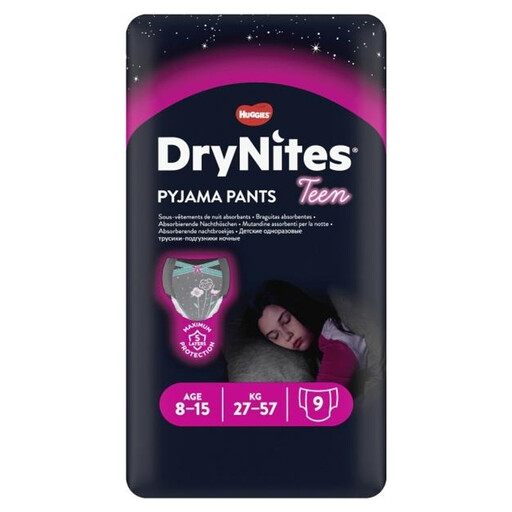
Why we recommend it: For older children, discretion is as crucial as absorption. The Huggies Drynites pants look like real underwear, with discreet designs and a slim fit that helps maintain self-confidence.
This isn't just a bigger diaper. It offers a targeted absorption zone, adapted to the anatomy of girls (or boys in the dedicated version), which is much more effective than uniform absorption.
Its 5-layer protection system ensures rapid and localised absorption. The brand claims it offers 30% more absorption than a standard daytime pant, all while remaining discreet under pyjamas.
Discover our full selection of products that meet our quality criteria and current standards.
A night-time diaper is designed for extended use, up to 12 hours. Its absorbent core is often higher-performing, and its anti-leak systems (barriers, back pocket) are reinforced to be effective in a lying-down position, where pressure and contact points are different.
As a general rule, it's better to choose the smaller of the two sizes, as long as it doesn't constrict the child. A diaper that's too large will gap at the thighs and waist, creating openings where leaks can seep through. Make sure you can comfortably fit two fingers under the waistband.
Night-time bedwetting (enuresis) is a physiological process that is not within a child's control. Night-time pants are not a hindrance, but rather a valuable tool for managing this period. They allow the child (and parents) to have peaceful nights, which reduces the stress associated with accidents. A well-rested and confident child will be in the best possible condition to achieve night-time dryness when the time is right.