
Livraison le jour même ou le lendemain

Qualité garantie

Débloquez vos offres de bienvenue: Livraison GRATUITE | Jusqu'à -80 % | 30 jours d'essai gratuits à JoyPlus
Téléchargez l'application
Natural food supplements appeal to people who want to enrich their diet with plants, algae, vitamins or superfoods. But a colourful label and a promise of vitality are not enough to guarantee the right choice. The format, the amount actually consumed and the traceability of the ingredients matter far more when placing your order.
An extract presented as “20 000 mg” may correspond to an equivalent quantity obtained through the extraction ratio, rather than 20 000 mg of raw material contained in the capsule. A 40:1 extract should therefore be interpreted carefully: the amount of extract present in the product and its raw-material equivalent do not mean the same thing.
To compare two products on a sound basis, always check:
Natural does not mean suitable for everyone. Seaweed, organic fenugreek, shilajit and plant-rich formulas may require certain precautions depending on your diet, any medicines you take or your stage of life.
A food supplement is not a substitute for a varied, balanced diet. If you are pregnant or breastfeeding, taking medication or have a health condition, ask a healthcare professional for advice before use.
For organic superfoods, look for the name of the certifying body rather than relying on a simple marketing claim. Organic certification confirms compliance with specific production standards; it does not guarantee any medical effect.
Also review the full ingredients list. A spirulina or chlorella capsule may contain only the powder and a plant-based shell. A combined formula may include anti-caking agents, vitamin C or other extracts.
Capsules make dosing easier and are convenient to carry. They work well as part of a daily routine, even though some recommendations require taking several. Spirulina tablets may require a larger quantity, while a super greens powder can be mixed into a drink or homemade preparation.
The right format therefore depends on your habits: a quick morning serving, use at work or adding it to a smoothie may not lead to the same choice.
Do not compare two bottles based solely on the number of capsules. A bottle of 180 capsules may provide 90 servings if the recommended intake is two capsules a day, or 180 days’ use if one capsule a day is sufficient.
The product pages featured specify, among other things:
This is the information that allows you to estimate the true cost of use, rather than comparing only the price shown on the bottle.
Check the manufacturer’s identity, the name of the responsible person in the European Union, storage conditions and the best-before date. For seaweed-based products, check the declared iodine content. For plants, look carefully at the species used and which parts of the plant are included in the formula.
Claims such as “vegan”, “gluten-free” or “GMO-free” can help you rule out products that do not match your preferences. However, they do not replace reading the full ingredients list.
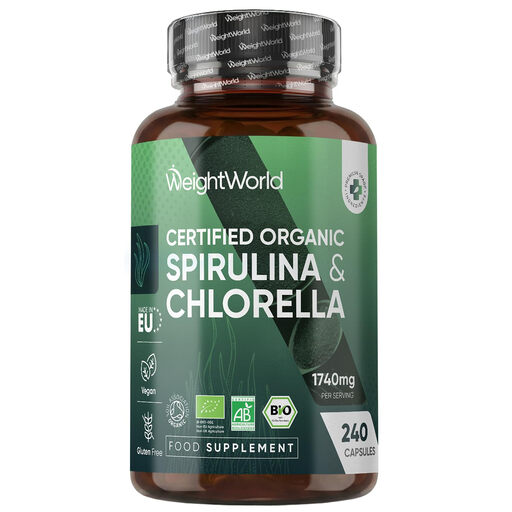
Why this choice suits this profile : This combination brings together two organic algae in one bottle, providing 80 servings at three capsules a day. A practical option for getting started with a vegan formula without having to buy several products.
The serving content is clearly detailed: 870 mg of organic spirulina and 870 mg of organic chlorella for three capsules. Soil Association certification and the absence of additives are also specified.
240 capsules, vegan formula, organic ingredients and a convenient format for taking on the go.
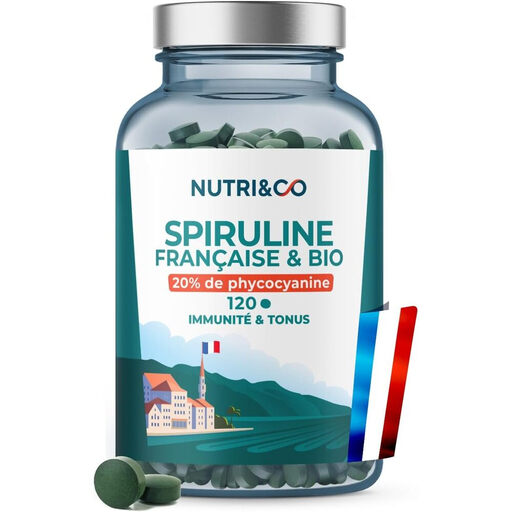
Why this choice suits this profile : This organic spirulina is grown and packaged in France. It has Ecocert AB certification and lists its composition as 100% spirulina.
The origin, certification, 3 g dosage for six tablets and absence of excipients are stated clearly, making comparison easier.
Advertised French production, Ecocert AB certification, vegan formula and no additives.
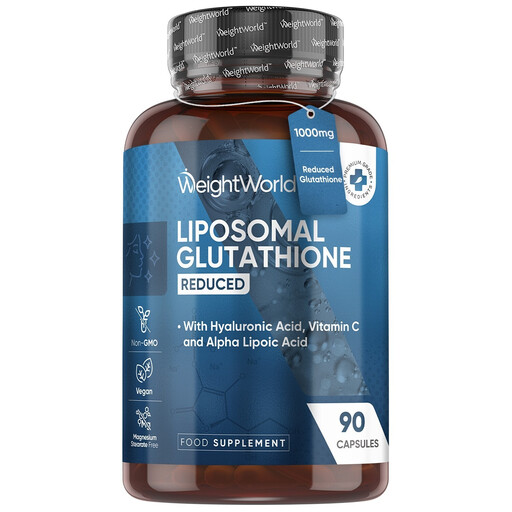
Why this choice suits this profile : This formula combines reduced liposomal glutathione, vitamin C, hyaluronic acid and alpha-lipoic acid in a single daily capsule.
The quantities are detailed for each capsule: 333,3 mg of liposomal glutathione, 66,7 mg of vitamin C and 50 mg of hyaluronic acid. Each component can therefore be assessed separately.
90 capsules, stated daily intake, vegan formula and GMO-free.
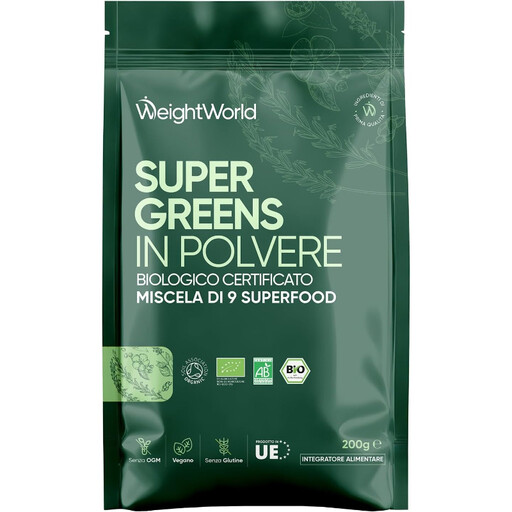
Why this choice suits this profile : This powder combines nine organic superfoods and mixes just as easily with water as with a smoothie or certain recipes.
The ingredients are detailed individually and the serving is clearly set at 5 g. However, the presence of guarana and matcha should be taken into account as part of your routine.
40 servings, Soil Association certification, vegan formula and 38,7 g of fibre per 100 g according to the product page.
We have selected a comprehensive range of products, updated in real time, that meet these demanding criteria and European safety rules.
Many are, including capsules with a hypromellose shell, spirulina, chlorella, organic moringa and super greens powders. Nevertheless, check for the “vegan” statement on the product page as well as the full composition, particularly for vitamins and the agents used during manufacture.
Follow the date shown on the packaging and the recommended storage conditions. Close the container carefully, store it in a dry place at a moderate temperature and keep it out of the reach of children. A powder may be more sensitive to moisture than a capsule.
Taking several supplements together is not necessarily useful and can quickly increase the number of ingredients consumed each day. Check for duplicate ingredients, dosages and the precautions specific to each formula. If you are taking medication, particularly anticoagulants or products that affect the thyroid, ask a professional for advice before adding seaweed, organic fenugreek or other plant extracts.