
Same-day & Next-day Delivery

Quality Guaranteed

Unlock Your Welcome Offers: FREE Delivery | Up to 80% OFF | Free 30-day JoyPlus trial
Download the APP
Buying natural mineral water from a supermarket or online seems straightforward. Yet the choice of multipack directly affects the price per litre, storage, transport and ease of use. Between still water, portable bottles, large containers and environmental claims, there are a few details worth checking before you place your order.
A pack of 24 x 500 ml bottles contains 12 litres, just like a pack of 8 x 1.5 L bottles. However, these two formats serve very different purposes. The first is easy to carry and can be handed out to several people. The second is better suited to the fridge, mealtimes and family storage.
A large container can also be difficult to lift. A 6 or 8 L water dispenser reduces the number of bottles you need to handle, but requires a stable spot and an easily accessible tap.
Terms like “pure”, “balanced” or “naturally filtered” sometimes describe the water’s origin or journey, but they aren’t enough to compare two products. For an objective comparison, look at the mineral composition, country of origin, net volume and storage instructions.
A French mineral water must also display its source and characteristics on the packaging. Don’t automatically confuse natural mineral water, spring water and purified water – these categories fall under different regulations and have different compositions.
A bottle with a sports cap can be very handy during exercise, on the go or at the office. Conversely, a standard cap is better for long-term storage at home. Also check the information about recycled or recyclable PET, as this can vary from product to product and may not include the cap or label.
Once opened, many products recommend refrigeration and consumption within two to three days. Always follow the date and instructions printed on the packaging.
Always compare the total volume of the pack, not just the number of bottles. A pack of 24 x 500 ml gives you 12 L, while a pack of 6 x 1.5 L totals 9 L.
The figures expressed in mg/L help you understand the water’s profile. Commonly listed elements include calcium, magnesium, sodium, sulphates, bicarbonates and dry residue. These values are not a medical recommendation – they are mainly useful for comparing products based on your habits and the information on the label.
For example, the product sheet for certain Vittel references shows 240 mg/L of calcium, 42 mg/L of magnesium and 5.2 mg/L of sodium. As figures can vary depending on the packaging or product sheet, always check the packaging you receive before making a precise comparison.
PET is lightweight and well suited to transport. Some products claim to be recyclable or made from recycled plastic. It is still essential to follow local recycling guidelines in France and to avoid prolonged exposure to heat or direct sunlight.
For professional or family use, also think about stock rotation, available space and how easy the packs are to carry. Home delivery can be convenient for large volumes, but you need to plan for storage as soon as it arrives.
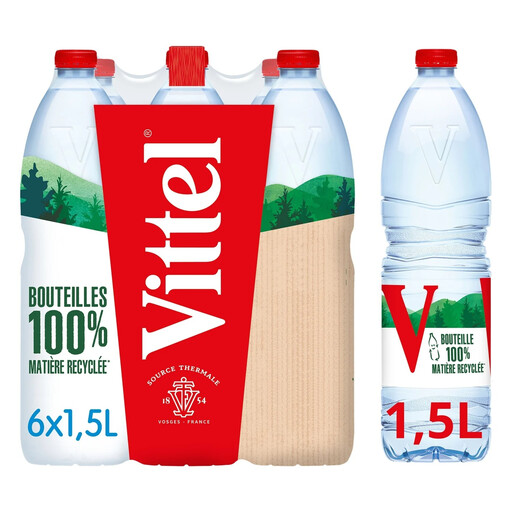
Why this choice suits this profile: The 6 x 1.5 L format is simple to understand and works well for meals, the fridge or building a small family supply.
The total volume of 9 L is clearly stated, making it easy to compare with other packs and avoiding reliance on the number of bottles alone.
A natural mineral water in 1.5 L bottles, with storage instructions to keep away from heat as stated on the product sheet.
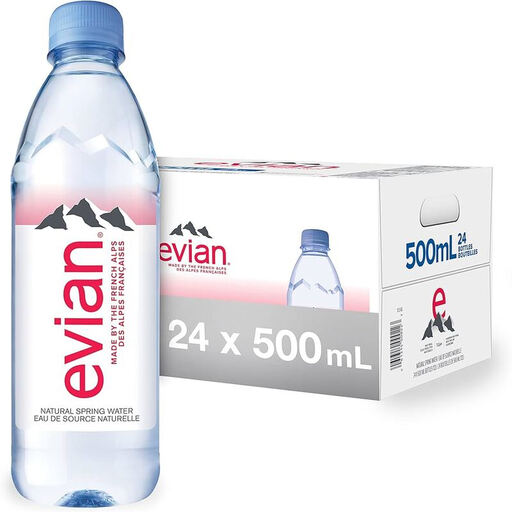
Why this choice suits this profile: The 24 x 500 ml bottles are ideal for those who want Evian water that’s easy to serve at meetings, on the go or at home.
The individual format means you don’t have to carry a large bottle that’s already been opened, and you can quickly see how many units you have left.
Sourced from the French Alps, a total volume of 12 L and a composition including 80 mg of calcium and 26 mg of magnesium, according to the product sheet provided.
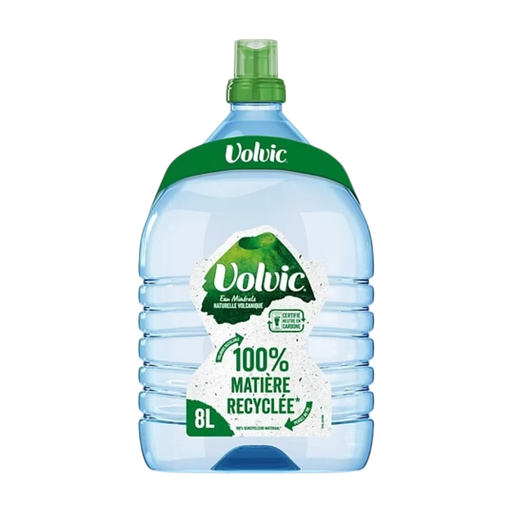
Why this choice suits this profile: The 8 L dispenser with a tap is designed for offices, families and spaces where you want to serve water without opening multiple bottles.
The tap meets a real need for easy dispensing. The instructions recommend keeping the container cool after opening and consuming it within three days.
An 8 L capacity, water sourced from Auvergne according to the product sheet, and a PET container stated as recycled and recyclable, excluding the cap and label.
For water on the go, go for 330 ml, 500 ml or 750 ml formats. The Vittel 8 x 330 ml with sports cap is designed for individual consumption and has a detailed mineral composition on its product sheet. For a family, 1.5 L or 6 L formats reduce the number of times you need to open a bottle each day and make storage simpler.
In the office or workplace, a 6 or 8 L dispenser can cut down on the number of small bottles being used, as long as you have a clean, stable and easily accessible spot for it. Large packs of 12 x 1.5 L are good for storage, but you need to think about their total weight when it comes to delivery and handling.
To compare more products, take a look at the water dispensing selection.
Natural mineral water comes from a protected underground source and has a stable mineral composition, which is declared on the label. Spring water also meets drinking water standards, but its mineral content can differ. The legal product name and the information printed on the bottle will help you tell the two categories apart.
Follow the manufacturer’s instructions. Many product sheets recommend storing an open bottle in the fridge and consuming it within two to three days. Always reseal the bottle after use and avoid leaving it in direct sunlight or in a hot car.
Divide the price of the pack by its total volume. Then compare that result with the storage space you have, the weight you need to carry and how often you drink it. A pack of 1.5 L bottles can be economical for home use, while 500 ml formats offer more flexibility when you’re on the move.