
Livraison le jour même ou le lendemain

Qualité garantie

Débloquez vos offres de bienvenue: Livraison GRATUITE | Jusqu'à -80 % | 30 jours d'essai gratuits à JoyPlus
Téléchargez l'application
A great natural duvet can literally transform your sleep. But with a maze of options and marketing promises, how do you make the right choice? Fillings that go flat in a few months, stifling heat in the summer, vague "?hypoallergenic?" labels... disappointment is common.
This guide breaks down the pitfalls to avoid and the true markers of quality for a long-lasting investment and optimal comfort.
Before you pull out your credit card, here are the 3 key points that separate a smart purchase from a costly mistake.
For an informed decision, scrutinise these three technical criteria.
The filling is the engine of your duvet. For a natural model, it's a blend of down and feathers.
A ratio of 70% down or more is generally the sign of a duvet that is light, warm, and lofty. A lower ratio is suitable if you're looking for a heavier duvet or one for the mid-season.
The weight, expressed in grams per square meter (GSM), measures the amount of filling. It's the key indicator for matching your duvet to the season and your room's temperature.
Labels provide you with guarantees about the composition and manufacturing of your duvet.
Let's get practical with a few models that exemplify these standards of quality and transparency.
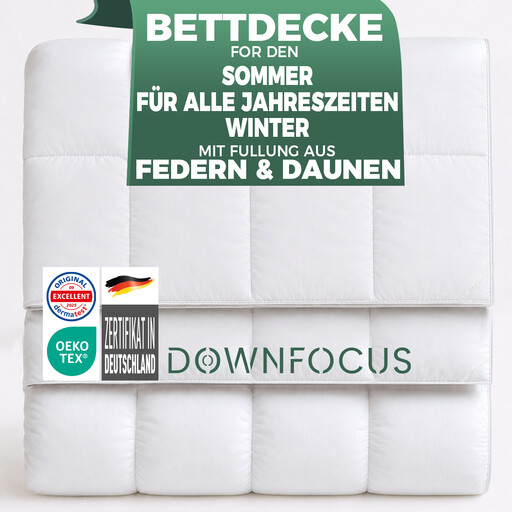
Why it stands out: Perfect for those who want a single, adaptable solution. Its 4-seasons duvet system means you don't have to juggle multiple models and it adapts perfectly to temperature changes.
It solves the problem of unsuitable warmth by combining two duvets (200 GSM and 450 GSM) that can be used alone or clipped together.
Its absolute versatility, combined with Oeko-Tex and RDS certifications that guarantee a healthy and ethical product.
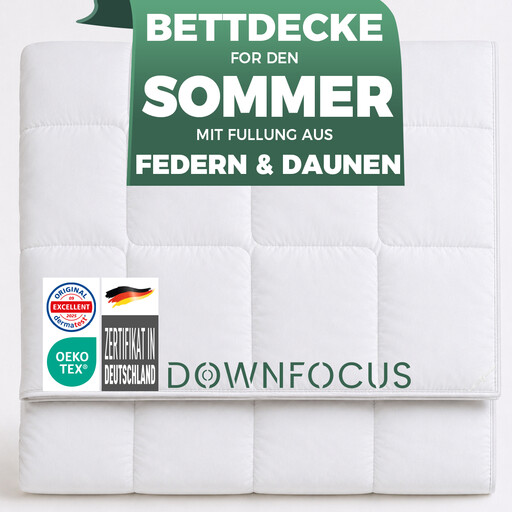
Why it stands out: The solution for those who always feel too hot at night or live in mild climates. It is specifically designed to maximise breathability and lightness.
It debunks the myth that a natural duvet is always hot. With its weight of 200 GSM, it's proof that a natural filling can make an excellent summer duvet.
Its lightness and breathability. The Oeko-Tex and RDS labels, along with its densely woven cotton cover, make it a healthy and reassuring choice.
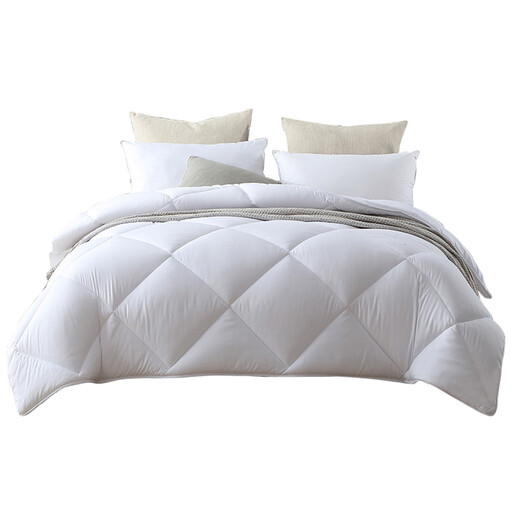
Why it stands out: A great entry point to enjoy the comfort of a natural duvet without breaking the bank. Its versatility and ease of care make it a smart, pragmatic choice.
No empty promises: it focuses on the essentials. A breathable, soft, and above all, washable "all-season" duvet that meets a real need for simplicity.
Machine washable, it radically simplifies daily maintenance. A major plus. Its standard 200x200 cm size makes it easy to find covers for.
We have compiled a complete and up-to-date list of products that meet these strict selection criteria and current regulations.
A quality natural duvet, if well-maintained, has a lifespan of 5 to 10 years. Its longevity depends on the quality of the filling and the cover. To preserve its loft, it's advisable to shake it out daily and air it regularly.
First rule: read the manufacturer's label. Most modern natural duvets can be machine washed at a low temperature (30 or 40°C) on a delicate cycle. The most important step is drying: it must be done perfectly to prevent mould and odours. The ideal method is to use a tumble dryer on low heat with dryer balls (or tennis balls) to restore the filling's full loft.
Yes, provided you choose carefully. Contrary to a persistent myth, the allergy is very rarely caused by the feathers themselves, but by the dust mites that take refuge in them. An effective anti-mite natural duvet must have a very tightly woven cotton cover (percale-type), which creates an impassable mechanical barrier. The filling's sterilisation treatments and the Oeko-Tex label are the ultimate guarantees for a reliable hypoallergenic duvet.