
Livraison le jour même ou le lendemain

Qualité garantie

Débloquez vos offres de bienvenue: Livraison GRATUITE | Jusqu'à -80 % | 30 jours d'essai gratuits à JoyPlus
Téléchargez l'application
The quest for the perfect night's sleep inevitably involves choosing the right duvet. The natural feather and down model remains a trusted choice, synonymous with comfort and longevity. The problem: faced with sometimes opaque marketing jargon, it's difficult to know where to start. To ensure you don't regret your investment, it's essential to know how to read between the lines on the labels.
As a product expert for Joybuy, I'm here to help you navigate the most common pitfalls and identify the true markers of quality. Follow this guide to make the right choice.
A wonderfully fluffy duvet is tempting. But be careful not to overlook the details that make all the difference (and can be costly).
To avoid these pitfalls, there's nothing like objective data. Here are the three key indicators to inspect on the label.
The natural filling defines the performance and feel of your duvet.
The fill weight, expressed in grams per square meter (g/m?), indicates the density of the filling and therefore its warmth level.
The casing (the outer fabric) is just as crucial as the filling.
To illustrate these criteria in practice, here are three models that each meet a specific need.
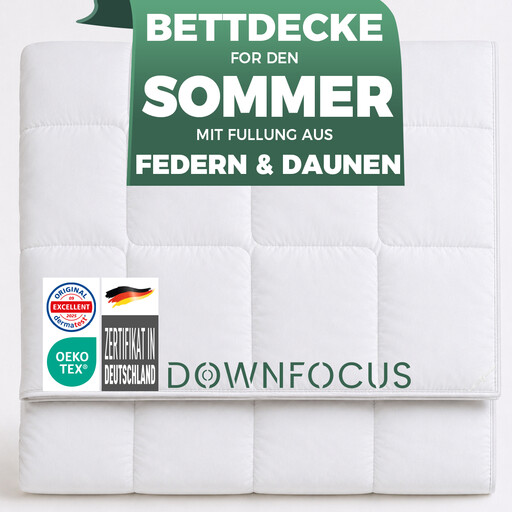
Why we love it: This duvet is designed for those who get too hot in the summer but still want the comfort of being covered. Its low fill weight makes it very breathable.
It doesn't claim to be universal. Its fill weight of 200 g/m? is clearly calibrated for summer use, thus avoiding the overheating common with imitation "all-season" duvets.
The 90% feather and 10% down filling ensures good air circulation, while the Oeko-Tex and RDS certifications confirm its quality and ethical standards.
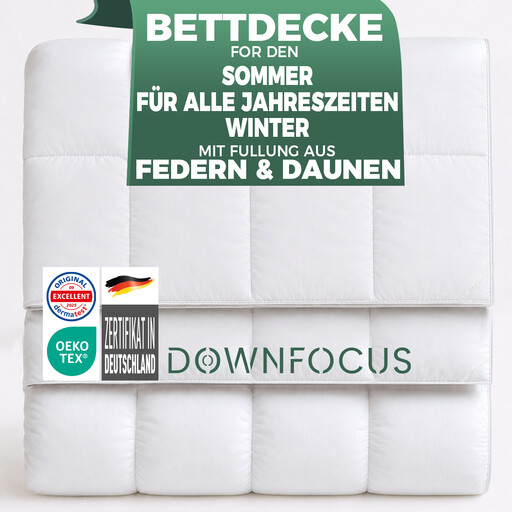
Why we love it: For those who want a complete solution and a luxury hotel experience. This high-end model offers total flexibility to adapt to every season without compromise.
This is the very definition of a true 4-season duvet. Instead of a single model, it combines a lightweight duvet (200 g/m?) and a mid-season duvet (450 g/m?) to be used separately or together.
Its versatility. You get three levels of warmth in a single purchase, ensuring optimal comfort from January to December. The Oeko-Tex and RDS certifications are also included.
Why we love it: Perfect for health-conscious individuals who want a natural product without compromising on protection against dust mites.
Here, the "hypoallergenic" claim isn't just a marketing gimmick. It's backed by a cotton casing with an extremely tight weave, which acts as a physical and natural barrier.
The double guarantee: a physical anti-dust mite barrier and the Oeko-Tex certification, which attests to the absence of harmful chemicals. The promise of a healthy and peaceful sleep.
Proper care extends the life and performance of your duvet. Remember to air it out daily along with your room, and shake it vigorously to redistribute the filling and restore its loft. For washing, professional dry cleaning is ideal. If you machine wash it, use a delicate cycle at a low temperature, very little detergent, and add tennis balls to prevent the filling from clumping. Drying is the most crucial step: it must be done completely in a tumble dryer on low heat to prevent any trace of moisture or mildew.
Yes, provided you choose the right one. Contrary to a common misconception, the allergy is rarely due to the feathers or down themselves, but rather to the dust mites that can thrive in them. A high-quality natural duvet with a very dense cotton casing prevents dust mites from penetrating. Furthermore, modern fillings are washed, sterilized, and dust-removed. Opt for models with an anti-dust mite casing and the Oeko-Tex certification.
This difference is simply explained by the rarity and properties of each material. Down, from the breast and underbelly of waterfowl, is composed of light, three-dimensional clusters that trap air, offering exceptional thermal insulation for a feather-light weight. It is rarer and therefore more expensive. Feathers, which are more abundant, are heavier and flatter. As a result, a duvet rich in down will be more expensive, but also incomparably lighter, warmer, and fluffier than a model where feathers dominate.