
Livraison le jour même ou le lendemain

Qualité garantie

Débloquez vos offres de bienvenue: Livraison GRATUITE | Jusqu'à -80 % | 30 jours d'essai gratuits à JoyPlus
Téléchargez l'application
A natural duvet promises unparalleled comfort and truly restorative nights. But in a market saturated with marketing promises, it's easy to make a misstep. Some models lose their loft after just a few months, while others turn out to be far too warm, or conversely, too light for winter. To prevent an exciting purchase from turning into a disappointment, it's best to know the most common pitfalls.
Identifying these issues is the first step toward making an informed choice. Here are the three most common mistakes?:
To avoid these pitfalls, focus on the few technical parameters that truly make a difference.
The filling is the heart of a natural duvet. Understanding the distinction between feather and down is therefore fundamental.
The ratio between these two elements is therefore a key indicator. A duvet with 90% down will be highly effective at insulation, while a model with 70% feathers will be heavier and less warm.
Fill weight, expressed in grams per square meter (g/m?), measures the density of the filling. It doesn't define quality, but rather the warmth index. The choice depends on your room temperature and your sleeping profile.
Don't underestimate the casing! Often made of cotton, it plays an important role. A tight weave (expressed in thread count) creates an effective natural barrier, making it an anti-dust mite duvet.
Certifications: a true seal of trust?:
Because every sleeper is unique, we've selected models suited to different profiles to help you find the perfect match.
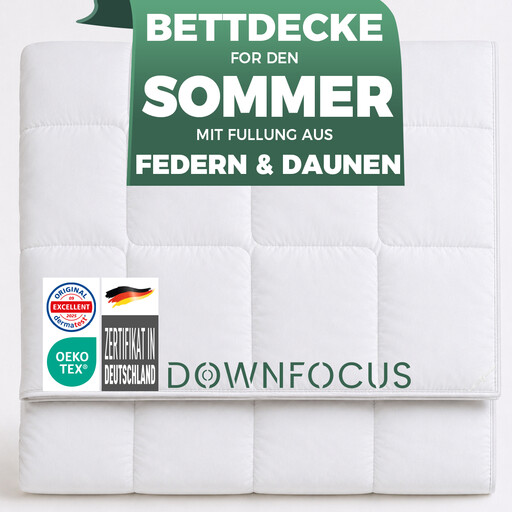
The verdict : Designed for those who seek lightness during summer nights. Its natural filling offers a breathability that synthetic materials struggle to match, thus preventing overheating.
It sidesteps the pitfall of an unsuitable fill weight. With its feather-light 200 g/m?, it's specifically calibrated for summer, offering gentle warmth with no risk of overheating.
Certified Oeko-Tex and RDS, it guarantees a healthy and ethical product. Its tightly woven cotton casing is a real bonus for those sensitive to allergens.
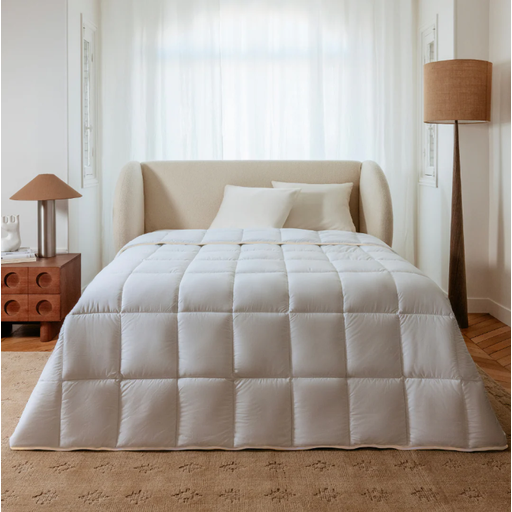
The verdict : Ideal for those sensitive to cold or for poorly heated rooms. Its dense duck feather and down filling is designed to provide enveloping and consistent warmth.
It avoids the feather/down confusion by clearly stating its composition: 90% feathers and 10% down. This ratio ensures generous warmth while maintaining a pleasant loft.
Its baffle-box stitching ensures an even distribution of the filling, preventing cold spots. The Oeko-Tex and Sanitized certifications are solid guarantees.
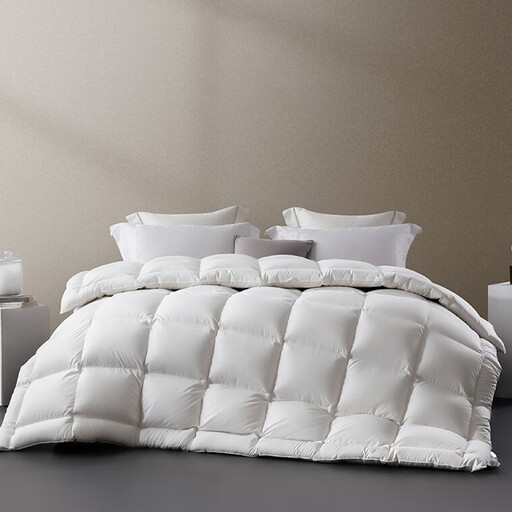
The verdict : For those who don't want to juggle multiple duvets throughout the seasons. This model offers natural thermoregulation that adapts to various conditions, from autumn to spring.
It counters the illusion of the "all-season" duvet, which is often a poor compromise. Thanks to the breathability of its natural filling, it adapts to temperature changes much better than a synthetic equivalent.
Its versatility makes it a practical and cost-effective choice in the long run. The duck feather and down filling offers an excellent balance of warmth, breathability, and comfort.
Explore our full selection of duvets that meet our quality criteria and current safety standards.
Caring for it is simpler than it seems. Most modern natural duvets can be machine washed at a low temperature (30 or 40°C), provided you use a large-capacity washing machine to avoid compressing the filling. Drying is the crucial step: it must be done thoroughly, preferably in a tumble dryer on low heat with dryer balls to help the duvet regain its full loft. A professional cleaning once a year remains a safe option to preserve its longevity.
Yes, provided you choose the right one. A natural hypoallergenic duvet is entirely possible if you focus on two key points: a cotton casing with a very tight weave that acts as a physical barrier against dust mites, and certified anti-dust mite treatments. The Oeko-Tex certification is also an excellent indicator, as it guarantees the absence of potentially irritating chemicals.
For optimal comfort, the duvet should hang generously over each side of the bed. Here are some common guidelines for bed sizes?: