
Livraison le jour même ou le lendemain

Qualité garantie

Débloquez vos offres de bienvenue: Livraison GRATUITE | Jusqu'à -80 % | 30 jours d'essai gratuits à JoyPlus
Téléchargez l'application
In a flat, every square centimetre counts. A narrow storage unit can free up space in a hallway, make use of a corner in the living room, or structure a corridor without eating into the floor area. But you need to make sure its dimensions and design genuinely meet your needs.
Some models boast generous capacity without detailing the actual usable space. Others lack stability, especially when they are tall and loaded up. Here are the criteria to consider before choosing a vertical storage unit, a bookcase or a hall stand.
A unit may be narrow but still too deep for a corridor or a small hallway. Measure the available space carefully, taking into account:
In a narrow passage, a depth of around 24 to 30 cm can work for a compact shoe cabinet or a decorative shelf. However, make sure you still have comfortable room to move around day to day.
A 6-tier bookcase multiplies your storage surfaces, but that number tells you nothing about the usable height of each compartment or the weight it can support. Shelves that are too close together can stop you from storing ring binders, baskets or certain decorative items.
Check the dimensions of each level, whether the shelves can be moved, and the maximum load stated by the manufacturer. A shelf designed for small spaces needs to be practical once installed, not just compact on paper.
A tall unit loaded at the top can topple if it is not properly secured. Choose a stable anti-tip shelf that comes with a wall-fixing system. The wall plugs must be selected according to the wall type: concrete, brick, plasterboard or hollow partition.
Wall fixing does not replace careful assembly. Follow the instructions, place heavy items on the lower shelves and never exceed the stated load.
Start by measuring the width, depth and height you have available. In a hallway, a shallow unit makes it easier to get past. In a living room, you may be able to opt for a slightly wider structure.
The actual usable volume also depends on the internal layout. Adjustable and removable shelves let you adapt the space for shoes, boxes, books or accessories. The HaluPeit unit shown below, for example, has four shelves and a drawer, with a stated capacity of up to 12 pairs of shoes depending on how you organise it.
Particle board is fine for everyday domestic use, provided it is properly assembled and protected from excessive moisture. A steel frame, on the other hand, can stiffen an industrial-style bookcase and improve its stability.
Also consider:
None of these elements alone can predict how long the unit will last. However, they do give you concrete facts to compare different models.
A unit that is simple to assemble should come with clearly labelled parts, an understandable instruction manual and all the necessary accessories. Before you start, check that its height will not interfere with a cornice, window or door.
For a tall bookcase or a unit with a drawer, check the alignment of the panels and tighten the fixings firmly, without forcing. Once the unit is installed, use the anti-tip kit provided if the product includes one.
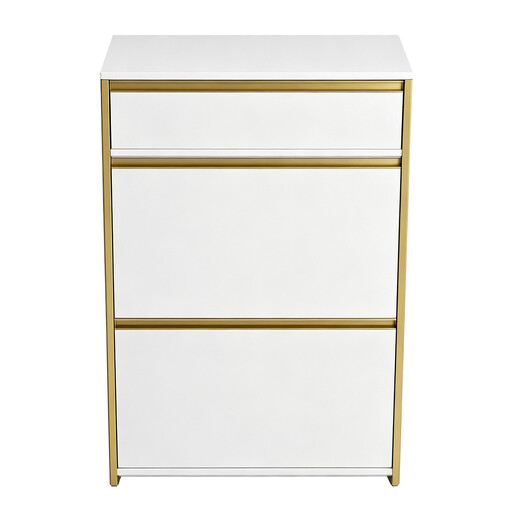
Why this choice suits this profile: With a width of around 60 cm and a stated depth of 24.5 cm, it fits easily into a hallway or corridor. The doors, drawer and top surface let you store shoes and everyday small items together.
The adjustable internal layout stops you wasting space on poorly sized compartments. The anti-tip device supplied must be fixed to the wall following the instructions.
Four adjustable and removable shelves, one drawer, two hinged doors and two anti-tip devices included.
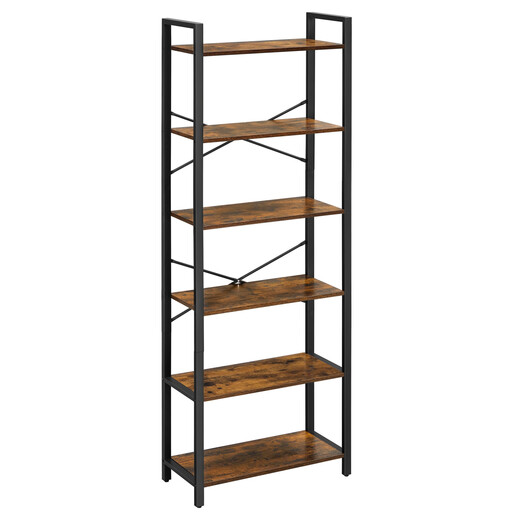
Why this choice suits this profile: At 186 cm tall, this industrial bookcase offers six levels for displaying books, plants and decorative items in a living room or office. Its greige and black finish complements contemporary décor easily.
The adjustable feet compensate for small floor irregularities, while the anti-tip kit lets you fix the bookcase to the wall. The stated maximum static load is 60 kg.
Six tiers, steel frame and particle board, X-brace, adjustable feet and a stated capacity of 60 kg.
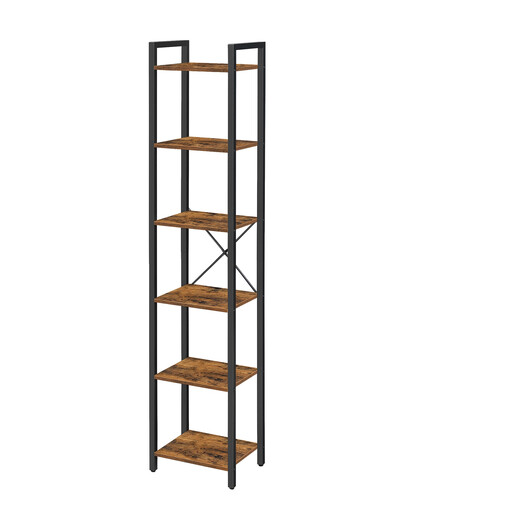
Why this choice suits this profile: With a stated width of 40 cm and a depth of 30 cm, this shelf fits into a nook, next to a desk or in a corridor. Its six levels hold books, stationery and accessories without taking up much floor space.
Its narrow format meets the constraints of small rooms. The X-braces, adjustable feet and anti-tip kit enhance its stability.
Six tiers, steel frame, particle board, stated capacity of 50 kg and stabilisation accessories included.
Place heavy items on the lower shelves and keep the upper shelves for lightweight objects. In a hallway, keep the shoes you wear regularly within easy reach and store seasonal accessories in a closed box.
In a living room, avoid overloading each shelf so you maintain a feeling of lightness. For a wall-mounted shelf, carefully mark the fixing points and check the weight the wall can support before drilling. After a few days of use, check the tightness of the screws, especially if the unit has been moved.
We have selected a complete, real-time updated list of products that meet these demanding criteria, while also taking European safety regulations into account.
Measure the available area, making sure you leave enough room to move around and open the doors. A depth of between 24 and 30 cm can work in a corridor, but always check the external dimensions, handles and skirting boards.
Choose a model that comes with an anti-tip kit, a back reinforcement or an X-brace, then fix it to the wall using wall plugs suitable for your wall type. Place heavy items on the lower shelves and respect the stated load capacity.
It depends on the number of parts and how experienced you are with assembly. A clear instruction manual, numbered parts and the tools provided make the job easier. Clear a workspace, check the contents of the parcel before you start, and only move the unit once the safety fixings are complete.