If depth is very limited
You may have enough width for a front-loader, but not enough depth in the alcove or doorway. A slim model is worth considering, as long as there’s enough room to open the door and connect the machine.


If depth is limited, consider a slim front-loader. If width or the space in front of the machine is the issue, a top-loader could work, provided you have room to open the lid. A shallower front-loader may also be an option if its full dimensions and door clearance fit; if you can’t confirm that any model will fit, compare local launderettes. In every case, check the capacity you need and the installation diagram for the specific model before ordering.
You may have enough width for a front-loader, but not enough depth in the alcove or doorway. A slim model is worth considering, as long as there’s enough room to open the door and connect the machine.
A narrow doorway or limited space in front of the appliance may make a top-loader a better option. You’ll need to check that there’s enough depth and room to open the lid.
A small room doesn’t necessarily mean you need a small drum. For one or two people, Que Choisir suggests 5 to 7 kg as a guide to compare with your usual laundry loads.
First, work out which dimension is actually preventing installation. Then check that the door or lid, capacity and connections will all suit the way you plan to use the machine.
| Criteria | What to check | Who is this for? |
|---|---|---|
| Overall dimensions | Measure the alcove and access route, then check the full dimensions and clearances shown in the manual. | If a doorway or alcove could prevent you from getting the machine into place, making sure it will fit comes before choosing a programme. Around 33% of consumers would prioritise this physical fit. |
| Capacity | Compare your usual loads with the capacity in kg; Que Choisir suggests 5 to 7 kg as a guide for one or two people. | In a small home, choosing a smaller drum could mean doing more loads than you’d like. Capacity would be the main consideration for around 27% of consumers. |
| Access to the laundry | Check how far the door or lid opens, taking furniture and access routes into account. | The machine needs to fit in the room and be easy to load day to day; around 20% of consumers would put access first. |
| Installation and use | Check the floor, connections and access for maintenance; also compare the noise levels listed for each model. | If the machine is near a living area, stability and noise are especially important. These practical considerations would be a priority for around 20% of consumers. |
A slim front-loader mainly reduces depth, while a top-loader mainly saves width. Neither format will solve an access or opening issue on its own.
Identify the dimension that’s causing the problem, then compare the installation diagram and clearance required for your chosen model with the space you actually have.
If the capacity is too small for your loads, you may need to run more cycles. ADEME recommends choosing a capacity to suit your needs; Que Choisir suggests 5 to 7 kg for one or two people.
Check the available space before choosing a capacity that suits your usual laundry loads, including bulky items.
Extra cycles also take more time and use more water and electricity.
A machine may fit in the alcove but still be difficult to connect or keep stable. For the installation described in its documentation, Electrolux recommends a flat, hard floor and a level appliance that doesn’t touch the wall or other appliances.
Check the manual, water inlet, drain and position of the socket. If changes to a rented property are needed, get your landlord’s approval before starting work.
The energy rating or spin speed won’t tell you whether the washing machine will fit through the door, open properly and work in the room.
Once you’ve confirmed the format and capacity, compare the water, energy and noise figures for the models you’re considering.
Electrolux’s French range includes slim front-loaders. The EW6S1064NA is listed as 411 mm deep, with a capacity of 6 kg.
Candy lists the TCAS284TM4-S top-loader with an 8 kg capacity and dimensions of 405 × 600 × 860 mm.
The TDLRBX65242BSFR top-loader is listed with a capacity of 6.5 kg. Whirlpool’s product information gives a noise level of 72 dB and water consumption of 44 L per Eco cycle.
Bosch’s French range includes front-loading washing machines, including integrated and under-counter models.
These two models illustrate different options for a narrow space: a top-loader to consider if width is limited, and a front-loader if you have enough room to get it in, fit it depth-wise and open the door.
 Image unavailable
Worth considering if a top-loader suits your space constraints and there’s room to open the lid fully. The product title lists a 6 kg capacity, 1,400 tr/min, a B rating, Wi-Fi and 17 programmes. Check the manual for the depth, connections and clearance needed to open the lid.
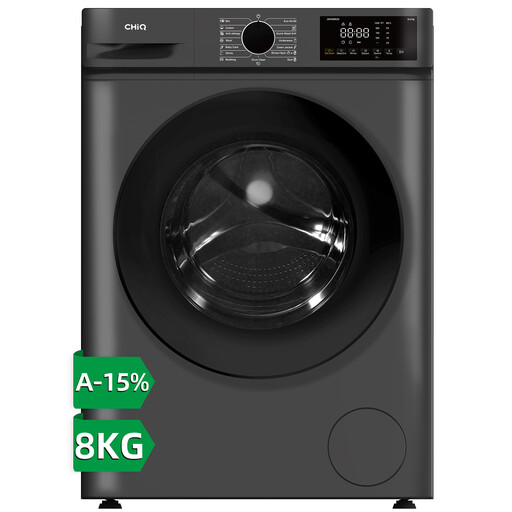 Image unavailable
Worth considering if you’d like a front-loader with an 8 kg capacity, provided you can get the appliance into place and open the door. The product title lists a 530 mm drum, 1,400 tr/min and 16 programmes. Check the full external dimensions, connections and door clearance in the installation diagram.
Measure the width, depth and height of the space, as well as the route into the room and the clearance needed to open the machine. Check for skirting boards and connections, then compare your measurements with the installation diagram for the specific model.
No. A slim front-loader mainly addresses limited depth, not necessarily a lack of width or space in front of the door. Electrolux describes its slim models as front-loaders with reduced depth. If width is the issue, look instead at the dimensions of a top-loader and the space available above it.
Que Choisir suggests 5 to 7 kg as a guide for one or two people. Compare this range with your usual loads and any bulky items you wash, rather than automatically choosing a smaller capacity to save space.
Check the floor and the model’s specific instructions for levelling. In its installation documentation, Electrolux recommends a flat, hard floor and a stable appliance that doesn’t touch the wall or other appliances. Also check the connections in the manual for the machine you choose.
It provides an additional way to compare washing machines that already suit your space and needs. France’s Ministry for Ecological Transition states that the durability index has been gradually replacing the repairability index for washing machines since 8 April 2025. It doesn’t remove the need to check dimensions, capacity and installation.