Start with the constraint that makes installation difficult: choose a top-loading model if width is limited, a slim front-loader if depth is the issue, or a built-in model if the washing machine needs to fit into a compatible unit. A standard front-loader may still work if its dimensions and door clearance are suitable. In every case, check the space, connections and access required against the instructions for the exact model before comparing capacity and everyday features.
Who are these formats suitable for?
Homes with a narrow doorway or alcove
If the width makes it difficult to get an appliance in or fit it into place, look at top-loading washing machines. Que Choisir describes their narrow width as an advantage, provided there is enough clearance above to open the lid.
Homes where depth is limited
If a front-loader would fit widthways but stick out too far into the kitchen or walkway, it’s worth comparing slim models. Also check the door clearance and whether the capacity suits your laundry needs.
Kitchens where you want to keep the cupboard front
If you want to install the machine behind a cupboard door, look for a model described as built-in and check that its niche, fixings and installation plan are compatible.
Which criteria should you check first?
For a restricted space, first rule out formats that can’t be installed. Then compare access to the laundry and the conditions of use for the remaining models.
| Constraint |
What to check |
Which consumers? |
| Width |
Measure the doorway and the space where the machine will go; for a top-loader, also check there’s room above to open the lid. |
If the doorway or alcove is narrow, I first need to be able to fit the machine in and open its lid. Around 33% of consumers would make width their priority. |
| Depth |
Compare the product’s depth with the installation plan and allow room for the door to open. |
In a kitchen where the machine could protrude into the walkway, I’m mainly looking to minimise its depth. This would be the main concern for around 27% of consumers. |
| Fitting into a kitchen unit |
Confirm that it’s designed for built-in installation, and check the niche dimensions and door fixings. |
If a kitchen door needs to conceal the washing machine, I want it to remain compatible once the appliance is installed. Around 20% of consumers would put this at the top of their list. |
| Everyday use |
Once installation is confirmed, compare capacity, loading type and any available information about spin noise. |
If several formats fit in my home, I prioritise a capacity that suits my laundry, convenient access and an acceptable noise level. For around 20% of consumers, this balance would be the main requirement. |
Mistakes to avoid before buying
-
Confusing the product dimensions with the space needed for installation
The depth listed for a washing machine isn’t enough to confirm that it will fit in an alcove: the door clearance, connections and space for the hoses matter too.
Measure the space and the delivery route, then compare them with the instructions and installation plan for the exact model.
-
Expecting a mini washing machine to do the same job as a standard model
Que Choisir describes mini models with a capacity of 2 to 3 kg, which can struggle with bulky items and often have a weak spin cycle.
If a standard washing machine can be installed, compare top-loading, slim and standard front-loading models first, based on your measurements and the laundry you need to wash.
A small capacity may mean running more cycles, while a weak spin cycle can also mean longer drying times.
-
Judging noise or washing performance by brand alone
Que Choisir tests washing, rinsing, spinning, programme duration, noise and ease of use separately. The format alone doesn’t tell you how a machine performs in these areas.
Once you’ve shortlisted models that fit the space, check their specifications and any available test results for the criteria that matter to you.
-
Making changes to a rented property’s fittings without permission
For an unfurnished rental in France, ANIL states that written permission from the landlord is required to make changes to the property or its fittings.
If installation involves adding or moving connections, discuss your plans with the landlord and get permission before any work begins.
Brands to consider by format
Electrolux
Models worth comparing across top-loading, slim front-loading and built-in formats.
- Electrolux product listings include the 400 mm-wide, 6 kg top-loader EW6T4613HA and the 8 kg built-in model EW7F1484BI.
- These specifications relate to specific models, so check the installation plan for the one you’re interested in.
Bosch
A brand to consider if your space can accommodate a freestanding front-loader or a compatible under-counter installation.
- Bosch lists a 7 kg capacity and product dimensions of 848 × 598 × 588 mm for the WGE02408FR.
- These dimensions don’t confirm the space needed for connections or whether the machine will fit a particular alcove.
AEG
A brand to look at if top loading suits your width restriction.
- Que Choisir lists the AEG LTR8C7331A among its representative top-loading washing machines.
- This listing doesn’t confirm that its dimensions or lid clearance will suit your space.
Miele
Front-loaders to compare once you’ve checked that this format will fit your available space.
- Que Choisir included the front-loading WCA132WCS and WED385 WCS in its tests.
- The fact that these models have been tested doesn’t mean they’ll fit a small alcove: measure each model separately.
A freestanding front-loader to consider on Joybuy
This front-loading washing machine is worth considering if your space can accommodate a freestanding installation, the required connections and enough room to open the door.
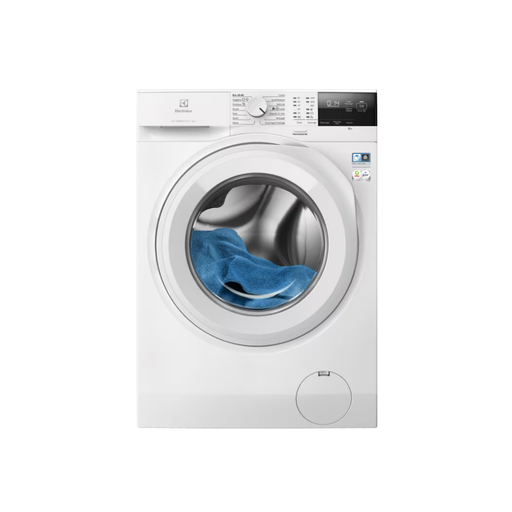 Image unavailable
Electrolux EW6FI4805AW, 8 kg, 1 400 rpm
Worth considering for washing at home if you have a suitable space for a freestanding front-loader. It has a stated capacity of 8 kg and a listed spin speed of 1 400 rpm. Before buying, check the instructions for the installation dimensions, connections and clearance needed in front of the door. Don’t choose it as a built-in appliance to go behind a cupboard door.
View on Joybuy
Frequently asked questions
Are the listed width and depth enough to choose a washing machine?
No. They help you rule out appliances that are too large, but they don’t confirm that installation is possible. Check the instructions for the exact model to confirm the connections, hose routing, door or lid clearance and access needed for maintenance.
Do you need the landlord’s permission to install a washing machine in an unfurnished rental?
In France, ANIL states that written permission is needed if installation involves changing the property or its fittings, for example by adding connections. This doesn’t mean that simply connecting a machine to existing fittings always requires the same permission; check your circumstances before carrying out any work.
Can a mini washing machine be the main appliance in a studio flat?
Think of it more as a back-up option if a standard washing machine can’t be installed. Que Choisir describes mini models with a capacity of 2 to 3 kg, often with a weak spin cycle and limited capacity for bulky laundry. Consider how these limitations compare with your usual washing needs before choosing one.


