
Livraison le jour même ou le lendemain

Qualité garantie

Débloquez vos offres de bienvenue: Livraison GRATUITE | Jusqu'à -80 % | 30 jours d'essai gratuits à JoyPlus
Téléchargez l'application
Putting up a shelf, decorative panel or skirting board without getting out the drill can make a job much easier, especially in a rented home. The key is choosing an adhesive that suits the material and the conditions it will face. An extra-strong formula designed for indoor walls won’t perform in the same way as a water-resistant adhesive made for outdoor use.
So before you place an order, look beyond claims such as ‘instant grab’ or ‘suitable for multiple surfaces’. Here are the factors to consider to avoid any nasty surprises.
An adhesive may hold an item in place after a few seconds without having reached its maximum strength. Depending on the formula, it can take up to 24 hours to cure fully. During this time, you may need to support a shelf, panel or heavy object with a temporary prop.
‘Instant grab’ refers to the initial hold, not necessarily the final load-bearing strength. Always check the drying and curing time stated on the product page.
Wood, concrete, plaster, glass and metal all have different levels of porosity and different textures. Some adhesives specifically exclude PE, PP, PTFE, copper, brass, silicone or flexible PVC.
It’s best to test the adhesive on a small, inconspicuous area first, especially when working with plastics. Preparing the surface is just as important: dust, grease, flaking paint or excessive moisture can all reduce adhesion.
An adhesive for walls and ceilings in a dry room may not be suitable for a bathroom, façade or area exposed to the elements. For outdoor use, look for a formula described as resistant to water, UV rays and temperature changes.
However, resistance to moisture doesn’t necessarily mean the adhesive can withstand continuous immersion. This distinction matters around a sink, on a patio or near a window.
For indoor fixing on brick, plaster, stone or wood, a mounting adhesive designed for porous materials may be enough. Some products specify that at least one of the two surfaces must be porous. This is worth bearing in mind when joining two smooth surfaces, such as glass and metal.
For glass, a mirror or certain transparent panels, a clear adhesive makes the joint much less noticeable. However, don’t assume that a transparent surface is acrylic or any other type of plastic: always follow the manufacturer’s guidance on excluded materials.
For a project that will be used indoors and outdoors, rely on detailed specifications rather than a simple ‘resistant’ claim. Some mounting adhesives state an operating range of -30 °C to +80 °C, while other multi-surface adhesives can withstand temperatures between -40 °C and +100 °C.
These figures reflect the conditions specified by the manufacturer. Surface preparation, bead thickness and the weight being supported are just as important. A fixing that is subject to repeated movement may need a flexible formula rather than a rigid adhesive.
A small tube is enough for a quick repair. For fitting skirting boards, decorative panels or several shelves, cartridge adhesive, applied with a sealant gun, lets you apply the product evenly in dots or beads.
Also consider the repositioning time. Some products let you adjust the item for 10 to 15 minutes, while others need to be held firmly in place as soon as they are applied. In every case, the surface should be clean, dry and free from grease.
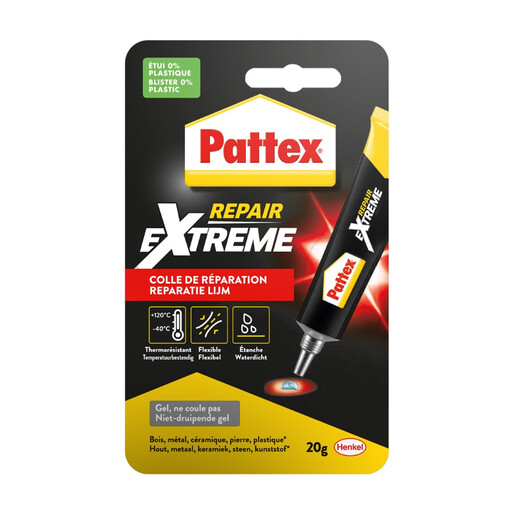
Why this product suits this user: Its compact size is ideal for everyday repairs and small-scale assembly jobs, both indoors and outdoors.
Its gel formula helps prevent drips on vertical surfaces. Compatible surfaces and excluded materials are clearly listed.
20 g tube, solvent-free gel, claimed instant grab and compatibility with several porous and non-porous surfaces.
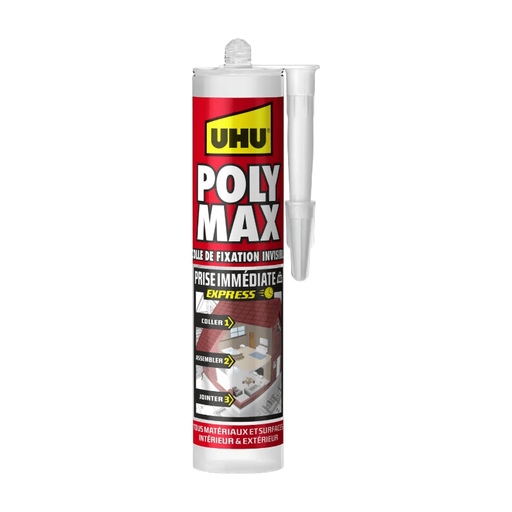
Why this product suits this user: Its format and formula are well suited to mounting, assembly and sealing jobs where a discreet finish is important.
The product page specifies resistance to water and UV, and a temperature range of -40 °C to +100 °C, rather than making a vague claim.
300 g cartridge, clear finish, solvent-free formula and claimed permanent flexibility.
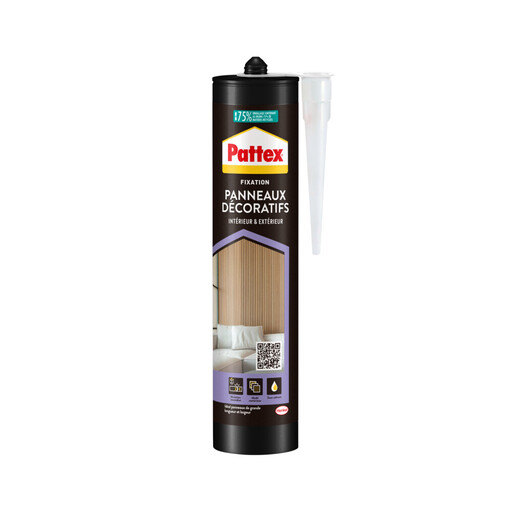
Why this product suits this user: This adhesive is designed for decorative panels, including felt-backed acoustic panels, wooden slat panels and wall coverings.
The product page details the intended applications and allows use on a slightly damp surface, without presenting the adhesive as a universal solution.
470 g format, gun application, solvent-free formula and the option to paint over the joint once dry.
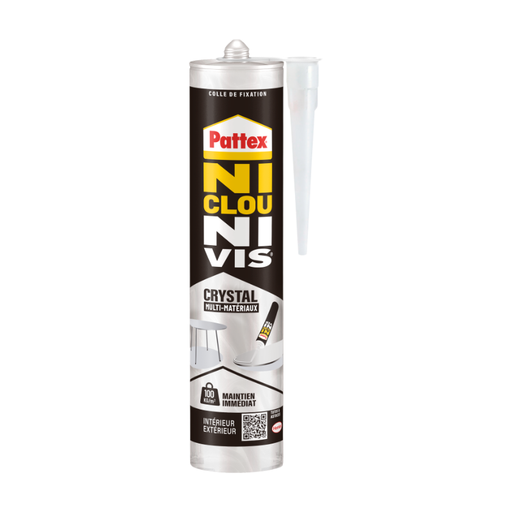
Why this product suits this user: Its clear finish is ideal for projects where the appearance of the joint matters, particularly with glass, mirrors or certain decorative features.
Resistance to moisture doesn’t mean the adhesive can withstand continuous immersion. Check the excluded materials, especially PE, PP and PTFE.
Clear finish, stated suitability for indoor and outdoor use, repositionable for 15 minutes and reaches full strength after 24 hours.
We’ve put together a comprehensive selection, updated in real time, of products that meet these demanding selection criteria and comply with European safety regulations.
A nail-free, screw-free mounting adhesive isn’t suitable for a threaded assembly exposed to vibration. Loctite threadlocker is specially designed for metal nuts, bolts and screws to help prevent them from coming loose. Always choose an adhesive for the job you actually need it to do.
Choose a mounting adhesive whose product page specifies compatible surfaces, the supported load and whether it can be used on a wall or ceiling. For plaster, brick, stone or wood, a formula designed for porous surfaces may be suitable. However, the object’s weight must be compatible with the curing time and the actual bonded surface area.
Not necessarily. ‘Clear’ describes how the joint looks, while water resistance depends on the formula. Look for explicit information about moisture, water, UV and outdoor use. Resistance to moisture doesn’t guarantee that the adhesive can withstand immersion.
The initial grab may be quick, but full strength often takes up to 24 hours. Follow the manufacturer’s recommended curing time and avoid hanging a load from the fixing during this period.