What should you look for?
Start with the drink you make most often, then compare machines based on everyday effort, consumables and the space you have available. UFC-Que Choisir identifies four types of espresso machine; a filter coffee maker is also included here to help households that mainly drink long coffee choose the right option.
Capsules
Worth considering: if you want to make a portioned espresso with minimal effort.
Bear in mind: you’ll need to keep your chosen system stocked with capsules and sort the packaging for recycling.
Soft pods
Worth considering: if you want a portioned drink without measuring out coffee by hand.
Bear in mind: your choice of drinks will depend on which pods are compatible with the machine.
Portafilter
Worth considering: if you want to choose your ground coffee and be involved in making your drink.
Bear in mind: you’ll need to fill, tamp and clean the portafilter. De'Longhi describes these steps for its manual machines.
Bean-to-cup
Worth considering: if you regularly make espressos from beans without measuring out each cup by hand.
Bear in mind: the noise from grinding and the need to clean the containers and, depending on the model, the brew unit.
Filter coffee maker
Worth considering: if several people mainly want to share long coffee made in one go.
Bear in mind: it won’t replace an espresso machine if espresso is what you’re after.
| What matters to you |
What to check |
Who is it for? |
| Making cup after cup |
Water tank capacity and the steps needed between drinks; a two-cup function if that would be useful. |
If several espressos need to be served one after another, I want to minimise refilling and handling. Around 27% of consumers prioritise this ease of serving. |
| Choosing your coffee |
The formats the machine accepts and the availability of beans, ground coffee or compatible portions. |
If I make coffee often, I want to be able to find my chosen format easily, without discovering after purchase that another type of portion won’t work. This freedom to choose what you buy comes first for around 33% of consumers. |
| Enjoying a variety of drinks |
Available recipes and whether there’s a milk system, plus how it needs to be cleaned. |
Whether it’s espressos, long coffees or milk-based drinks, I need the features my household will actually use. Around 20% of consumers say variety is their top priority. |
| Living with your machine |
Dimensions and access to containers; maintenance, noise during preparation and sorting used portions for recycling. |
If space or peace and quiet matters in my kitchen, I’d rather know about the everyday considerations before choosing. Maintenance, space, noise or waste is the priority for around 20% of consumers. |
Machines available on Joybuy
These models let you compare three ways to make espresso at home: bean-to-cup, portafilter and capsules. Compare their controls and everyday considerations with the way your household makes coffee.
 Image unavailable
Philips Series 2200 EP2230/10 LatteGo, glossy black
Worth considering if you’re looking for an espresso machine with a grinder and would also like to make milk-based drinks. Check how to clean the LatteGo system and how much space you’ll need to access the parts that require maintenance.
View on Joybuy
 Image unavailable
De'Longhi Magnifica S ECAM22.140.B, black
An automatic bean-to-cup espresso machine to consider if you make coffee regularly. Before choosing a spot for it, check its dimensions, access to the containers and the maintenance required for this model.
View on Joybuy
 Image unavailable
De'Longhi Magnifica Start ECAM220.21.WW, white
This bean-to-cup model is suited to households that prefer automated espresso preparation to using a manual portafilter. If you also plan to use ground coffee, check that this is possible with the ECAM220.21.WW model before choosing.
View on Joybuy
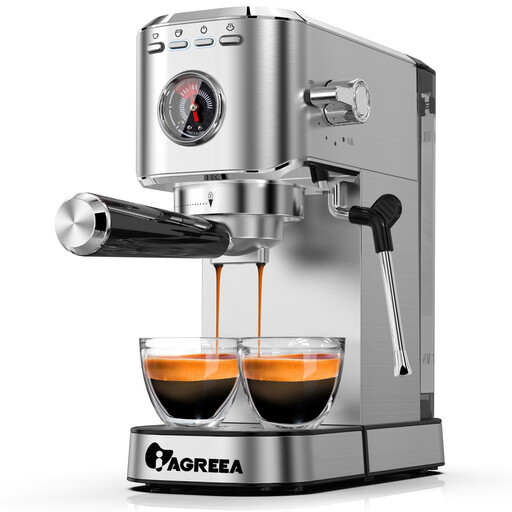 Image unavailable
IAGREEA 20Bar with steam wand, 1.1 L water tank
Worth considering if you prefer a portafilter espresso machine and would like a steam wand. The product name mentions a pressure gauge and cup-warming tray; check the manual to confirm which coffee to use and how to prepare it with this model.
View on Joybuy
 Image unavailable
KRUPS Nespresso Essenza Mini 0.6 L, pure white
A capsule option for households that prefer making espresso with pre-measured portions rather than handling ground coffee or beans. Its name specifies a 0.6 L water tank and 1200 W power; check which capsule format it accepts and how often you’re happy to refill the tank.
View on Joybuy
Frequently asked questions
Where should you dispose of aluminium or plastic coffee capsules in France?
ADEME advises putting them in the recycling bin, bag or container for packaging. If you’re unsure what your capsule is made of, check its composition and the recycling instructions for your area.
How often should you descale an espresso machine?
Follow the manual and alerts for your model. How often you need to descale depends in part on the water hardness and how much you use the machine. As a general guide, UFC-Que Choisir suggests descaling every two to three months, depending on water hardness.
Does the absence of a repairability index tell you anything about a coffee machine?
No. On its own, it doesn’t tell you whether a model can be repaired. Coffee machines aren’t included in the list of products covered, published by the ministry responsible for the ecological transition. Instead, check the documentation, parts available for the specific model and support options.
What statutory guarantee applies to a machine bought from a business in France?
The statutory guarantee of conformity applies when a business sells a machine to a consumer. The French Ministry of the Economy states that you have two years to claim under it; any commercial warranty is in addition to, and does not replace, this guarantee. It covers faults with the product’s conformity, not simply a change of mind.


